
Is Godrej Varanya Kharghar a Good Investment in 2026?
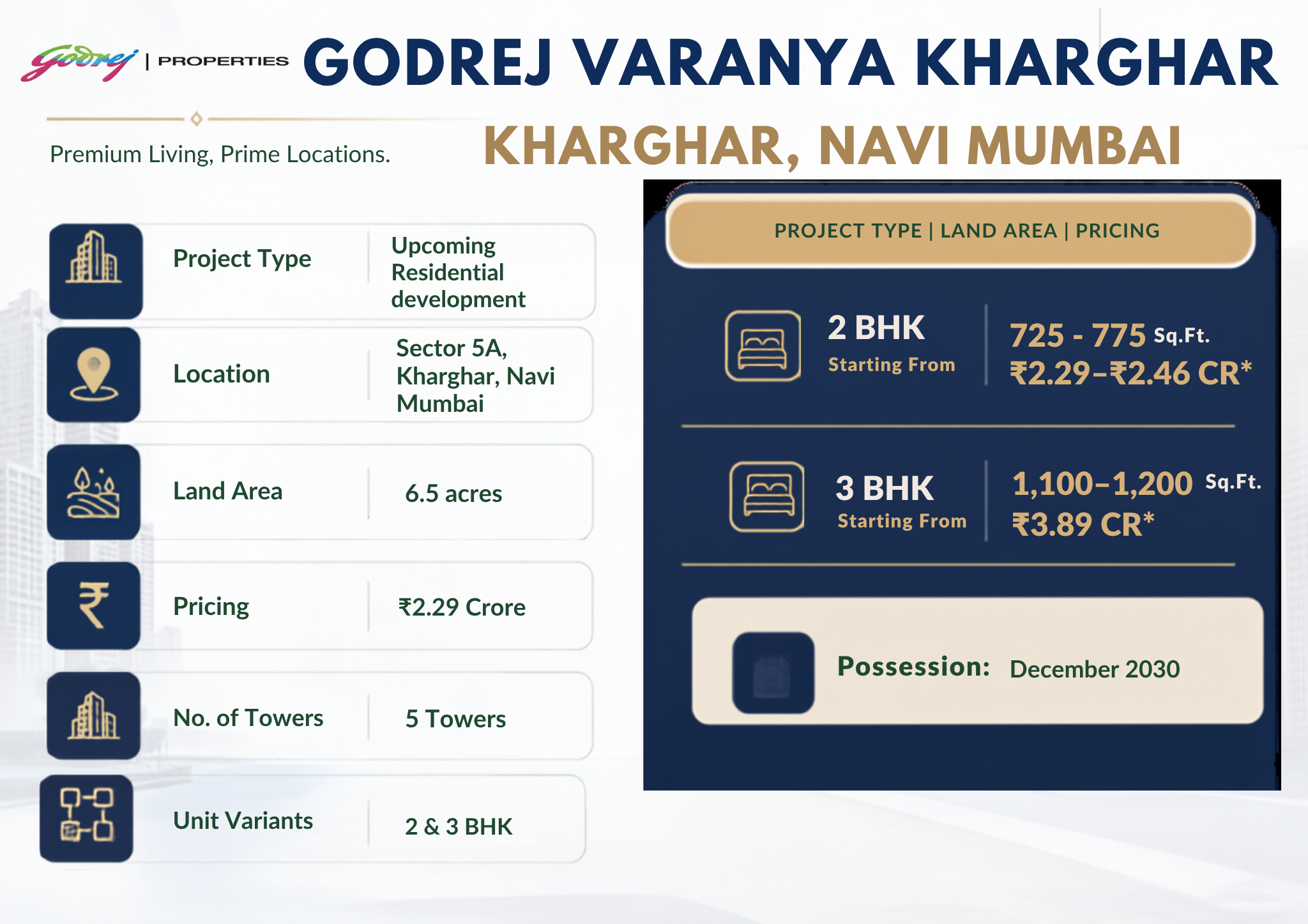
Project: Godrej Varanya, Sector 5A, Kharghar | 2 & 3 BHK | ₹2.29 Cr onwards | RERA: P51271012502176 / P51271012502343
Bottom line: A low-density Godrej-branded address with dual rail connectivity in an established Navi Mumbai node — the investment case rests on Kharghar’s premium positioning, the airport catalyst and the developer’s resale liquidity advantage over unbranded alternatives.
1. Introduction — Why Investors Are Watching Godrej Varanya
Godrej Varanya at Sector 5A, Kharghar, Navi Mumbai is a 6.5-acre premium residential development by Godrej Properties Limited (NSE: GODREJPROP) offering 2 and 3 BHK apartments from ₹2.29 Crore. With only 305 units across 5 towers rising G+37 floors, the project delivers a density profile that is significantly lower than most Kharghar launches — roughly 47 units per acre versus the 80–120 that is common in the belt. For an investor, the first question is whether that low-density premium translates into stronger capital appreciation and rental demand over a 5-to-7-year horizon.
The project’s RERA registrations — P51271012502176 and P51271012502343 — lock in carpet areas of 725–1,200 sqft and a December 2030 possession timeline. That 4-year construction window means the investment is a medium-term hold by default, and the return equation hinges on three factors: Kharghar’s micro-market trajectory, the Navi Mumbai airport catalyst and Godrej’s brand premium at resale. This analysis breaks down each factor with verified numbers so you can evaluate the opportunity on data rather than sentiment.
Kharghar is not a speculative greenfield location — it is an established CIDCO-planned node with operational schools, hospitals, malls and dual rail connectivity. That maturity reduces the infrastructure-delivery risk that undermines returns in newer corridors like Ulwe or Dronagiri. The question for investors is whether the ₹30,500–33,000 per-sqft entry at Varanya leaves enough room for appreciation, or whether the premium has already been priced in. Our detailed Godrej Varanya listing page covers the full project specifications for reference.
2. Developer Background — Godrej Properties Limited
Godrej Properties Limited, founded in 1990 and listed on the NSE and BSE in 2010, is the real-estate arm of the 128-year-old Godrej group. The company has delivered more than 250 million sq ft across 300-plus projects in 12-plus cities, with a market capitalisation that positions it among India’s top-three listed developers. For an investor, the developer’s balance-sheet depth matters because it directly affects construction-timeline reliability — a delayed possession erodes IRR on any under-construction investment, and Godrej’s institutional capacity to fund and deliver on schedule is a core risk mitigant. Review the developer’s full portfolio at Godrej Properties.
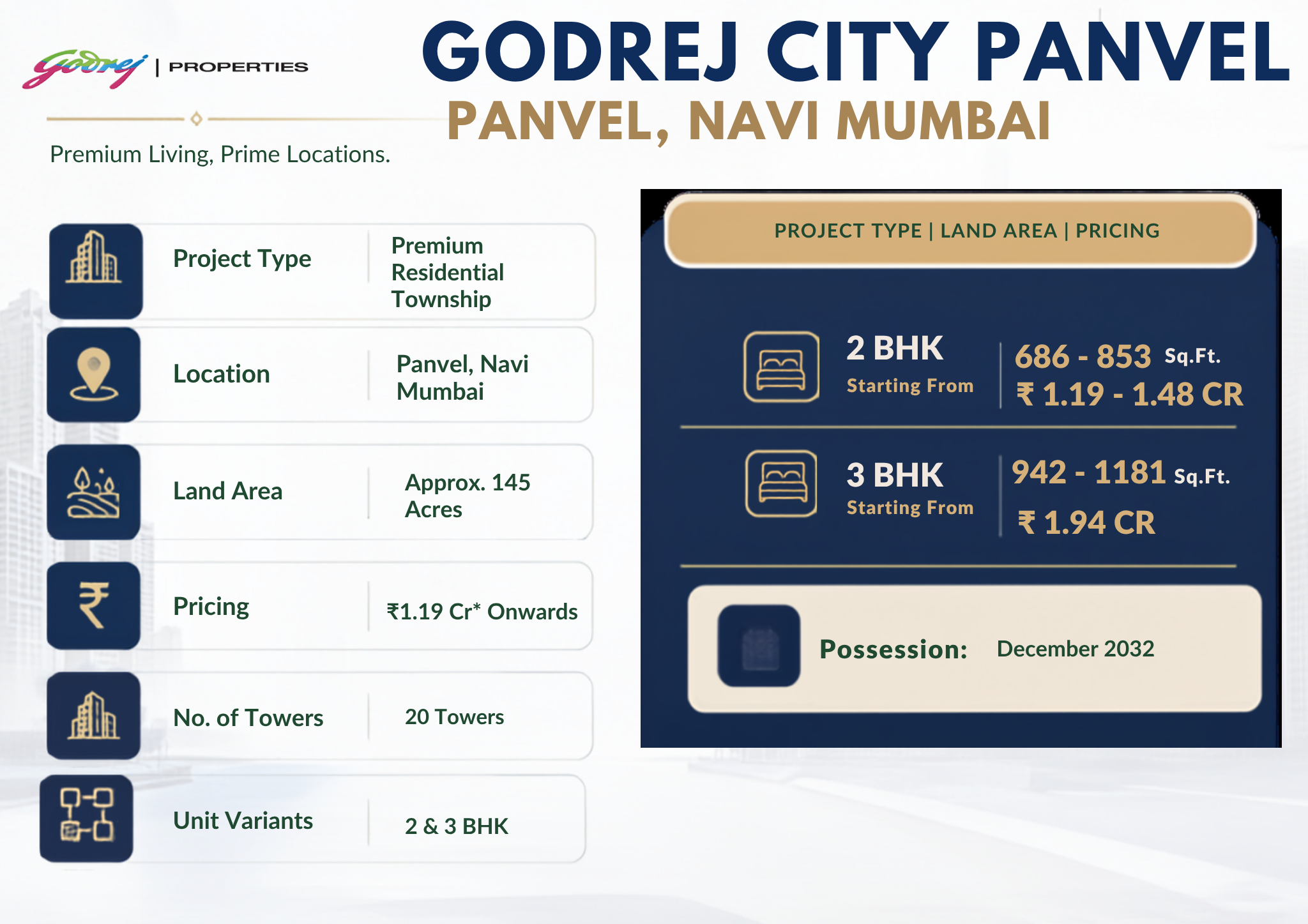
In the Navi Mumbai context, Godrej’s most relevant proof of execution is the fully delivered Godrej City township at Panvel, where over 3,000 families are already in residence. That operating track record in the same region demonstrates that the developer can deliver multi-tower, multi-year projects in the Navi Mumbai belt without the delays that have plagued smaller developers in the Panvel–Kharghar corridor. For Varanya’s investors, this precedent reduces the single biggest risk in under-construction property investment: the developer failing to deliver on time.
The Godrej brand also commands a measurable resale premium. In micro-markets where Godrej competes with regional developers, the branded inventory typically trades at a 10–20% per-sqft premium at resale, reflecting stronger buyer confidence and wider lender acceptance. That brand liquidity is particularly relevant for Varanya, where the 4-year hold means the exit strategy must account for market conditions in 2030 and beyond. A Godrej-branded asset finds buyers faster and finances more easily than an equivalent unbranded flat — an advantage that compounds as ticket sizes rise above ₹2 Crore.
3. Investment Snapshot — Key Numbers
Before diving into the analysis, the table below captures the core investment parameters that drive the return calculation for Godrej Varanya. Every number here is sourced from the RERA registration, current market pricing and published infrastructure timelines — not brochure projections.
| Parameter | Detail |
|---|---|
| Entry Price (2 BHK) | ₹2.29 Crore (725 sqft carpet) |
| Entry Price (3 BHK) | ₹3.89 Crore (1,100–1,200 sqft carpet) |
| Rate per sqft | ₹30,500 – ₹33,000 |
| Possession | December 2030 (RERA timeline) |
| Total Units | 305 (across 5 towers, G+37) |
| Kharghar 5-Year Appreciation | ~25–35% (premium segment) |
| Estimated Rental Yield (post-possession) | 2.5–3% gross for premium 2/3 BHK |
| Key Catalyst | Navi Mumbai International Airport (~20 min away) |
| Payment Plan | Construction-linked (slab-by-slab) |
| RERA Registrations | P51271012502176 / P51271012502343 |
The ₹30,500–33,000 per-sqft entry positions Varanya at the upper end of Kharghar’s pricing spectrum. For context, Panvel’s branded stock trades at ₹14,000–18,000, while Vashi commands ₹30,000–40,000 — placing Kharghar at the premium-but-not-ceiling level of the Navi Mumbai market. The construction-linked payment plan means capital is deployed incrementally across the build period, which improves effective IRR compared to a lump-sum drawdown at booking — an advantage that is often overlooked in headline return calculations.
The 305-unit cap is a structural advantage for post-possession rental and resale. With only 60 apartments per tower, the supply of competing units entering the resale or rental market simultaneously is naturally limited — unlike a 1,000-unit project where 50-plus units may be listed for rent at the same time, depressing yields and extending vacancy periods. Lower supply within the development itself supports both rental rate stability and resale pricing power, a dynamic that investors in large-format projects frequently underestimate.
4. Market Analysis — Kharghar’s Appreciation Trajectory
Kharghar’s premium residential segment has appreciated in the range of 25–35% over the past five years, driven by three infrastructure catalysts: the Navi Mumbai metro rollout, the Atal Setu (Mumbai Trans Harbour Link) improving South Mumbai access, and the anticipation around the Navi Mumbai International Airport. That appreciation has outpaced most Navi Mumbai micro-markets outside the direct airport catchment, reflecting Kharghar’s specific advantage of being both well-connected and already liveable — investors are not betting on infrastructure arriving, they are betting on established infrastructure improving further.
| Navi Mumbai Node | Current Rs/sqft (Premium) | 5-Year Appreciation | Maturity Level |
|---|---|---|---|
| Kharghar | ₹28,000–35,000 | 25–35% | Established premium node |
| Vashi | ₹30,000–40,000 | 15–22% | Fully mature (limited upside) |
| Panvel | ₹14,000–18,000 | 30–40% | Growth corridor (higher risk) |
| Belapur | ₹25,000–32,000 | 18–25% | Mature commercial hub |
| Ulwe | ₹12,000–16,000 | 35–50% | Airport-adjacent (high risk/reward) |
The comparison table reveals Kharghar’s positioning clearly. It has appreciated more than Vashi and Belapur (which are closer to their pricing ceilings) but less than Panvel and Ulwe (which started from a lower base and carry higher infrastructure-delivery risk). For an investor, Kharghar offers a balanced risk-return profile — meaningful upside tied to the airport catalyst and metro expansion, but without the infrastructure-speculation risk that makes Ulwe or Dronagiri volatile. The question is whether the ₹30,500 entry at Varanya specifically leaves enough margin for the 15–25% appreciation that would deliver an acceptable IRR over the 4-year construction hold.
Our analysis suggests it does, for two reasons. First, the airport timeline creates a step-change in value rather than a gradual drift — airport-corridor properties in Indian metros (Bangalore’s Devanahalli, Hyderabad’s Shamshabad) have shown 40–60% appreciation in the 5 years surrounding airport commissioning. Second, Varanya’s low-density positioning insulates it from the supply-glut risk that has dampened returns in high-density Kharghar projects where 500-plus units flood the resale market simultaneously. The combination of a macro catalyst and a micro supply constraint is the investment thesis in a single sentence.
5. Deep Dive — What Drives Returns at Godrej Varanya
The primary return driver is the Navi Mumbai International Airport, approximately 20 minutes from Godrej Varanya by road. The airport is the single largest infrastructure investment in the MMR’s recent history, and its impact on surrounding property values will be structural rather than cyclical. Historical precedents from Hyderabad’s Rajiv Gandhi International Airport and Bangalore’s Kempegowda International Airport show that residential catchments within a 30-minute driving radius of a new airport appreciate 40–60% in the 5-year window surrounding the airport’s commissioning. Kharghar sits squarely within that radius, and Varanya’s premium positioning means it captures the upper-end of that appreciation band.
The second driver is Godrej’s brand premium at resale. When Godrej City Panvel’s early phases were delivered and the secondary market activated, Godrej-branded units traded at a 10–15% premium over comparable unbranded stock in the same Panvel belt. That premium reflects faster transaction velocity, wider lender acceptance for buyer financing and the maintenance and community-management standards that a Godrej-managed property delivers. For a Varanya investor, this brand premium is effectively a built-in exit advantage — when you sell in 2031–2033, the Godrej name on the society gate accelerates the sale and supports the asking price.
The third driver is rental demand from the Belapur–Airoli–Taloja employment corridor. Premium 2 BHK apartments in well-connected Kharghar locations currently command monthly rents of ₹30,000–40,000, while 3 BHKs fetch ₹50,000–65,000. Post-possession in 2030, Varanya’s walk-to-station advantage will position it at the upper end of these rental bands. With only 305 units, the rental supply within the development itself will be naturally limited, supporting rate stability. A 2 BHK at ₹2.29 Crore generating ₹35,000–40,000 per month post-possession translates to a gross yield of approximately 2–2.1%, which is in line with premium Navi Mumbai averages — not exceptional, but supplemented by the capital appreciation that is the primary return component.
The risk factor to weigh is the 4-year construction timeline. Capital locked into an under-construction asset cannot be redeployed, and the opportunity cost depends on what alternative investments the same capital could earn. At an 8.5% home-loan rate, the financing cost of holding the asset during construction is a real drag on net returns unless the appreciation over that period exceeds the cumulative interest paid. The construction-linked payment plan mitigates this partially by phasing the loan drawdown, but investors should model the actual interest outflow against their projected appreciation to arrive at a realistic net IRR rather than relying on headline price-appreciation percentages.
6. Return Scenarios & Comparative Analysis
The table below models three return scenarios for a ₹2.29 Crore 2 BHK investment at Godrej Varanya, based on different appreciation assumptions over a 7-year total holding period (4 years construction + 3 years post-possession). The scenarios use Kharghar’s historical appreciation data and the airport-catalyst precedent as anchors.
| Scenario | 7-Year Appreciation | Exit Value (2 BHK) | Gross Gain | Notes |
|---|---|---|---|---|
| Conservative | 20–25% | ₹2.75–2.86 Cr | ₹46–57 Lakh | No airport catalyst, steady organic growth |
| Base Case | 35–45% | ₹3.09–3.32 Cr | ₹80 Lakh–1.03 Cr | Airport operational, metro expansion complete |
| Bullish | 50–60% | ₹3.44–3.66 Cr | ₹1.15–1.37 Cr | Full airport impact + commercial development wave |
The base-case scenario of 35–45% appreciation over 7 years is anchored in the Hyderabad/Bangalore airport precedent, adjusted downward for the fact that Kharghar’s starting base is higher than what those airport catchments priced at when their respective airports launched. Even in the conservative scenario, the gross gain of ₹46–57 Lakh on a ₹2.29 Crore investment represents a meaningful return, although net of interest costs (assuming a 80% LTV home loan at 8.5%), the effective return drops to the 8–12% CAGR range — competitive with but not dramatically superior to alternative asset classes.
Where Godrej Varanya’s investment case strengthens is in the comparison with competing Kharghar projects at similar price points. Higher-density alternatives may offer lower per-sqft rates, but the resale market dynamics of a 1,000-unit project are fundamentally different from a 305-unit one. When 50 units in a large project list simultaneously on resale portals, they compete against each other and drive prices down. Varanya’s limited supply means fewer competing listings at any given time, which supports both the asking price and the time-to-transaction — two variables that directly affect investor returns. For a comparative view of the Navi Mumbai opportunity at a different price point, see our Godrej City Panvel listing.
7. Buyer Guidance — Making the Investment Decision
If you are evaluating Godrej Varanya as an investment, the first step is to model your actual cash outflow under the construction-linked payment plan. The slab-by-slab disbursement means you do not draw the full home loan at booking — you pay in tranches as construction milestones are met, which reduces the cumulative interest cost during the build period. Ask your lender for a tranche-wise disbursement schedule mapped to the developer’s construction timeline, and calculate the total interest outflow during the 2026–2030 build period separately from the post-possession EMI. This gives you a realistic cost basis that headline price comparisons miss.
The second step is to visit the site and evaluate specific floor options. In a G+37 tower, the view premium between lower floors (1–10), mid floors (11–25) and upper floors (26–37) is significant — and upper-floor units with hill views or unobstructed panoramas command the strongest resale premiums. If your budget allows, prioritising an upper-floor unit improves both the rental potential and the exit value, because view-premium apartments attract the highest-paying tenants and the most motivated buyers. The floor-rise premium at booking is typically 2–4% of the unit cost, but the resale premium on a view apartment can exceed 8–10%.
The third consideration is timing. Launch-period benefits of up to ₹20 Lakh on select units are currently available, but these are limited to specific inventory parcels and will not last through the entire sales cycle. If your research confirms the investment thesis, booking during the launch window captures the lowest possible entry price — and in under-construction property, entry price is the single most important determinant of eventual returns. Every rupee saved at entry compounds across the holding period. For a broader view of the Godrej portfolio across the MMR, compare our Godrej Golf Side Estate (villa plots from ₹59.90 Lakh) listing.
8. Conclusion & FAQs
Godrej Varanya Kharghar presents a premium-segment investment opportunity that combines Godrej’s brand premium, Kharghar’s established infrastructure and the Navi Mumbai airport catalyst into a coherent return thesis. The ₹2.29 Crore entry and December 2030 possession demand a medium-term holding view, and the 305-unit supply cap provides a structural advantage at resale that higher-density alternatives cannot match. The investment is not a speculative bet on a greenfield corridor — it is a premium play in an established node with a specific infrastructure catalyst that has historical precedent for driving step-change appreciation.
The risk is concentration: a single asset at ₹2.29 Crore and above represents a significant capital commitment, and the 4-year construction timeline locks that capital into an illiquid position. Investors should size this position relative to their overall portfolio, model the actual interest cost during construction and maintain a realistic 5-to-7-year exit horizon rather than expecting quick returns. For those who fit the profile — patient capital, dual-income household, portfolio diversified beyond real estate — Godrej Varanya earns its place on the shortlist.
What is the expected ROI on Godrej Varanya Kharghar?
Based on Kharghar’s historical appreciation of 25–35% over five years and the airport catalyst, a base-case 7-year gross return of 35–45% is realistic. Net of financing costs, the effective CAGR lands in the 10–15% range for leveraged buyers — competitive with premium real estate across the MMR.
What is the rental yield at Godrej Varanya post-possession?
Premium 2 BHK apartments in connected Kharghar locations currently fetch ₹30,000–40,000 per month. At a ₹2.29 Crore entry, that translates to a gross yield of approximately 2–2.1%. The 305-unit cap limits competing rental supply within the development, supporting rate stability.
Is the construction-linked payment plan better for investors?
Yes — the slab-by-slab disbursement reduces cumulative interest during the 4-year build period compared to a full upfront drawdown. You only service interest on the amount disbursed, not the full loan. This improves effective IRR by 1–2 percentage points over the hold period.
How does the airport affect Godrej Varanya’s value?
Historical precedents from Hyderabad and Bangalore show 40–60% appreciation in residential catchments within 30 minutes of a new airport. Godrej Varanya is approximately 20 minutes from the Navi Mumbai International Airport, placing it squarely within the primary impact zone.
Should I invest in Godrej Varanya or Godrej City Panvel?
Different profiles. Godrej City Panvel (₹55 Lakh entry) targets mass-market returns in a growth corridor. Varanya (₹2.29 Crore entry) targets premium appreciation in an established node. Panvel has higher percentage upside potential but lower absolute ticket and higher infrastructure risk. Choose based on your capital, risk appetite and holding timeline.