Quick Answer
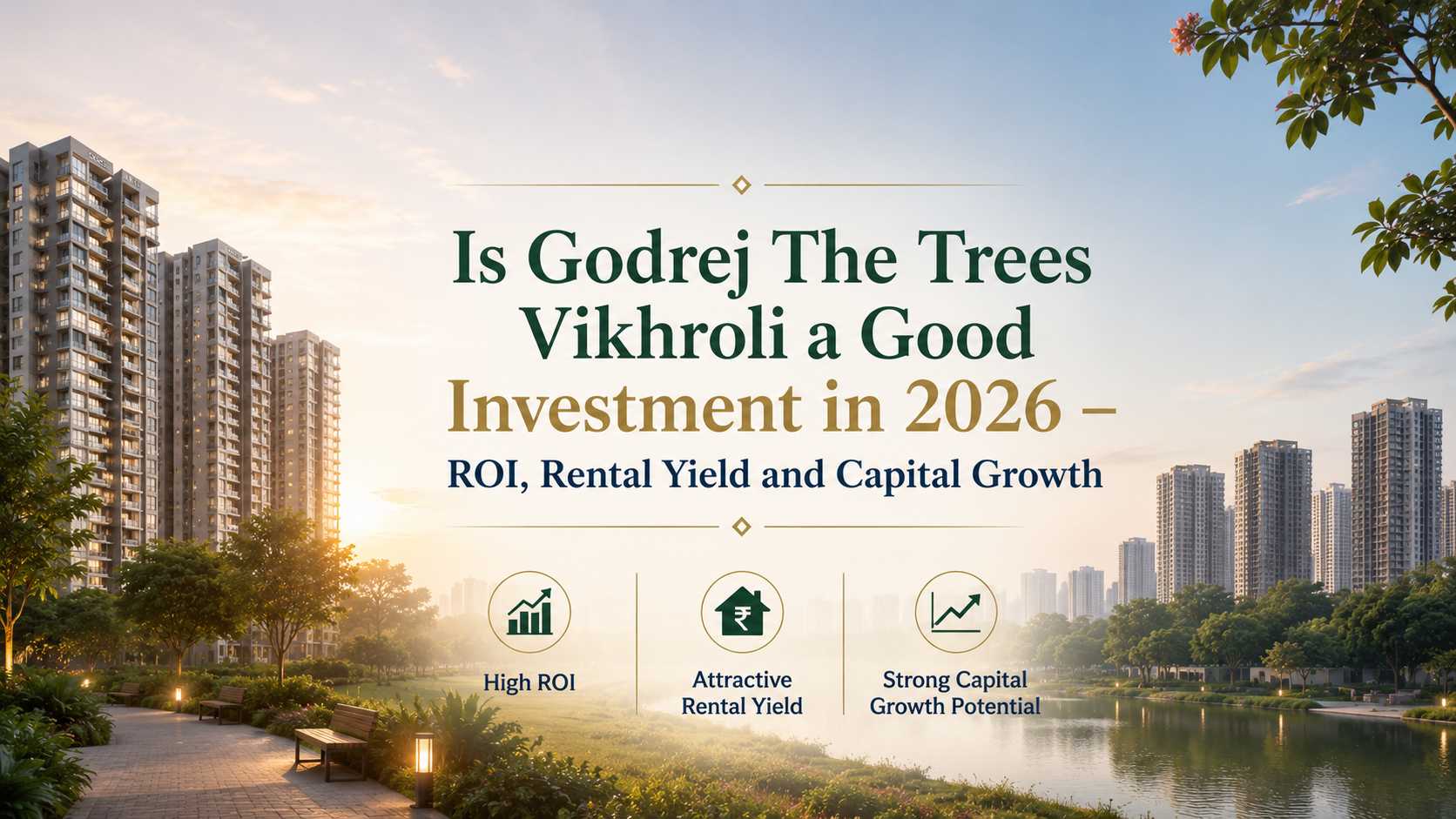
Godrej The Trees Vikhroli delivers gross rental yields of 3.4–4.3% — well above the Mumbai norm — on rents of Rs 60,000 to Rs 2 lakh a month. But it trades at roughly Rs 41,100 per sq ft against a Vikhroli East average near Rs 28,700, a 43% premium that limits capital upside. Our verdict: a strong income asset, a cautious appreciation bet.
Most Mumbai investment analyses have to explain away a weak yield. This one has the opposite problem. Godrej The Trees Vikhroli generates gross yields between 3.4% and 4.3% depending on configuration, against a citywide norm closer to 2.5–3%, and Vikhroli East as a locality carries a rental yield of about 5%. The income case here is genuinely strong.
The capital case is where it gets complicated. The project trades at roughly Rs 41,100 per sq ft while the surrounding locality averages about Rs 28,700 — a 43% premium. An asset that already carries that spread does not automatically ride the locality’s appreciation curve; more often, the gap simply narrows. Anyone underwriting this purchase on the assumption that Vikhroli’s improvement flows through proportionally is making a mistake.
What follows is the full return analysis for Godrej The Trees Vikhroli East — configuration-wise yields, net returns after costs, the Metro Line 6 catalyst, the risks that could break the thesis, and which configuration actually works as an investment.
Rental Yield by Configuration
Homes at The Trees rent between Rs 60,000 and Rs 2 lakh a month. The tenant base is drawn from the Powai employment cluster ten minutes away, the eastern corridor’s corporate offices and professionals who need Eastern Express Highway access — a mix that keeps vacancy low.
| Configuration | Purchase Price | Monthly Rent | Annual Rent | Gross Yield |
|---|---|---|---|---|
| 1 BHK (418–699 sq ft) | Rs 1.85 Cr | Rs 60,000–72,000 | Rs 7.2–8.6 L | 3.9–4.7% |
| 2 BHK (559–1,136 sq ft) | Rs 3.15 Cr | Rs 90,000–1,10,000 | Rs 10.8–13.2 L | 3.4–4.2% |
| 3 BHK (859–2,377 sq ft) | Rs 4.50 Cr | Rs 1.3–1.6 L | Rs 15.6–19.2 L | 3.5–4.3% |
| Penthouse / duplex | Rs 6.50–8.30 Cr | Rs 1.8–2.0 L | Rs 21.6–24.0 L | 2.9–3.3% |
The 1 BHK produces the highest yield despite carrying the highest rate per square foot in the project. That is not a contradiction — small formats always yield better because rent scales less than price. It does mean the 1 BHK is the one configuration where the investment case diverges sharply from the end-user case, where we would advise against it.
Vikhroli East carries a locality rental yield of roughly 5%, against a Mumbai average nearer 2.5–3%. The eastern suburbs’ proximity to Powai and the Eastern Express Highway corridor is doing real work in that number.
From Gross to Net — The Numbers That Matter
Gross yield ignores the cost of being a landlord. On a premium development with mature landscaping across 34 acres, maintenance is a real line item, and any honest projection carries it.
| Line Item | 2 BHK | 3 BHK | Notes |
|---|---|---|---|
| Annual rent (mid-band) | Rs 12.0 L | Rs 17.4 L | Rs 1.0 L / Rs 1.45 L per month |
| Society maintenance | Rs 1.10 L | Rs 1.55 L | Large-format premium development |
| Property tax | Rs 32,000 | Rs 46,000 | MCGM |
| Vacancy (1 month) | Rs 1.00 L | Rs 1.45 L | Realistic for premium stock |
| Repairs and brokerage | Rs 70,000 | Rs 95,000 | Annualised |
| Net annual income | Rs 8.88 L | Rs 12.99 L | — |
| Net yield | 2.8% | 2.9% | On purchase price |
A 2.8–2.9% net yield is still comfortably above what most premium Mumbai stock delivers after costs, where 1.8–2.2% is common. Combined with the absence of GST — the project is OC-received, saving 5% against any under-construction equivalent — the entry economics are better than the headline price suggests.
The GST Advantage, Quantified
Buying ready stock saves 5% GST: Rs 15.75 lakh on a Rs 3.15 crore 2 BHK and Rs 22.5 lakh on a Rs 4.50 crore 3 BHK. Against net rental income of Rs 8.88–12.99 lakh a year, that single saving is worth roughly 18 months of net rent.
The Capital Appreciation Question
This is where the thesis needs care. The Trees trades at about Rs 41,100 per sq ft against Vikhroli East at roughly Rs 28,700, and some data sources put the locality closer to Rs 23,600. Take the more conservative locality figure and the premium approaches 74%.
A premium of that scale does one of three things over a holding period. It can hold, if the project’s differentiators — 34 acres, 864 homes, completed status — remain scarce. It can widen, if Vikhroli fails to attract comparable competing supply. Or it can compress, if new premium developments arrive in the micro-market and the scarcity argument weakens. Our assessment is that holding is the base case and compression is the meaningful risk.
| Scenario | Driver | 5-Year Capital Outcome |
|---|---|---|
| Base case | Metro Line 6 opens, premium holds | 6–8% annual |
| Upside | Metro terminus repositions Vikhroli, supply stays tight | 9–11% annual |
| Downside | Competing premium supply compresses the spread | 3–5% annual |
Blend the base case with a 2.8% net yield and the total expected return sits around 9–11% annually. That is a reasonable outcome for a low-risk, completed, income-producing Mumbai asset. It is not a growth story, and it should not be sold as one.
Metro Line 6 — The One Real Catalyst
The Pink Line is the single development most likely to reprice Vikhroli. It runs 15.31 km from Swami Samarth Nagar in Andheri West to Vikhroli via the Jogeshwari–Vikhroli Link Road, with 13 stations and interchanges to Line 2 at Adarsh Nagar, Line 3 at SEEPZ, Line 4 at Kanjurmarg West and Line 7 at JVLR. MMRDA has cleared an opening in the second half of 2026 without the Kanjurmarg car depot, though some projections place full commissioning later.
Two features make it material for an investor here. First, Vikhroli is the eastern terminus, and terminus stations draw wider catchments than intermediate ones. Second, the line creates a direct east-west connection that does not currently exist — travel times along the JVLR corridor are expected to fall by 30–45 minutes, and roughly 30% of current road users on that route are projected to shift to metro.
For a landlord, that translates into a broader tenant pool. A Vikhroli address that reaches Andheri West and SEEPZ by metro competes for tenants it cannot reach today. This is the strongest argument for buying here now rather than after commissioning.
Six Risks to Underwrite Before You Buy
- The premium is already large. At 43% over the locality average, much of Vikhroli’s improvement is priced in; do not double-count it in your return model
- Metro timelines slip. MMRDA has cleared a second-half 2026 opening, but some projections extend to 2028. Model your returns without the metro and check they still work
- Penthouse liquidity is thin. The Rs 6.50–8.30 crore bracket has few buyers in Vikhroli and yields the least at 2.9–3.3%. Avoid it as an investment
- Competing supply. New premium developments in the eastern suburbs would directly pressure the spread that justifies current pricing
- Layout variance within configurations. A 3 BHK spans 859 to 2,377 sq ft — rent and resale differ enormously across that range, so verify the specific unit rather than the label
- Maintenance on a 34-acre estate. Landscaped commons at this scale cost real money; confirm the current per sq ft charge before modelling net yield
Which Configuration Actually Works as an Investment
Our ranking for an investor differs from our ranking for an end-user, and the difference is worth stating explicitly.
| Configuration | Gross Yield | Liquidity | Investor Verdict |
|---|---|---|---|
| 1 BHK | 3.9–4.7% | Good | Best yield; smallest ticket |
| 2 BHK | 3.4–4.2% | Strongest | Best balance of yield and exit |
| 3 BHK | 3.5–4.3% | Strong | Best rate per sq ft; good all-round |
| Penthouse | 2.9–3.3% | Weak | Avoid for investment |
The 2 BHK is our pick. It combines a solid 3.4–4.2% gross yield with the deepest resale market in the development, and Rs 3.15 crore is a ticket size that a wide pool of Mumbai buyers can finance. The 1 BHK yields better but is the configuration we advise end-users against in the full Godrej The Trees review, which matters because end-users are who you eventually sell to.
Comparing Within the Godrej Eastern Suburbs Portfolio
The nearest alternative is Godrej Urban Park Chandivali, ten minutes away, priced from Rs 1.38 crore with December 2026 possession. It is cheaper per square foot and sits in a locality with roughly 3–3.8% rental yields, but it attracts 5% GST and is not yet complete. For an investor wanting rent from this quarter, The Trees is the only one of the two that delivers.
Godrej Properties Limited reported FY26 sales bookings of Rs 34,171 crore across 17,515 homes — the highest full-year booking value by any listed Indian developer — with Rs 10,313 crore from the Mumbai Metropolitan Region. For a completed asset, that scale matters mainly through brand support for resale values. Corporate information is at Godrej Properties Limited.
Frequently Asked Questions
Q: Is Godrej The Trees Vikhroli a good investment in 2026?
As an income asset, yes — gross yields of 3.4–4.3% and net yields near 2.8–2.9% beat most premium Mumbai stock. As a capital-growth bet, be cautious: a 43% premium over the Vikhroli East average means much of the locality’s future improvement is already reflected in the price.
Q: What rental yield does The Trees actually deliver?
Gross yields run 3.9–4.7% on a 1 BHK, 3.4–4.2% on a 2 BHK and 3.5–4.3% on a 3 BHK, from rents of Rs 60,000 to Rs 2 lakh a month. After maintenance, tax, vacancy and repairs, net yield settles around 2.8–2.9%.
Q: Which configuration is the best investment?
The 2 BHK at Rs 3.15 crore. It pairs a 3.4–4.2% gross yield with the deepest resale market in the development at a ticket size a wide pool of buyers can finance. Avoid the penthouse bracket, which yields least and exits slowest.
Q: How much does the ready-to-move status save?
Five percent GST — Rs 15.75 lakh on a Rs 3.15 crore 2 BHK and Rs 22.5 lakh on a Rs 4.50 crore 3 BHK. Measured against net rental income, that saving is worth roughly 18 months of rent, and it applies from day one.
Q: Will Metro Line 6 increase property values in Vikhroli?
Likely, though the extent is uncertain. Vikhroli is the eastern terminus of the 15.31 km Pink Line, with interchanges to four other lines and JVLR corridor travel times expected to fall 30–45 minutes. MMRDA has cleared a second-half 2026 opening; some projections extend later, so model returns without it as a base case.
Q: What is the realistic total return over five years?
Blending a 2.8% net yield with base-case capital appreciation of 6–8% annually gives roughly 9–11% total return. The downside case, where competing premium supply compresses the locality spread, drops capital growth to 3–5%.
Q: Is the 43% premium over Vikhroli East justified?
Partly. Roughly 34 acres carrying only 864 homes, completed status with occupancy certificates, and Eastern Express Highway access at 0.3 km are real and hard to replicate. But a premium of that size caps how much of the locality’s appreciation flows through to you.
Our Verdict
Godrej The Trees Vikhroli is a better income investment than most premium Mumbai addresses and a more modest appreciation play than its brochure suggests. The 3.4–4.3% gross yields are genuine, the tenant demand from Powai and the eastern corridor is real, and the OC-received status removes both construction risk and 5% GST.
Buy the 2 BHK, underwrite it at a 2.8% net yield and 6–8% base-case appreciation, and treat Metro Line 6 as upside rather than as the reason for the purchase. If your model only works with the metro and with the premium widening, it is not a model — it is a hope. Our team can share recent rental and resale comparables from within the development to test your assumptions against actual transactions.