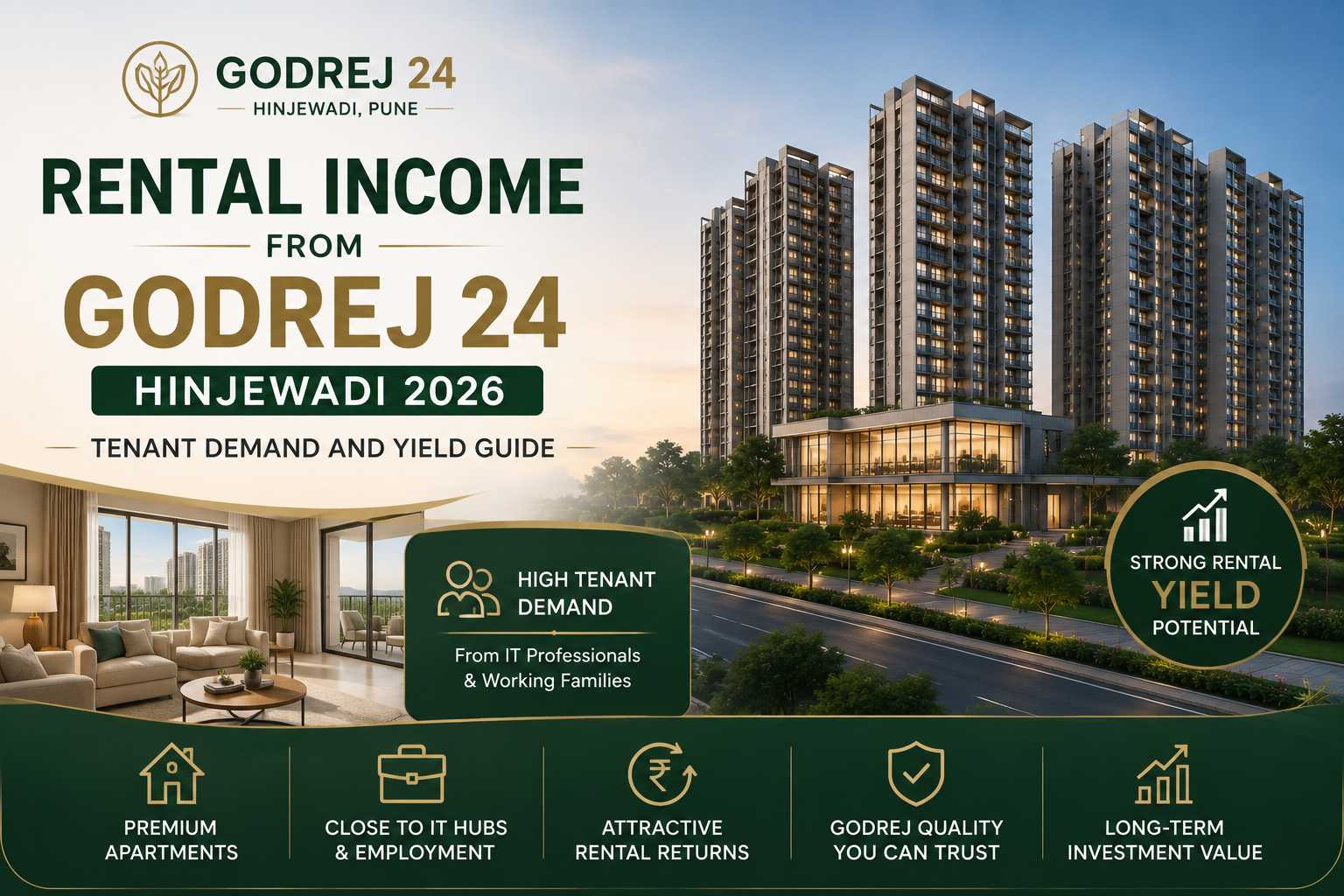

Godrej 24 Hinjewadi is an immediate-yield play at Pune’s deepest IT-corridor address — 3.5-4.5% gross yield from day one of possession, no three-year construction wait.
2-3 BHK from Rs 85 Lakh | Gross yield 3.5-4.5% | Rent starts immediately | Rajiv Gandhi Infotech Park ~5 min | Active secondary market, May 2026 registry data.
The entry ticket is real at Rs 85 Lakh minimum — this is a medium-to-high bracket investment. The case is strongest for the 3 BHK format at Rs 1.05-1.35 Cr, where the EMI-to-rent gap is most manageable and the long-hold buyer pool deepest.
1. The Investment Case for Godrej 24 Hinjewadi in 2026
Godrej 24 at Hinjewadi is the rare combination that defines a strong real-estate investment: a delivered branded address at Pune’s single largest employment cluster, generating rental income from the day of possession rather than after a multi-year construction period. The project offers 2 and 3 BHK apartments from Rs 85 Lakh at Rs 11,000-13,000 per square foot, with registry transactions from May 2026 confirming that the secondary market is active — both a liquidity signal and a price discovery mechanism independent of the developer. The full project detail is on the Godrej 24 listing page.
The headline investment thesis is straightforward: buy a delivered branded home inside Hinjewadi Phase 1, collect Rs 28,000-55,000 per month in rent from the IT professional tenant pool at the doorstep, and hold for five-plus years as the corridor’s deep employment base supports appreciation of approximately 6-8 percent per year. The caveats — a Rs 85 Lakh minimum ticket and a real negative carry on the EMI-to-rent gap — are equally important and are covered in full below.
2. Why Hinjewadi Phase 1 Is the Strongest IT Rental Market in Pune
The Rajiv Gandhi Infotech Park across Hinjewadi Phases 1, 2 and 3 is Maharashtra’s largest IT cluster outside Mumbai, employing a large, continuously churning professional workforce. Phase 1 — where Godrej 24 sits — is the most established and most employer-dense phase, home to the campuses of major global technology firms and Indian IT majors. That concentration of employment means the tenant pool for a 2 or 3 BHK at a Phase 1 address is not a thin market: it is one of the deepest rental demand segments in all of South Asia for this asset class.
Rental yields in Hinjewadi run 3.5-4.5 percent gross for branded premium stock, with 2 BHK rents at Rs 28,000-38,000 and 3 BHK rents at Rs 38,000-55,000 per month. These yields have held across multiple market cycles because the demand driver — IT employment — is not cyclical in the way that speculative project-driven demand is. Even in the years when Pune’s broader residential market softened, Hinjewadi rental demand stayed firm because the IT park kept adding tenants faster than the supply pipeline added units. For an investor, that structural demand floor is the most valuable attribute a micro-market can offer. Godrej Properties Limited’s consistent investment in West Pune (Hinjewadi, Mahalunge, Mamurdi) reflects exactly this demand reading. Review the developer’s portfolio at godrejproperties.com.
3. Yield Table — 2026 Investment Numbers
| Configuration | Purchase Price | Down (20%) | Loan | EMI (8.5%, 20yr) | Monthly Rent | Gross Yield | Monthly Gap |
|---|---|---|---|---|---|---|---|
| 2 BHK (~660 sqft) | Rs 85 Lakh | Rs 17 Lakh | Rs 68 Lakh | ~Rs 59,000 | Rs 28,000-38,000 | ~3.5-4.3% | Rs 21,000-31,000 |
| 2 BHK (~760 sqft) | Rs 98 Lakh | Rs 19.6 Lakh | Rs 78.4 Lakh | ~Rs 68,000 | Rs 32,000-42,000 | ~3.5-4.0% | Rs 26,000-36,000 |
| 3 BHK (~960 sqft) | Rs 1.10 Cr | Rs 22 Lakh | Rs 88 Lakh | ~Rs 76,000 | Rs 40,000-52,000 | ~3.8-4.5% | Rs 24,000-36,000 |
| 3 BHK (~1,100 sqft) | Rs 1.35 Cr | Rs 27 Lakh | Rs 1.08 Cr | ~Rs 93,500 | Rs 45,000-55,000 | ~3.5-4.2% | Rs 38,500-48,500 |
The monthly negative-carry gap — the EMI-to-rent difference — is the number that separates investors who suit this project from those who do not. On the entry 2 BHK, the gap is Rs 21,000-31,000 per month. On a 3 BHK at Rs 1.10 Cr, it falls to Rs 24,000-36,000 — a smaller percentage negative carry relative to the gross yield. This is why our team flags the 3 BHK at Rs 1.05-1.35 Cr as the investment configuration of choice: the yield is marginally stronger (3.8-4.5%), the tenant pool for 3 BHK is deep and dual-income (less vacancy risk), and the long-hold resale buyer pool is larger. An investor who can manage Rs 24,000-36,000 per month negative carry for five to seven years while the asset appreciates is positioned well.
4. The Appreciation Case — Hinjewadi Phase 1 Track Record
Hinjewadi Phase 1 residential rates have broadly appreciated 8-12 percent per annum over the last five years, supported by employment growth, the metro corridor announcement, the NH-48 highway infrastructure and the continued tightening of supply in Phase 1 itself as land becomes scarcer. Neighbouring Mahalunge — which did not have the same Phase 1 adjacency — still appreciated close to 90 percent over five years, which is the corridor effect. For Phase 1 itself, the forward catalysts are: the Hinjewadi-Shivajinagar metro corridor opening, which will add rail liquidity to what is currently a car-dependent IT commute; continued Phase 2 and Phase 3 development that drives further Phase 1 premium; and the broader West Pune residential infrastructure investment that follows employer expansion. Our team models conservative forward appreciation of 6-8 percent per year for Phase 1 branded delivered stock over a seven-year hold — below the historic rate to allow for market maturation, but above inflation and comparable equity returns in the same bracket.
5. Comparing Against Under-Construction Hinjewadi Options
The most direct comparison for a Godrej 24 investor is The Gale at Godrej Park World, the same developer’s under-construction township at Hinjewadi with a 2029 possession timeline. The Gale launches from Rs 79.9 Lakh (1/2/3 BHK) at Rs 14,000-14,500 per square foot. The table below maps the financial difference between a 2026 purchase of Godrej 24 and a 2026 purchase of The Gale across the critical metrics.
| Metric | Godrej 24 (Delivered) | The Gale (Under Constr., 2029) |
|---|---|---|
| 2 BHK entry price | ~Rs 85 Lakh (secondary) | ~Rs 1.05 Cr (carpet, estimated) |
| Rate/sqft | Rs 11,000-13,000 | Rs 14,000-14,500 |
| Possession | Immediate | March 2029 (~3 years) |
| Rental income start | Month 1 | After March 2029 |
| 3-year rental income (2 BHK) | ~Rs 10-13.7 Lakh | Rs 0 |
| Construction risk | None | Exists (mitigated by Godrej brand) |
The three-year rental income advantage of Godrej 24 — roughly Rs 10-14 Lakh on a 2 BHK — partially bridges the Rs 20 Lakh rate difference. Investors who assign value to income certainty, zero construction risk and immediate cash flow will find Godrej 24 the more rational choice even at the higher secondary-market rate. Investors who can afford to wait three years and place a high value on the 36-storey views and township amenity scale of The Gale will find the under-construction proposition compelling. These are not the same buyer — and both are rational, depending on individual financial position and horizon. For The Gale’s investment case, see our dedicated The Gale investment guide.
6. Who Should Invest in Godrej 24
The ideal Godrej 24 investor has an Rs 85 Lakh-plus budget, a five-to-seven-year investment horizon, and wants immediate rental income from Pune’s strongest IT catchment without the construction risk of a 2029-timeline under-construction project. The 3 BHK at Rs 1.05-1.35 Cr is the preferred format: stronger yield percentage, deeper tenant pool, wider resale buyer base. An NRI investor who wants a managed Godrej address in Pune’s top IT micro-market without project-delivery uncertainty is a strong candidate, as is a local high-income IT professional buying a second investment property while living elsewhere.
Who should not invest at Rs 85 Lakh-plus: investors who need positive cash flow from day one (the EMI-to-rent gap precludes this in almost all scenarios), investors with a sub-three-year horizon (the appreciation is medium-term, not immediate), and investors who need the lowest possible entry price (where Godrej Greens Handewadi at Rs 45 Lakh is the relevant alternative). If your budget targets the Rs 45-65 Lakh range with a comparable IT-corridor demand argument, compare Godrej Greens directly.
7. Summary — Buy, Hold or Avoid?
Our recommendation for Godrej 24 Hinjewadi is a BUY for investors targeting the 3 BHK format with a five-to-seven-year hold, and a CONDITIONAL BUY for 2 BHK investors who can manage a Rs 21,000-31,000 per month negative carry without financial strain. The appreciation from Phase 1 Hinjewadi’s employment base is structurally supported, the rental income is immediate and real, and the Godrej brand provides resale liquidity that alternative Hinjewadi delivered addresses cannot match. Avoid if you need positive cash flow, a short horizon or a lower entry ticket.
Q. What is the rental yield at Godrej 24 Hinjewadi?
Gross rental yield is approximately 3.5-4.5 percent. A 2 BHK rents for Rs 28,000-38,000 per month, a 3 BHK for Rs 38,000-55,000. The yield starts immediately on possession — no construction waiting period. The negative carry (EMI minus rent) ranges from Rs 21,000-31,000 per month on the entry 2 BHK to Rs 24,000-36,000 on the 3 BHK at Rs 1.10 Cr.
Q. Which is better — Godrej 24 or The Gale at Godrej Park World for investment?
Godrej 24 is the immediate-income play: delivered, rental income from month one, zero construction risk, Rs 11,000-13,000/sqft on secondary market. The Gale is the 2029 capital-appreciation play: lower launch rate potential, township scale and 36-storey views, but no income for three years and construction-period risk. Both are Godrej products at Hinjewadi; the right one depends on whether you value income now or a potentially lower entry rate with a three-year wait.
Q. How much appreciation can I expect from Godrej 24 over five years?
Our team models conservative appreciation of 6-8 percent per annum over a seven-year hold for Phase 1 Hinjewadi branded delivered stock, based on the corridor’s historic track record and forward catalysts (metro opening, employment growth, supply tightening in Phase 1). On a Rs 85 Lakh 2 BHK, 6-8 percent annualised appreciation over seven years points to a value of approximately Rs 1.28-1.46 Cr — on top of the rental income collected throughout that period.