
Best Areas to Buy a Flat in Navi Mumbai — 2026 Buyer Guide
Coverage: Kharghar, Panvel, Vashi, Belapur, Ulwe, Airoli, Nerul, Seawoods | Budget Range: ₹55 Lakh to ₹5 Crore+
Bottom line: Navi Mumbai offers 8–10 distinct residential nodes, each with a different risk-return profile. Kharghar leads the premium segment with 25–35% five-year appreciation. We rank every major area by price, connectivity, infrastructure maturity and growth potential to help you find the right node for your budget and timeline.
1. Introduction — Why Navi Mumbai Is the MMR’s Growth Engine
Navi Mumbai has evolved from a satellite-city concept into a self-sustaining urban centre with its own employment hubs, social infrastructure and premium residential market. In 2026, the city is at an inflection point driven by three infrastructure catalysts: the Navi Mumbai International Airport nearing completion, the Navi Mumbai Metro expanding its network and the Atal Setu (Mumbai Trans Harbour Link) that has cut travel time to South Mumbai by over 50%. For buyers evaluating where to purchase a flat in the Mumbai Metropolitan Region, Navi Mumbai offers a combination of relatively accessible pricing, planned infrastructure and appreciation potential that Mumbai proper and Thane cannot match at equivalent budget levels.
Godrej Properties Limited (NSE: GODREJPROP), one of India’s top-three listed developers, has committed significant capital to the Navi Mumbai market — with active projects including Godrej Varanya in Kharghar (RERA: P51271012502176 / P51271012502343), Godrej City in Panvel and Godrej Golf Side Estate in Panvel. This developer conviction reflects the institutional view that Navi Mumbai is the MMR’s highest-growth residential market for the 2025–2030 period.
This guide ranks every major residential area in Navi Mumbai across the parameters that matter: current pricing, five-year appreciation, connectivity infrastructure, social amenities and future growth potential. Whether you are a first-time buyer at ₹55 Lakh or a premium buyer at ₹4 Crore, the area you choose determines 70% of your investment outcome — the specific project accounts for the remaining 30%. Choose the right node first, then the right project within it.
2. Navi Mumbai — Market Overview and Infrastructure Context
Navi Mumbai was planned by CIDCO (City and Industrial Development Corporation) in the 1970s as a counter-magnet to Mumbai’s congestion, with a grid-based road network, designated commercial zones and pre-planned residential sectors that give it an urban-planning advantage over organically-grown cities. That planning discipline means infrastructure — roads, drainage, water supply, open spaces — was designed into the city from inception rather than retrofitted, resulting in wider roads, higher green cover and more predictable development patterns than what you find in suburban Mumbai or older parts of Thane. For the broader Godrej Properties portfolio and developer background, visit Godrej Properties.
The 2024–2026 period has been transformative for Navi Mumbai’s connectivity. The Atal Setu has reduced the South Mumbai commute from 90-plus minutes to under 40 minutes for many Navi Mumbai residents. The Navi Mumbai Metro is progressively connecting nodes that were previously car-dependent. And the Navi Mumbai International Airport, located near Panvel-Ulwe, is the single largest infrastructure investment in the region’s history — expected to trigger the same kind of step-change in property values that Hyderabad’s Shamshabad airport and Bangalore’s Devanahalli airport drove in their respective catchments.
Current pricing across Navi Mumbai ranges from approximately ₹10,000–12,000 per sqft in emerging nodes like Taloja to ₹30,000–40,000 in mature nodes like Vashi and premium Kharghar. This 3–4x price range within a single city reflects the varying levels of infrastructure maturity, connectivity and social amenities across different nodes — and creates opportunities at every budget level for buyers who understand the trade-offs between current livability and future appreciation.
3. Area-Wise Pricing Snapshot — Navi Mumbai 2026
The table below captures current per-sqft pricing, typical apartment budgets and maturity levels for every major residential node in Navi Mumbai. Rates reflect the premium branded segment where possible, and the general market range otherwise.
| Area | Rate (Rs/sqft) | 2 BHK Budget | 3 BHK Budget | Maturity Level |
|---|---|---|---|---|
| Kharghar | ₹28,000–35,000 | ₹1.80–2.50 Cr | ₹2.80–4.00 Cr | Established premium |
| Vashi | ₹30,000–40,000 | ₹2.00–3.00 Cr | ₹3.20–5.00+ Cr | Fully mature |
| Belapur (CBD) | ₹25,000–32,000 | ₹1.60–2.20 Cr | ₹2.50–3.50 Cr | Mature commercial hub |
| Nerul | ₹22,000–30,000 | ₹1.40–2.00 Cr | ₹2.20–3.20 Cr | Established residential |
| Seawoods | ₹22,000–28,000 | ₹1.40–1.90 Cr | ₹2.00–3.00 Cr | Rapidly maturing |
| Airoli | ₹20,000–26,000 | ₹1.20–1.70 Cr | ₹1.80–2.80 Cr | IT corridor hub |
| Panvel | ₹14,000–18,000 | ₹55 L–1.10 Cr | ₹85 L–1.60 Cr | Growth corridor |
| Ulwe | ₹12,000–16,000 | ₹50 L–95 L | ₹75 L–1.40 Cr | Airport-adjacent (emerging) |
| Taloja | ₹10,000–14,000 | ₹40 L–80 L | ₹60 L–1.10 Cr | Emerging (infrastructure pending) |
| Dronagiri | ₹8,000–12,000 | ₹35 L–65 L | ₹50 L–90 L | Early stage (speculative) |
The pricing gradient reflects infrastructure maturity and connectivity. Vashi and Kharghar command the highest rates because they offer fully-built social and transport infrastructure — you buy here and live comfortably from day one. Panvel, Ulwe and Taloja offer lower entry prices but require a 3–5-year view for infrastructure to catch up, meaning the current living experience involves longer commutes, fewer retail options and developing social infrastructure. The trade-off is simple: pay more for certainty, or pay less for growth potential with associated risk.
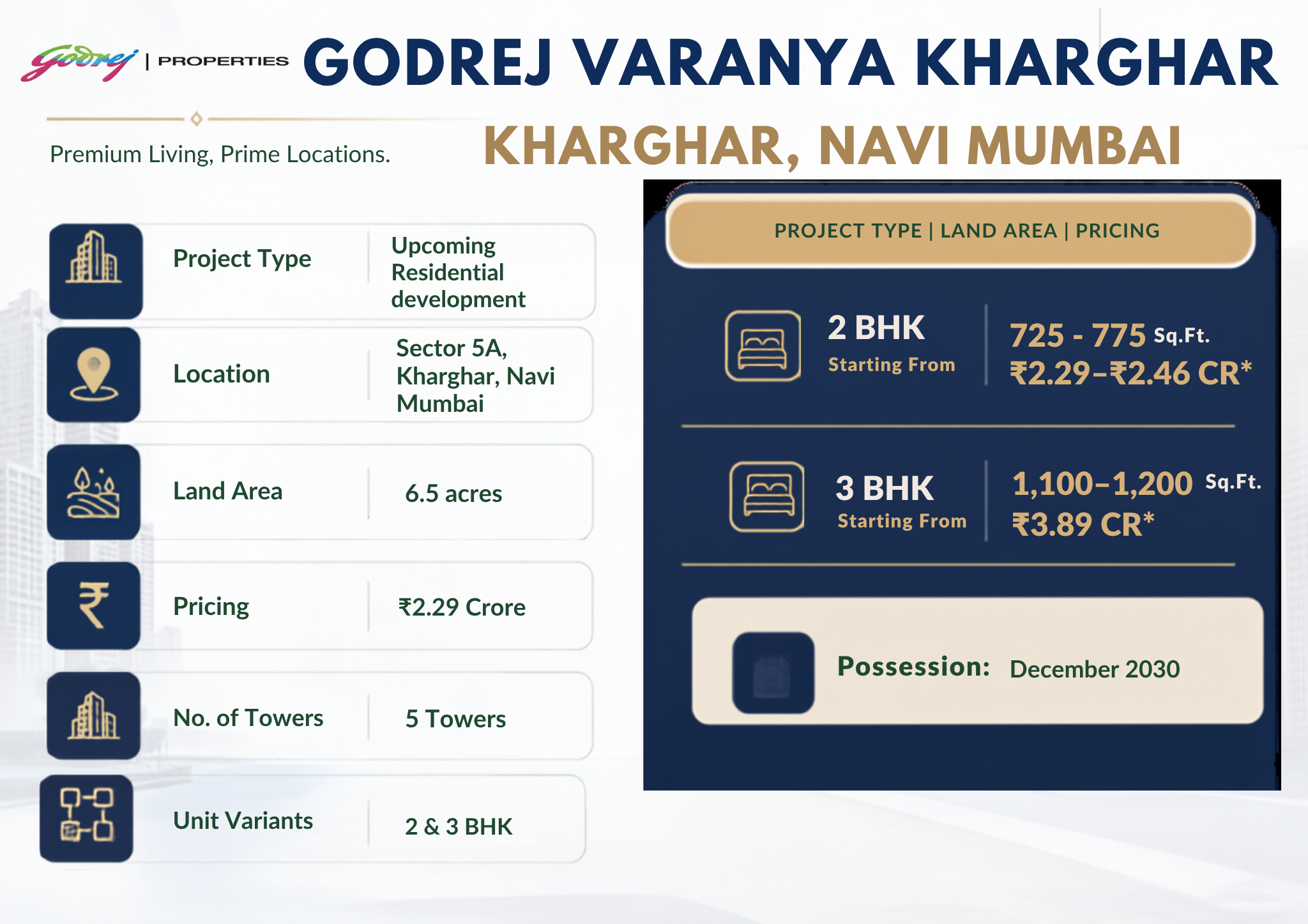
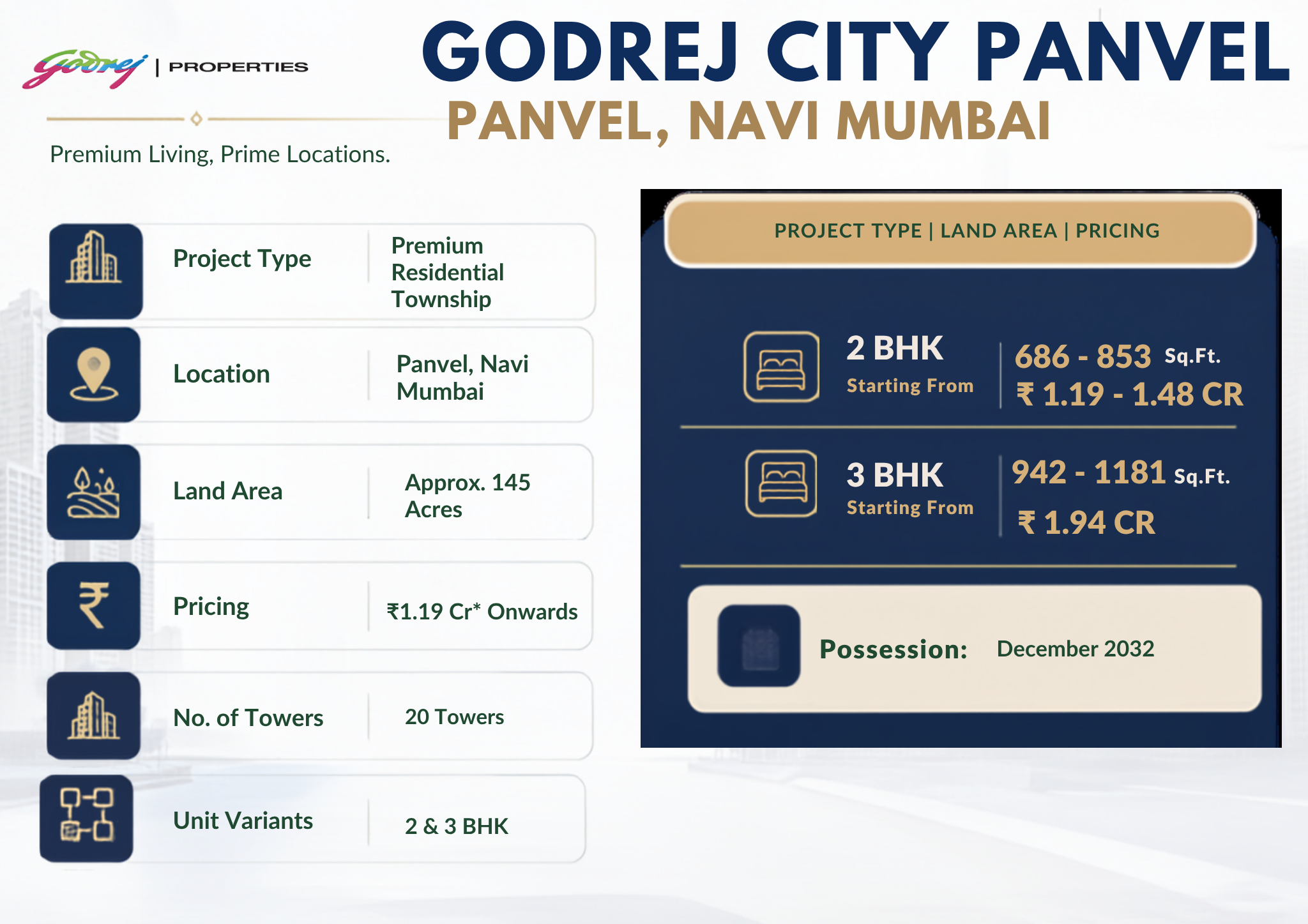
For context, Godrej Varanya in Kharghar is positioned at ₹30,500–33,000 per sqft — the premium end of the Kharghar range. This pricing reflects the Godrej brand premium, the low-density design (305 units on 6.5 acres) and the dual-rail connectivity advantage at Sector 5A. Buyers who want the Navi Mumbai growth story at a lower entry point can look at Godrej City Panvel, which starts from ₹1.19 Crore in the mass-market Panvel corridor.
4. Appreciation Trends — Which Areas Have Grown Fastest
Past appreciation does not guarantee future returns, but it does reveal which areas have the infrastructure momentum and buyer demand to sustain price growth. The table below compares five-year appreciation rates across Navi Mumbai’s major residential nodes.
| Area | 5-Year Appreciation | Key Growth Driver | Forward Outlook (2026–2031) |
|---|---|---|---|
| Kharghar | 25–35% | Metro + Atal Setu + premium positioning | Strong (airport catalyst still ahead) |
| Vashi | 15–22% | Established demand, limited new supply | Moderate (nearing price ceiling) |
| Panvel | 30–40% | Airport proximity, mass-market demand | Strong (airport commissioning) |
| Ulwe | 35–50% | Airport-adjacent, low base effect | High potential, high risk |
| Belapur | 18–25% | Commercial hub, steady demand | Moderate (mature market) |
| Airoli | 20–28% | IT corridor employment | Moderate to strong |
| Seawoods | 22–30% | Seawoods Grand Central, waterfront | Strong (retail + transit hub) |
| Taloja | 25–35% | Low base, industrial corridor | Moderate (infrastructure pending) |
Kharghar’s 25–35% five-year appreciation is particularly significant because it has been achieved from a relatively high base (₹18,000–22,000 per sqft in 2019–2020). Ulwe and Taloja have shown higher percentage gains but from much lower bases, meaning the absolute rupee appreciation per sqft is comparable or lower. More importantly, the growth in emerging nodes like Ulwe comes with infrastructure-delivery risk that does not exist in Kharghar, where schools, hospitals, malls and transit are already operational.
The forward outlook for 2026–2031 favours Kharghar and Panvel, both of which sit within the airport’s impact radius and have additional catalysts (metro expansion, commercial development) that sustain demand. Vashi’s ceiling effect limits upside, while Ulwe’s potential is high but contingent on infrastructure delivery that remains partially uncertain. For buyers who want both appreciation potential and current livability, Kharghar offers the optimal balance — which is why it commands the premium rates documented above.
5. Deep Dive — Top 4 Areas for Different Buyer Profiles
Not every buyer has the same priorities. We have mapped Navi Mumbai’s residential areas to four distinct buyer profiles, each with a recommended primary and secondary area based on the data above.
Profile 1: Premium end-user (Budget ₹2–4 Crore, plans to live in the flat). Primary recommendation: Kharghar. The area offers the best combination of premium housing stock, operational social infrastructure (schools like Ryan International and DAV, hospitals like MGM and Kharghar General), retail (Little World Mall, Raghuleela), and dual-rail connectivity. Godrej Varanya at Sector 5A is the standout project for this profile, offering 2 BHK from ₹2.29 Crore and 3 BHK from ₹3.89 Crore with only 305 units on 6.5 acres. Secondary recommendation: Vashi, if proximity to established commercial infrastructure and the Atal Setu gateway is prioritised over value for money.
Profile 2: Investment-focused buyer (Budget ₹1–3 Crore, 5–7-year horizon). Primary recommendation: Kharghar (premium segment) for brand-backed appreciation and resale liquidity, or Panvel (mass market) for higher percentage returns on a lower ticket. The Kharghar thesis is built on Godrej-branded resale premium and airport-catalyst appreciation; the Panvel thesis is built on lower-base growth with higher unit volume. Secondary recommendation: Seawoods, which is rapidly maturing as a transit-oriented hub and offers a middle ground on pricing.
Profile 3: First-time buyer (Budget ₹55 Lakh – ₹1.20 Crore). Primary recommendation: Panvel. Godrej City Panvel offers 1, 2 and 3 BHK apartments from ₹1.19 Crore with a fully-delivered township environment — over 3,000 families already in residence. The area provides the lowest entry into branded Navi Mumbai real estate with strong appreciation potential from the airport catalyst. Secondary recommendation: Taloja, for buyers who can accept a 2–3-year infrastructure maturation period in exchange for the lowest per-sqft entry in the Navi Mumbai belt.
Profile 4: NRI or high-net-worth buyer (Budget ₹3 Crore+, brand and resale focus). Primary recommendation: Kharghar, specifically a branded project like Godrej Varanya that offers institutional developer backing, strong resale liquidity and the convenience of professional post-handover management. NRI buyers particularly value developer credibility and management quality because they cannot personally oversee the property. Secondary recommendation: Mumbai proper (Vikhroli, Wadala) via projects like Godrej The Trees or Godrej Horizon Wadala for ready-to-move or near-ready options in Mumbai.
6. Cost Comparison — What Your Budget Gets You Across Navi Mumbai
To help you visualise what different budgets buy across Navi Mumbai’s areas, the table below maps three common budget levels to the apartment size and quality you can expect in each node.
| Budget | Kharghar | Panvel | Ulwe | Vashi |
|---|---|---|---|---|
| ₹1 Crore | Compact 1 BHK (limited stock) | Spacious 2 BHK (branded) | Large 2 BHK or compact 3 BHK | Compact 1 BHK (older stock) |
| ₹2.30 Crore | Premium 2 BHK (Godrej Varanya) | Large 3 BHK (branded) | Spacious 3 BHK + 3 BHK combo | Standard 2 BHK (newer building) |
| ₹3.90 Crore | Premium 3 BHK (Godrej Varanya) | 4 BHK or two 2 BHK investment | Multiple investment units | Good 3 BHK (premium segment) |
The budget comparison makes the value proposition clear. At ₹2.30 Crore, you can buy a premium 2 BHK in Kharghar’s top-tier project (Godrej Varanya) with 725 sqft carpet and walk-to-station access, or a large 3 BHK in Panvel with more space but a developing infrastructure environment. The Kharghar option prioritises location quality, developer brand and current livability. The Panvel option prioritises space and growth potential at the cost of current convenience. Neither is inherently better — the right choice depends on whether you are optimising for living now or investing for later.
For buyers at the ₹3.90 Crore level, Kharghar offers the opportunity to enter the premium 3 BHK segment with a project like Godrej Varanya (1,100–1,200 sqft carpet), while the same budget in Panvel or Ulwe could fund multiple investment units — a strategy that diversifies risk but requires active management of multiple properties. Our investment analysis of Godrej Varanya covers the single-unit premium investment thesis in detail.
7. Buyer Guidance — How to Choose Your Navi Mumbai Node
Our team recommends a three-step process for choosing the right area in Navi Mumbai. This framework applies whether you are a first-time buyer at ₹55 Lakh or a premium buyer at ₹4 Crore.
Step 1: Map your daily commute. The most underestimated factor in real-estate satisfaction is the daily commute. Before evaluating any project, identify your workplace and calculate the commute time from each potential area using current public-transport options — not Google Maps driving estimates, which understate Mumbai-region traffic. If you work in Belapur, Airoli or Thane, Kharghar offers a 10–25-minute rail commute. If you work in South Mumbai, the Atal Setu makes Kharghar and Vashi viable at under 40 minutes. If you work in Pune, Kharghar’s expressway access is the strongest advantage. The commute determines your daily quality of life more than any other factor.
Step 2: Define your timeline. If you need to move in within 6–12 months, your options are limited to ready-to-move or nearing-completion projects in established areas like Vashi, Belapur, Nerul or Kharghar. If you can wait until 2030, under-construction projects like Godrej Varanya (December 2030 possession) offer lower entry prices and construction-linked payment plans that reduce upfront capital requirements. Your timeline determines whether you are buying current livability or future value — and the financial structures differ significantly.
Step 3: Visit on a weekday and a weekend. Every area in Navi Mumbai presents differently on a weekday morning (commute traffic, school congestion, market activity) versus a Sunday afternoon (quiet streets, closed shops, residential character). Visit your shortlisted areas at both times to understand the actual living environment. Walk from the project site to the nearest railway station, school and grocery store. Time the walk. That 15-minute brochure claim may be a 25-minute reality through traffic — and you will make that walk thousands of times. For a detailed walkthrough of Kharghar’s daily-living infrastructure, our Kharghar neighbourhood guide covers schools, hospitals and commute routes.
8. Conclusion & FAQs
Navi Mumbai in 2026 offers the widest range of residential investment opportunities in the Mumbai Metropolitan Region, from ₹35 Lakh entries in Dronagiri to ₹5 Crore-plus premium addresses in Vashi and Kharghar. The airport, metro and Atal Setu have transformed the city’s connectivity and triggered a re-rating of property values across every node. For buyers who want the best balance of current livability, developer quality and appreciation potential, Kharghar remains the top recommendation in the premium segment, with Godrej Varanya leading the branded options. For value-focused buyers, Panvel’s growth corridor offers the strongest entry point with airport-catalyst upside.
The area you choose matters more than the project. Get the node right, then get the project right — not the other way around. Use the data in this guide to shortlist 2–3 areas, visit each in person, map your commute and then evaluate specific projects within your chosen node. That sequence produces better outcomes than falling in love with a brochure and then discovering the area does not match your daily-living needs.
Which is the best area to buy a flat in Navi Mumbai in 2026?
Kharghar is the top recommendation for premium buyers (₹2–4 Crore) based on its combination of established infrastructure, dual-rail connectivity, 25–35% five-year appreciation and the airport catalyst ahead. Panvel is the best pick for budget-conscious buyers (₹55 Lakh – ₹1.50 Crore) with a 3–5-year growth view.
What are property rates in Kharghar in 2026?
Premium segment rates in Kharghar range from ₹28,000 to ₹35,000 per sqft. Godrej Varanya, one of the leading branded projects, is priced at ₹30,500–33,000 per sqft with 2 BHK from ₹2.29 Crore and 3 BHK from ₹3.89 Crore. Mid-market rates in Kharghar start around ₹22,000–25,000 per sqft.
Is Ulwe a good area to invest in Navi Mumbai?
Ulwe offers high-growth potential (35–50% five-year appreciation from a low base of ₹12,000–16,000 per sqft) due to its proximity to the Navi Mumbai International Airport. However, the infrastructure is still developing, with limited schools, hospitals and retail. It is a higher-risk, higher-reward bet compared to established nodes like Kharghar.
How does Kharghar compare to Vashi for home buyers?
Vashi is fully mature with rates of ₹30,000–40,000 per sqft and limited new supply, offering stability but capped appreciation (15–22% over five years). Kharghar offers comparable infrastructure maturity at slightly lower rates (₹28,000–35,000) with stronger growth potential (25–35%) driven by the airport catalyst and metro expansion. For new purchases, Kharghar offers better value.
What is the cheapest area to buy a flat in Navi Mumbai?
Dronagiri offers the lowest entry point at ₹8,000–12,000 per sqft (2 BHK from approximately ₹35 Lakh), but it is in the early stages of development with limited current infrastructure. Taloja (₹10,000–14,000) and Ulwe (₹12,000–16,000) are the next-lowest options, both emerging areas with improving but still-developing infrastructure.