Quick Answer
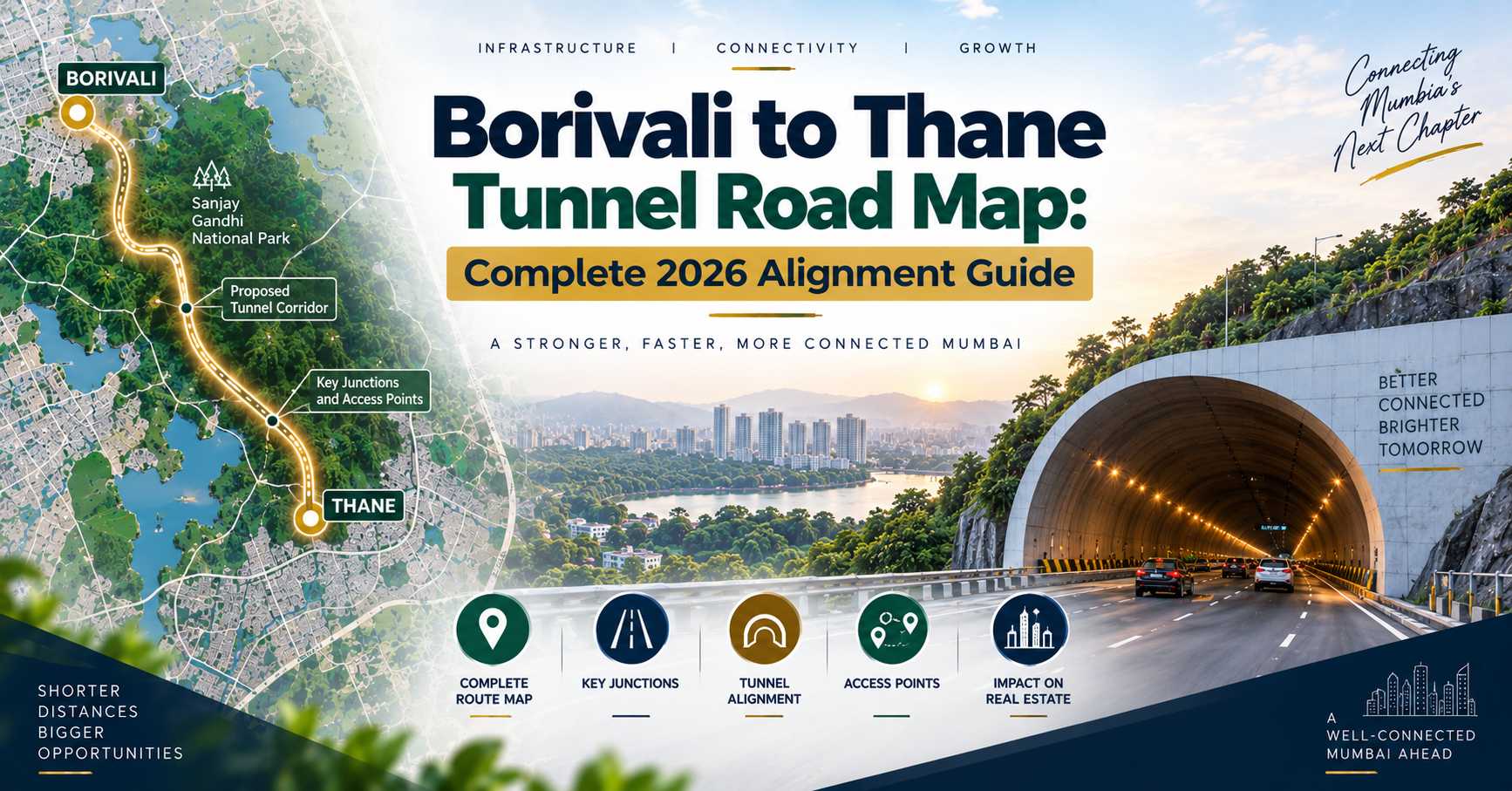
The borivali to thane tunnel road map covers 11.84 km in total — roughly 10.25 km of bored twin tunnel plus approach roads — running from the Western Express Highway at Magathane, Borivali East, to Ghodbunder Road near Tikuji-ni-Wadi in Thane. The alignment passes 23 to 60 metres below Sanjay Gandhi National Park without touching its eco-sensitive surface zone.
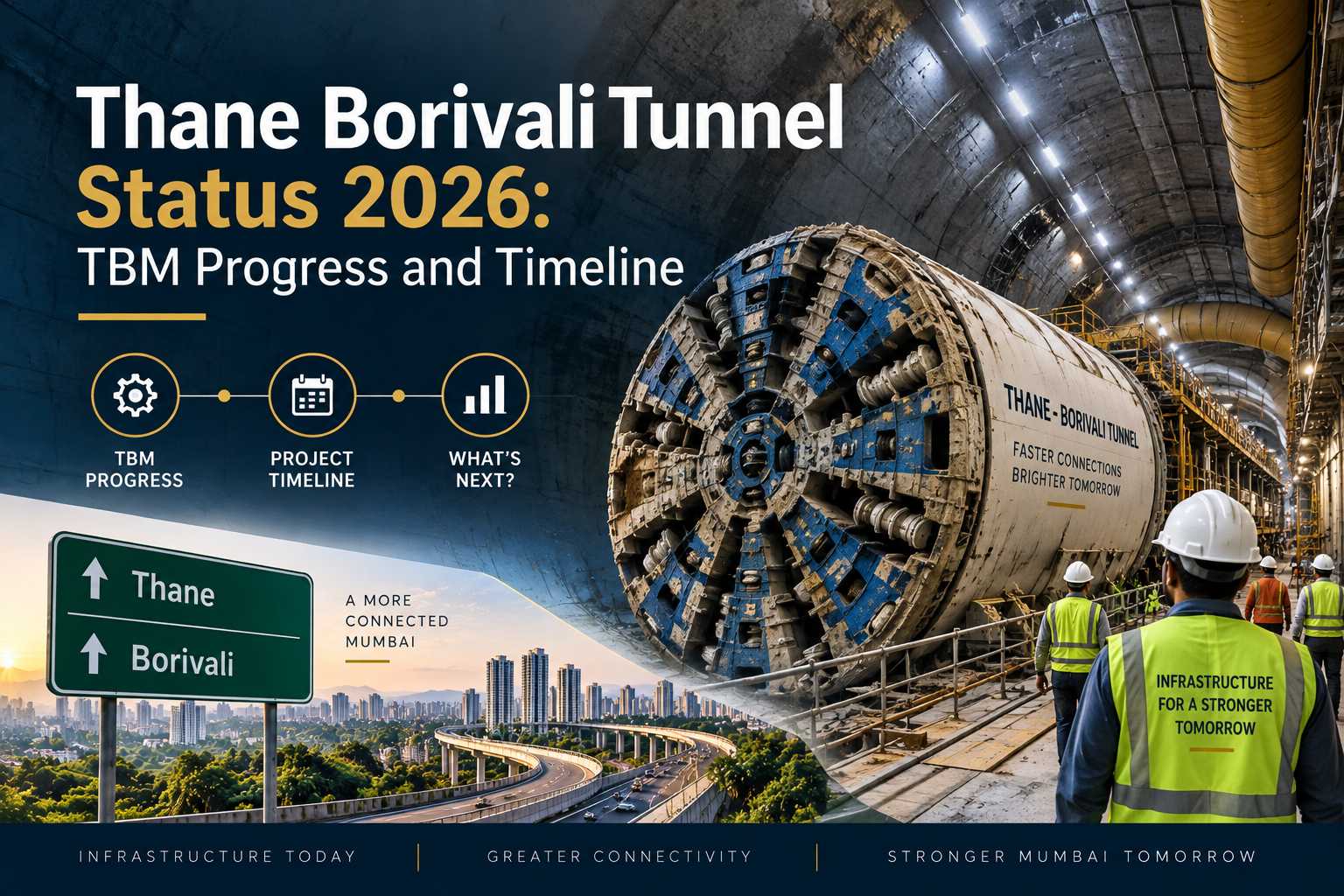
Anyone who has sat through the Ghodbunder Road crawl on a Monday morning already knows the arithmetic. Borivali and Thane sit roughly 12 km apart as the crow flies, yet the drive between them takes 60 to 90 minutes because Sanjay Gandhi National Park forces every vehicle to detour around 100-plus square kilometres of protected forest. The MMRDA’s answer is to go underneath it. In September 2026, with TBM Nayak already cutting rock from the Thane end, the borivali to thane tunnel road map has moved from consultation drawings to a fixed, surveyed alignment that homebuyers can plan around.
We at Godrej Properties MMR get asked the same question in almost every Thane and Borivali site visit: where exactly does this thing surface, and how close is it to the flat I am considering? That question matters more than the headline travel time, because the value uplift along this corridor is intensely local. A tower 900 metres from the Magathane portal and a tower 6 km away on the same highway will not behave the same way over the next four years.
This guide lays out the alignment section by section — the portals, the depth profile, the ventilation and cross-passage arrangement, the surface points the tunnel runs under, and what the geometry means for the residential pockets on either side. Every number below comes from the MMRDA detailed project report, the contractor’s published scope, or reporting from 2025 and 2026.
The Borivali to Thane Tunnel Road Map: Alignment in Numbers
The project is officially the Thane–Borivali Twin Tube Underground Road Tunnel. Two separate tubes run parallel, one carrying traffic in each direction, so there is no bi-directional mixing and no head-on risk. Each tube is 12.2 metres in internal diameter, which is what allows three running lanes plus a dedicated emergency lane in a single bore.
| Parameter | Specification | What It Means On The Ground |
|---|---|---|
| Total project length | 11.84 km | Includes approach roads and portal structures at both ends |
| Bored tunnel length | 10.25 km per tube | The section actually under the national park |
| Approach roads | ~1 km combined | Split between the Thane and Borivali portals |
| Internal diameter | 12.2 m per tube | Three lanes plus one emergency lane |
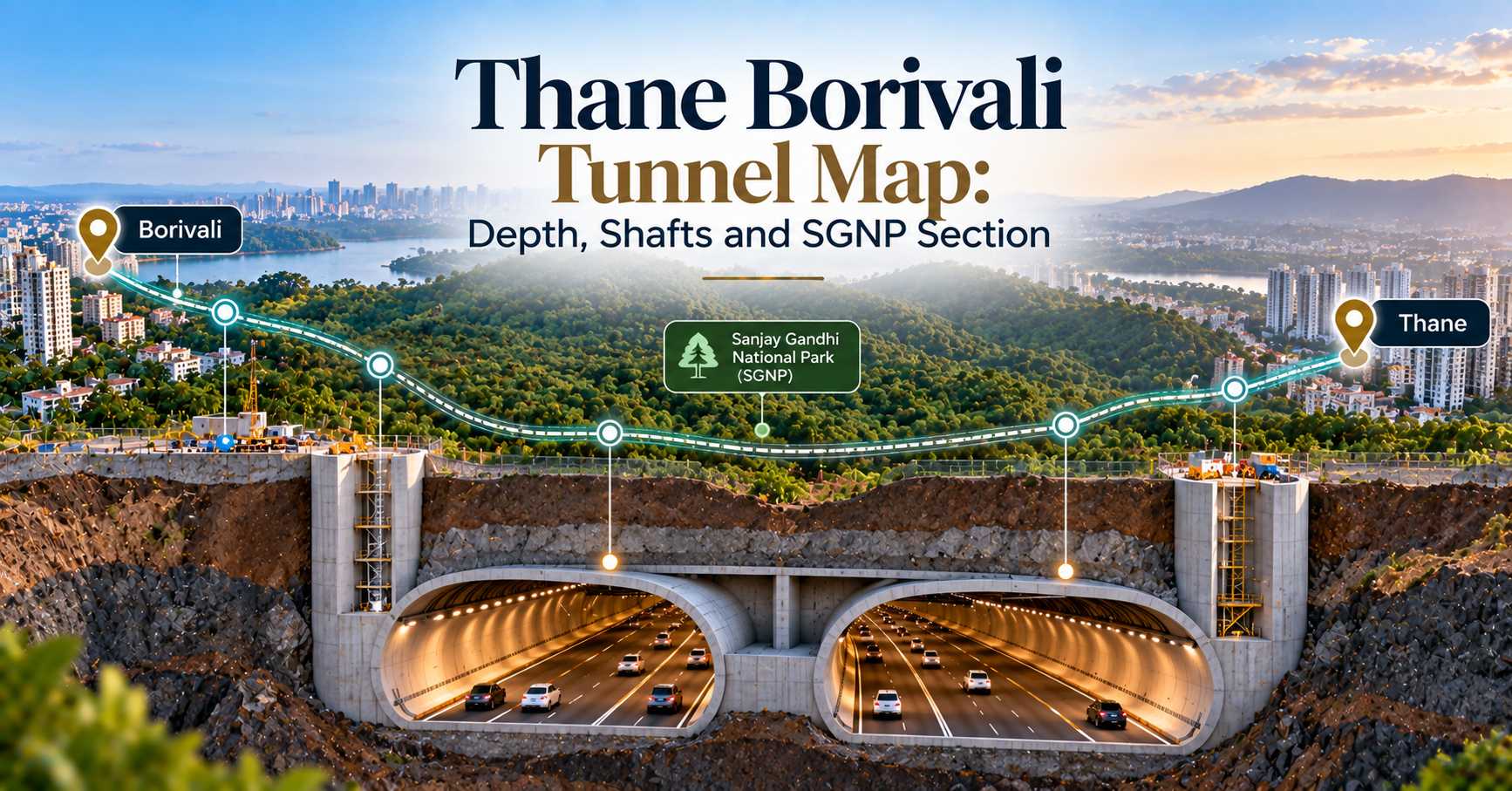
| Depth below surface | 23 m to 60 m | Deep enough to leave SGNP’s eco-sensitive zone untouched |
| Cross passages | Every 300 m | Escape route from one tube to the other in an emergency |
| Project cost | Around Rs 20,000 crore | One of MMRDA’s largest single road contracts |
| Implementing agency | MMRDA | Construction by Megha Engineering and Infrastructure Ltd |
The depth range is the detail most people miss. At 23 metres the tunnel is shallow enough that the Borivali approach needed surface clearance work — over 500 structures were cleared on the Borivali side by February 2026. At 60 metres, under the deepest part of the park ridge, the tunnel is far below anything that could disturb forest hydrology, which is how the project cleared its environmental objections.
Reading the Map from the Borivali End
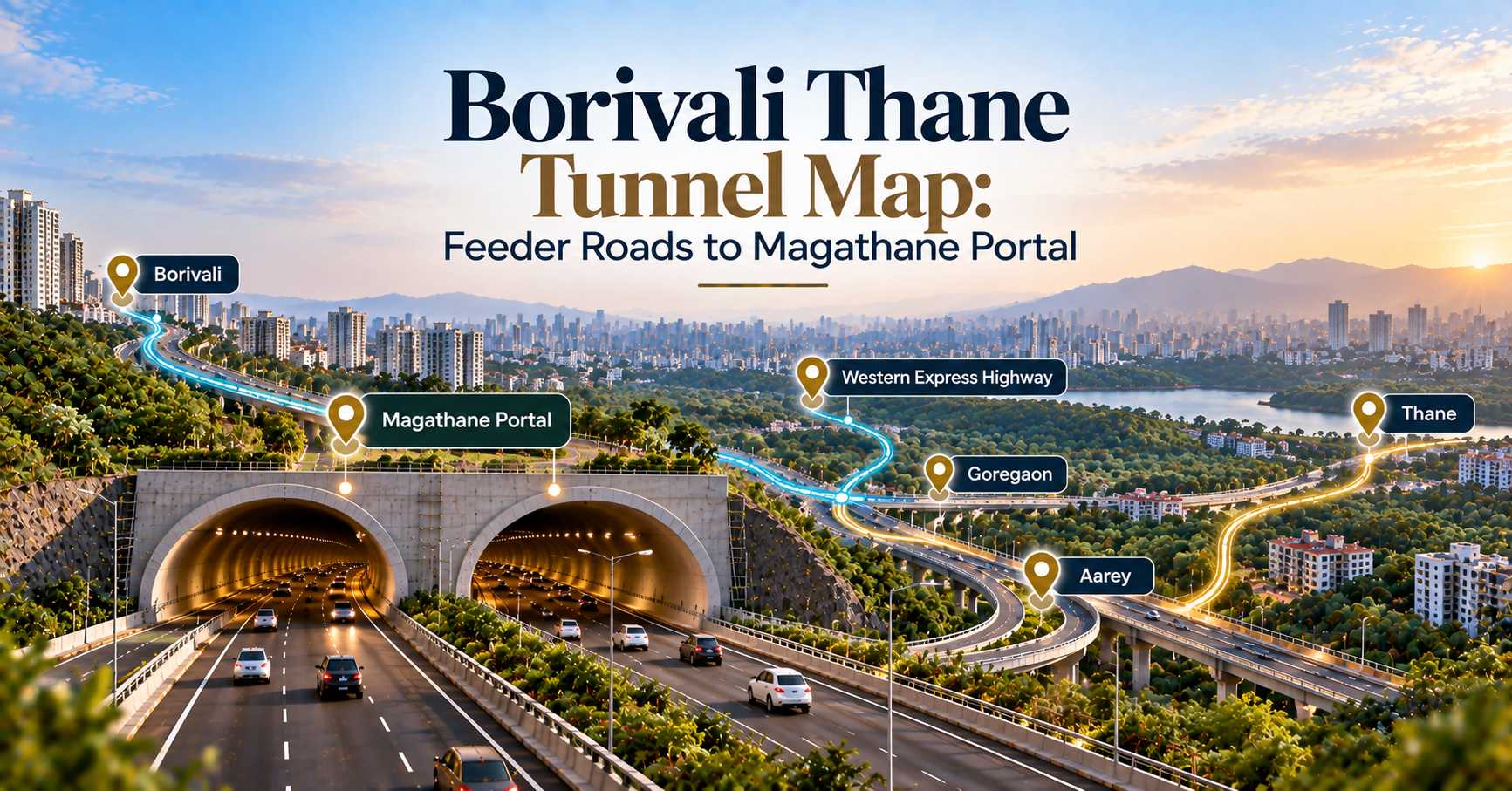
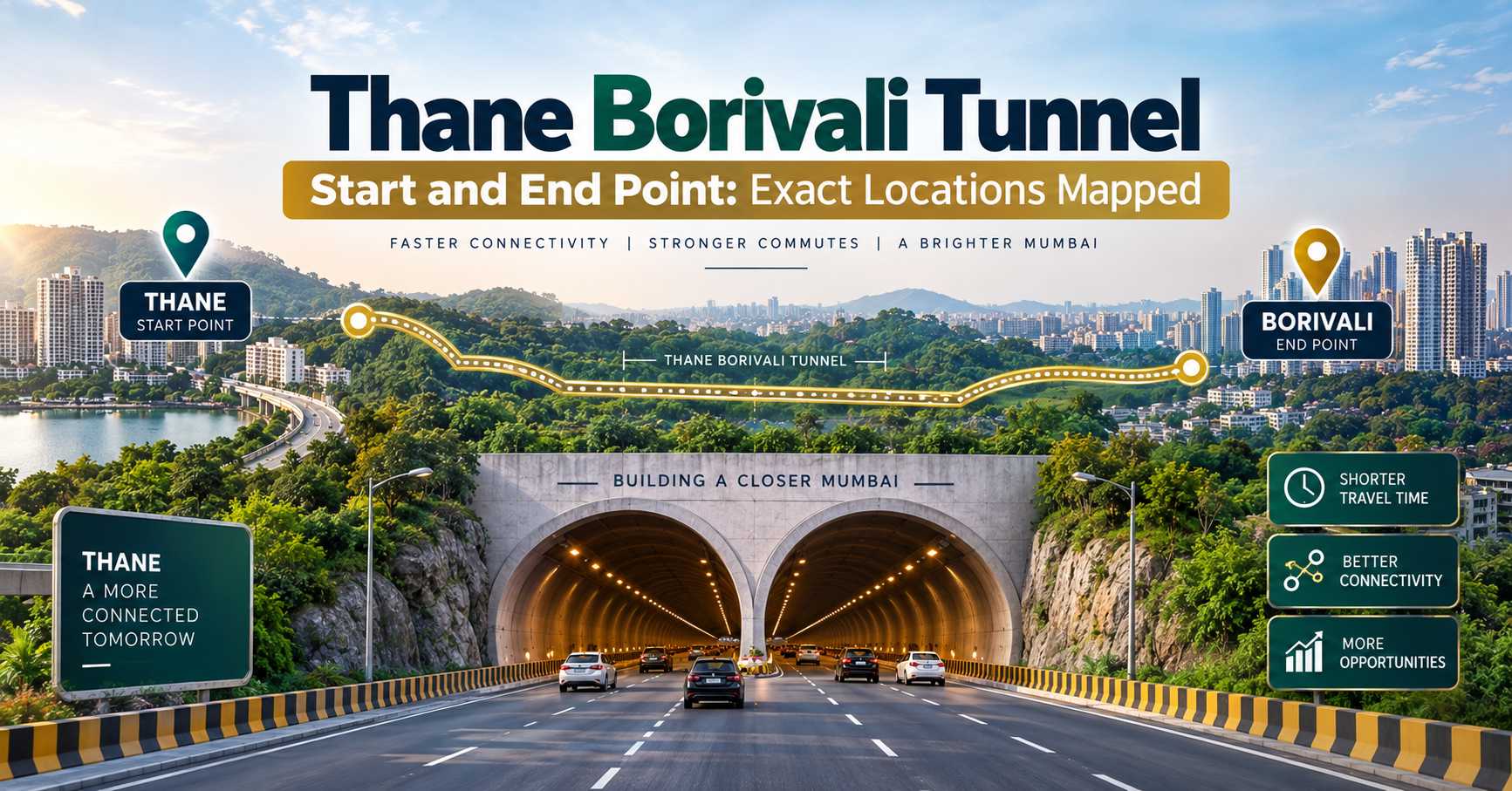
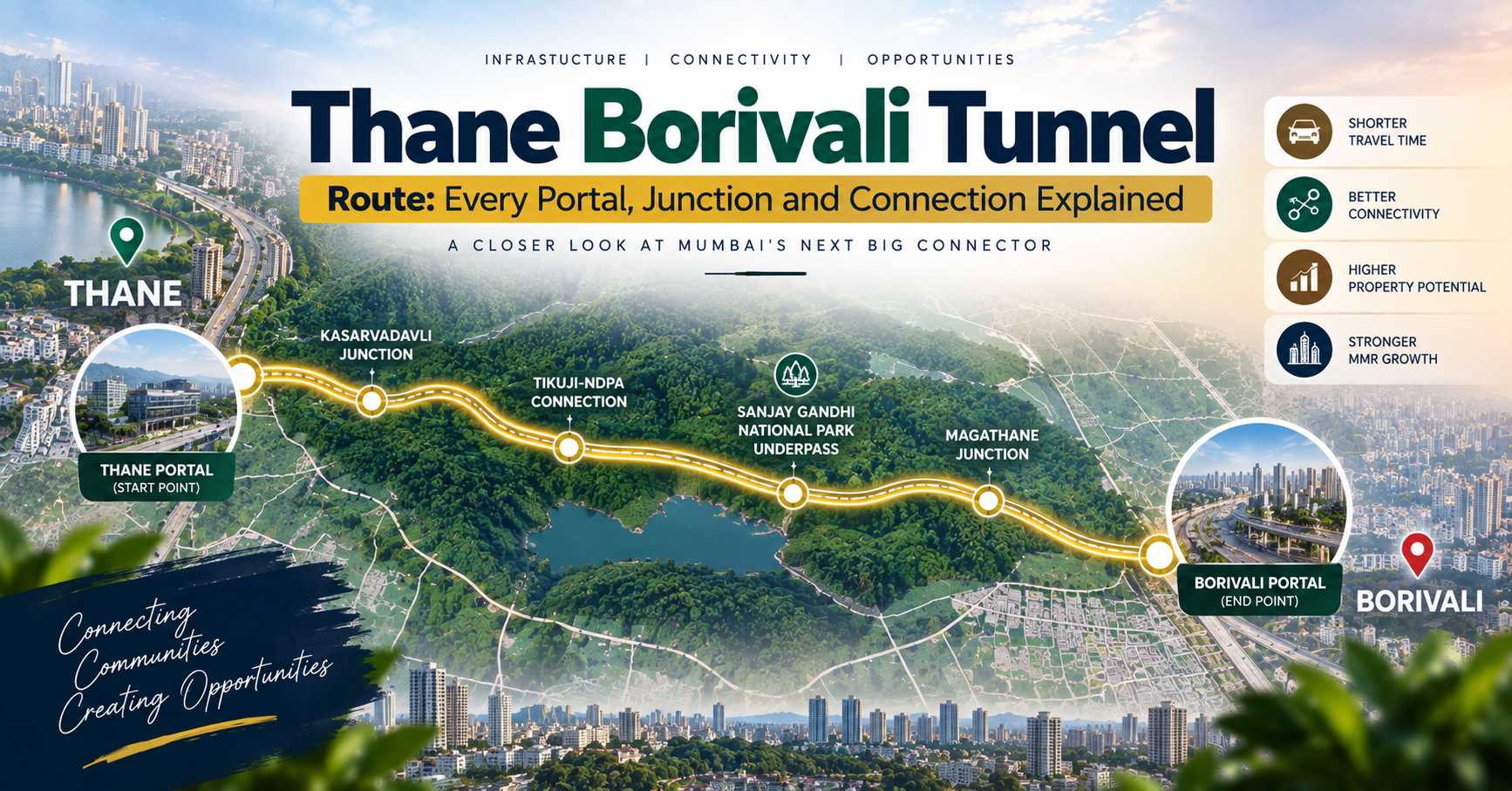
Start where most Mumbai drivers will: the Western Express Highway. The Borivali portal sits near Magathane, in the Ekta Nagar pocket of Borivali East, where the tunnel’s approach road ties directly into the WEH carriageway. This is the same stretch served by Magathane metro station on Line 7, which means the portal area will carry both a metro node and a tunnel mouth within walking distance of each other.
From that portal the alignment turns east and immediately begins descending under the western flank of Sanjay Gandhi National Park. There are no intermediate exits inside the tunnel — this is a point-to-point link, not a road with slip roads. Once you enter at Magathane the next daylight you see is Thane.
- Borivali portal locality: Magathane / Ekta Nagar, Borivali East
- Tie-in road: Western Express Highway, northbound and southbound carriageways
- Nearest metro: Magathane station, Mumbai Metro Line 7
- Nearest rail: Borivali station on the Western Line, roughly 3 km west
- Surface impact: 500-plus structures cleared for the approach corridor as of February 2026
- Residential catchment: Borivali East, Magathane, Dattapada, and the Kandivali East belt just south
For buyers, the practical consequence is that Kandivali East and Borivali East stop being “end of the western suburbs” and start being the western gateway to Thane. Borivali East currently trades around Rs 32,150 per sq ft with an 11.2% year-on-year move, and the Western Express Highway frontage specifically averages closer to Rs 28,794 per sq ft as of August 2026. Kandivali East, one stop south, sits at about Rs 30,950 per sq ft — a corridor where projects like Godrej Nest in Kandivali East already sit inside the tunnel’s drive-time catchment.
Reading the Map from the Thane End
The Thane portal is the more contested half of the alignment, and the one that changed most recently. The tunnel surfaces on Ghodbunder Road near Tikuji-ni-Wadi, in the Manpada belt of Thane West. After residents raised concerns about dust, noise and construction traffic in a dense residential pocket, MMRDA shifted the portal roughly 225 metres further along the alignment, towards the Satyashankar wall boundary.
That 225-metre shift is a small number on a drawing and a large number in a valuation. It moved the heaviest construction and future portal traffic away from several residential clusters that would otherwise have sat directly at the tunnel mouth — a reminder that on this corridor, micro-location beats macro-narrative.
From the Thane portal the approach road feeds onto Ghodbunder Road, which is already the spine connecting Thane West to the Ahmedabad highway at Fountain Hotel junction. Ghodbunder currently averages about Rs 15,000 per sq ft across a wide Rs 11,000 to Rs 20,000 band, and the segment has had a soft three years — down 13.5% over that period — which is precisely why the infrastructure pipeline matters here.
Why the Thane end carries more upside
Borivali East already prices in Mumbai-city access. Ghodbunder Road does not yet price in Borivali access. When the tunnel opens, the Thane side gains a connection it never had, while the Borivali side gains a faster version of a connection it partly had. The gap between Rs 15,000 and Rs 32,150 per sq ft is where that repricing plays out.
What the Tunnel Runs Under — and Why It Matters
Between the two portals the alignment passes beneath the southern portion of Sanjay Gandhi National Park. This is hard basalt rock, which is both good news and bad news. Good, because hard rock is stable and does not need the constant settlement monitoring that soft-ground tunnelling under built-up Mumbai demands. Bad, because hard rock is slow to cut — which is why MMRDA commissioned some of the largest hard-rock machines ever deployed on an Indian urban project.
TBM Nayak, launched in April 2026 and described as the country’s largest single-shield hard rock TBM for an urban tunnel, is boring from the Thane side towards Borivali. A second machine, Arjuna, was being assembled through 2026 to drive the parallel tube. Herrenknecht is the machine supplier, with a total of four mega TBMs planned across the drives. For the full machine-by-machine picture, our tunnel status and TBM progress tracker follows each breakthrough as it is announced.
The alignment’s depth profile is deliberately designed so the tunnel never enters the eco-sensitive zone of SGNP. This is the legal basis on which the project proceeded, and it is also why there is no mid-park ventilation shaft cluster of the kind you see in European mountain tunnels. Ventilation is handled from the portal ends, with cross passages every 300 metres providing the emergency egress path between tubes.
Five Things to Check Before You Buy on This Corridor
The map is public. Turning it into a buying decision takes a little more work. Our team walks every client through the same five checks.
- Measure the actual portal distance, not the locality name. “Near the tunnel” is a marketing phrase. Pull up the MMRDA alignment, drop a pin on your project, and measure. Anything beyond 3 km from a portal is buying the corridor story, not the corridor access.
- Check which side of Ghodbunder Road the project sits on. The portal feeds one carriageway more conveniently than the other. A U-turn adds 10 minutes at peak hour and permanently affects daily commute quality.
- Verify the MahaRERA registration and its completion date against 2028. If a project’s RERA possession date lands in 2029 or 2030, you are buying the tunnel benefit at day one of occupancy, not waiting for it. That is a better trade than it sounds.
- Ask about construction-phase disruption. Year-long traffic diversions around the work sites were notified from mid-May. If your project’s access road is a diversion route, factor two to three difficult years into your rental or self-use plan.
- Compare against the metro timeline separately. Metro Line 4 from Wadala to Kasarvadavali is a different asset serving a different trip. Do not double-count the two infrastructure stories into one price expectation.
What This Means for Godrej Projects Across the Corridor
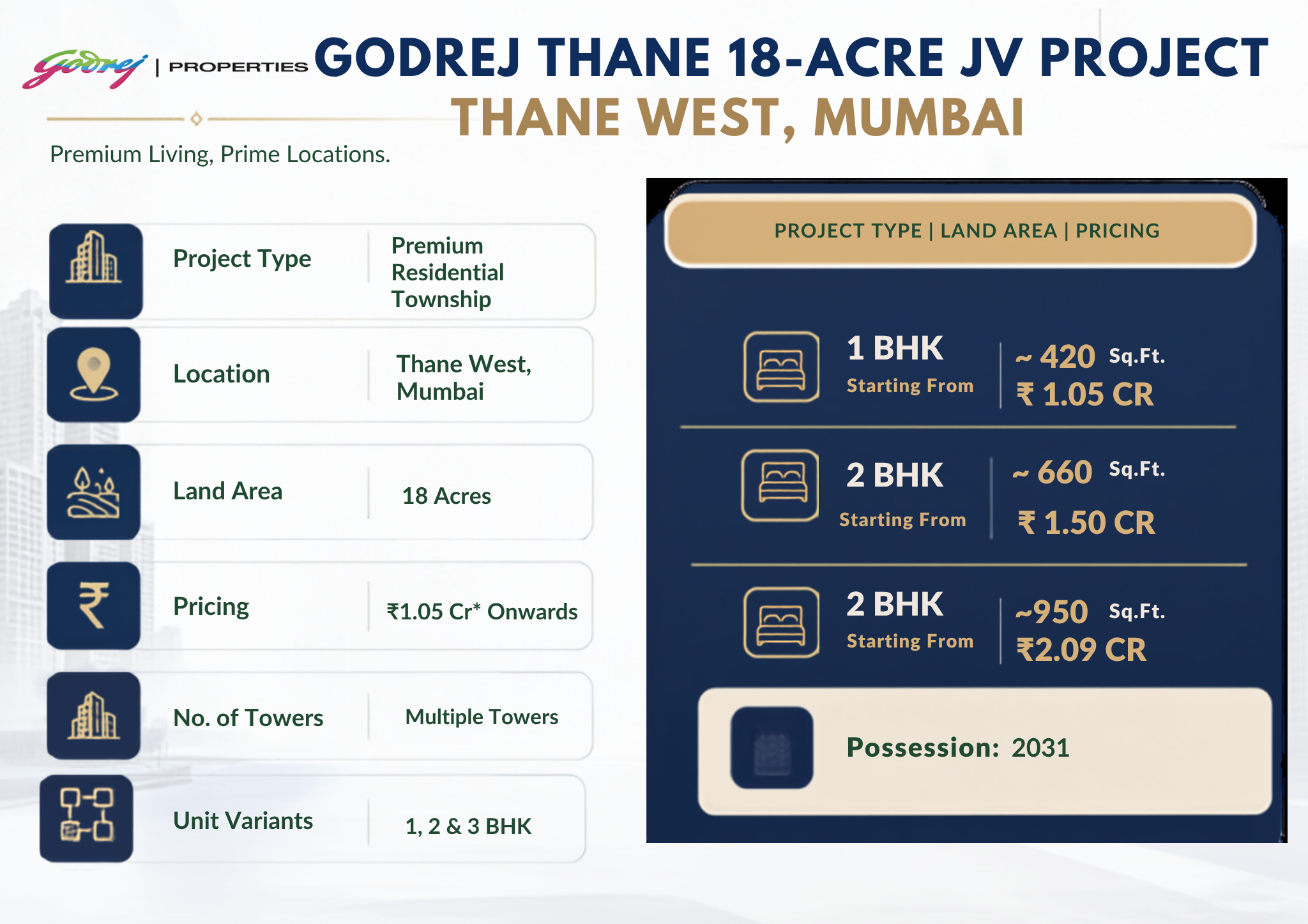
Godrej Properties Limited, the third-party developer behind the projects we track, has an unusually symmetric position on this alignment — land on both sides of the park. On the Mumbai end that means the Kandivali East cluster, within the WEH catchment that feeds the Magathane portal. On the Thane end it means the Ghodbunder Road belt itself, where the 18.5-acre Ghodbunder Road township sits on the corridor the Thane portal feeds directly into.
That symmetry is the useful part. A buyer weighing Borivali against Thane today is really weighing Rs 30,000-plus per sq ft against Rs 15,000 per sq ft for broadly comparable build quality, with the difference being connectivity that a 2028 tunnel is designed to close. You can read more about the developer’s MMR portfolio at Godrej Properties Limited.
Our verdict: the alignment favours whoever buys the cheaper side of the hill before the connection exists. That is the whole trade, and the map makes it legible.
Frequently Asked Questions
Q: How long is the Borivali to Thane tunnel road map in total?
The full project length is 11.84 km, of which roughly 10.25 km is bored twin tunnel under Sanjay Gandhi National Park. The remaining distance is approach roads and portal structures, totalling about 1 km split across the Borivali and Thane ends.
Q: Where exactly does the tunnel start and end?
The Borivali end surfaces at the Western Express Highway near Magathane in the Ekta Nagar area of Borivali East. The Thane end surfaces on Ghodbunder Road near Tikuji-ni-Wadi in Manpada, with the portal shifted about 225 metres after resident representations.
Q: Are there any exits inside the tunnel?
No. It is a point-to-point link with no intermediate entry or exit. Once you enter at one portal, the next surface point is the other portal. Cross passages every 300 metres connect the two tubes but are for emergency evacuation only, not for vehicle turning.
Q: How deep does the tunnel run under the national park?
Between 23 and 60 metres below the surface, depending on the terrain above. The depth profile was designed specifically so the alignment never enters the eco-sensitive zone of SGNP, which was the condition on which environmental clearance proceeded.
Q: How much travel time will the tunnel actually save?
MMRDA projects a drop from the current 60 to 90 minutes down to roughly 15 to 20 minutes. The saving comes from eliminating the detour around the national park rather than from higher speeds, which makes it relatively robust to traffic growth.
Q: Will the tunnel be tolled?
MMRDA has not published a toll schedule as of September 2026. Comparable MMRDA-built links in the region operate on a user-fee basis, so a toll is widely expected, but any figure quoted today is speculation. [VERIFY: not sourced]
Q: When is the tunnel expected to open?
The official target is mid-2028, with TBM Nayak expected to reach Borivali by 2028. Physical progress stood at 8.19% as of 31 August 2025. Independent observers flag a possible slip into 2029 depending on monsoon interruptions and rock conditions.
The Practical Takeaway
The alignment is settled, the machines are in the ground, and the two portal locations are now specific enough to buy against. What separates a good purchase from an average one on this corridor is not conviction about the tunnel — that is already consensus — but precision about distance from the portal, carriageway orientation, and possession timing relative to 2028.
If you are weighing a specific project on either side of the park, our team can map it against the published alignment and tell you honestly whether it sits inside the catchment or just inside the marketing radius. Book a site visit on the Ghodbunder Road corridor or the Kandivali East cluster and we will walk the drive-time with you.