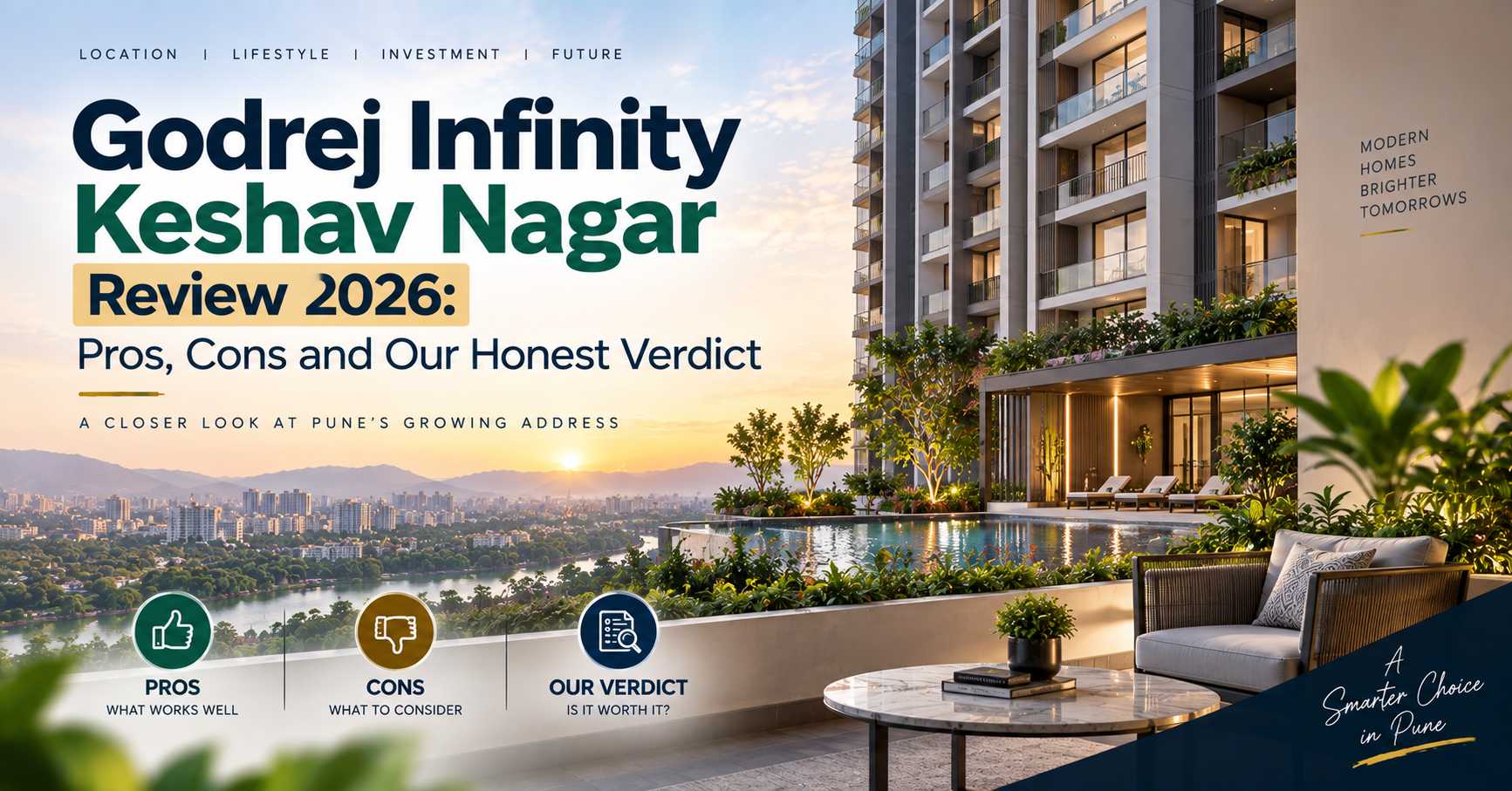
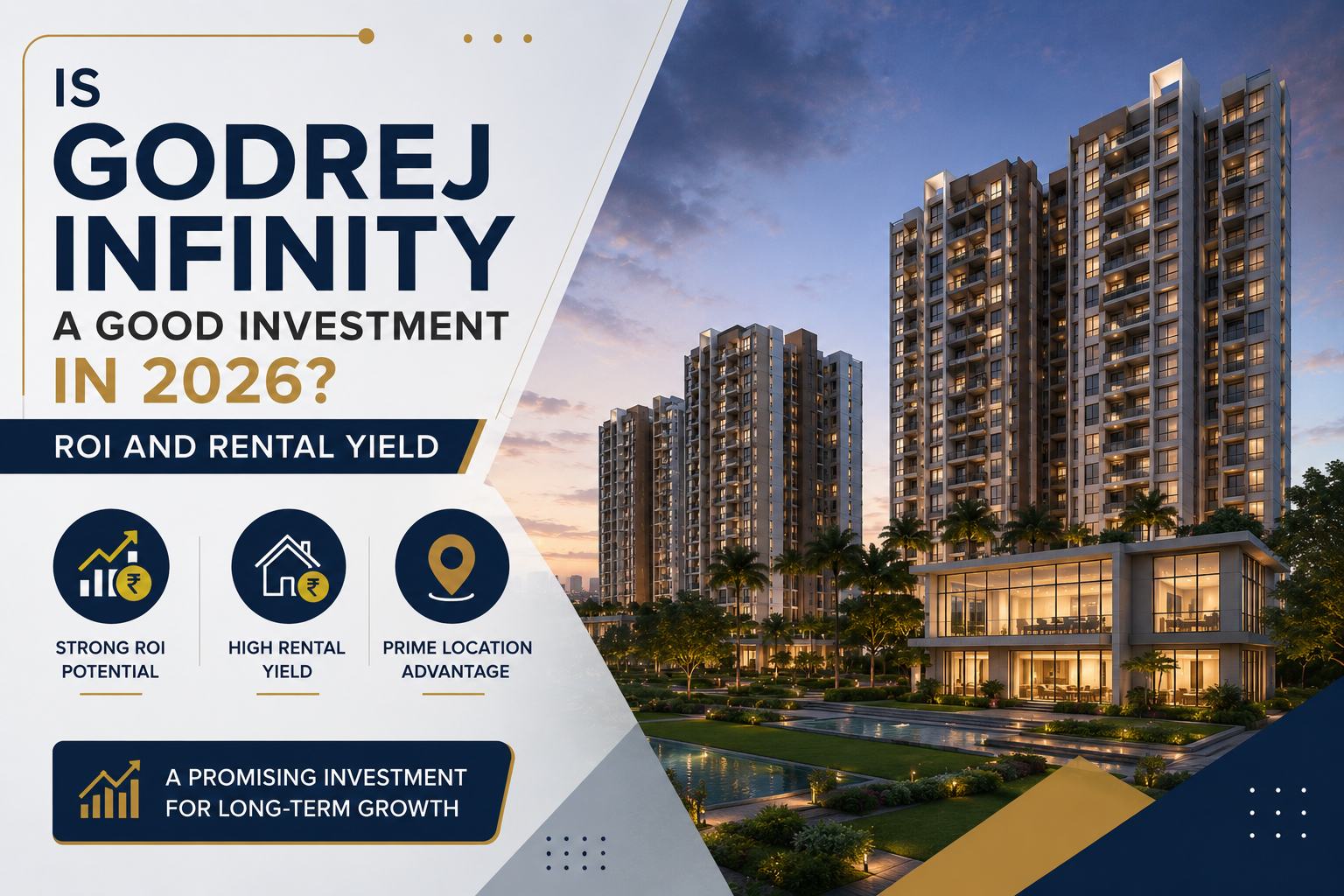
Godrej Infinity is a solid yield-plus-stability buy in 2026, not a quick-flip play.
RERA: P52100003129 | Ready to Move | Builder: Godrej Properties Limited | Our Rating: 4.4/5
Our Verdict: A delivered riverfront township at ₹12,000–14,000/sqft offers day-one rent and a deep resale market for steady returns. The risk is East Pune’s heavy supply pipeline, which keeps capital appreciation steady rather than explosive.
The question on every investor’s mind is simple: is a godrej infinity investment worth your capital in 2026? This guide answers it with numbers, not adjectives. Built by Godrej Properties Limited in Keshav Nagar, Mundhwa, East Pune (411036), Godrej Infinity is a ready-to-move township under RERA P52100003129, with 2 BHK homes starting near ₹80 lakh and rates between ₹12,000 and ₹14,000 per sqft. Because the project is delivered, your money starts working from possession day rather than after a two-year construction wait.
Across this post our team breaks down rental yield, capital appreciation, exit liquidity and the supply-side caveat that every East Pune buyer should weigh. We have priced the trade-offs honestly so you can decide whether this asset matches your goals, whether you are an end-user who wants a roof first and returns second, or a pure investor chasing the highest internal rate of return.
1. Why Godrej Infinity Is on Every Investor’s Shortlist
Godrej Infinity sits on roughly 43 acres (42.95 to be exact) along the Mula-Mutha riverfront, a configuration that is rare for delivered stock in East Pune. The registered phase carries 1,204 homes within a wider development of 18 towers rising to 24 floors each, with 2 and 3 BHK configurations available today and carpet areas spanning 504 to 1,582 sqft. Scale matters for investors because a large, single-developer township produces a deep, comparable resale and rental pool rather than a thin, illiquid set of units.
The strongest investment argument here is timing of cash flow. A ready-to-move asset earns rent from month one, while an under-construction competitor at the same ticket sits idle and consumes EMI for 24 to 36 months before a single rupee of rent arrives. On an ₹80 lakh 2 BHK, that head start can equal ₹5–8 lakh of rent that an under-construction buyer simply forfeits during the build period.
Zero construction risk is the second pillar. The completion and occupancy certificates are in hand, with possession running from roughly 2019–2020, so there is no delivery-delay risk, no escrow worry and no half-finished amenity. All 45-plus amenities, from the clubhouse, swimming pool and gymnasium to the jogging and cycling tracks, are operational today, which directly supports the rent a tenant will pay and the price a resale buyer will accept.
For a fuller qualitative picture of what works and what does not, our team’s Godrej Infinity review for 2026 covers the pros and cons in detail. This investment guide instead stays focused on returns, yield and exit.
2. The Builder Behind the Numbers
An investment is only as durable as the company that built it. Godrej Properties Limited (NSE: GODREJPROP) was founded in 1990 and listed in 2010, and it has delivered 300-plus projects spanning more than 250 million sq ft across 12-plus cities. That track record matters to resale buyers, who pay a premium for a recognised, IGBC-certified developer over an unknown local builder.
Brand equity translates directly into liquidity. When you list a Godrej-built unit, the buyer pool is wider because the name reduces perceived risk, which shortens time-on-market and protects your exit price. In a supply-heavy micro-market like East Pune, that brand pull is the difference between a six-week sale and a six-month wait.
Godrej Properties Limited also brings governance discipline to documentation, society formation and title clarity, the unglamorous factors that quietly destroy returns when they go wrong. For an investor, clean paperwork on a delivered, RERA-registered asset (P52100003129) is not a luxury; it is what makes a fast, clean resale possible.
3. Godrej Infinity Investment Snapshot
Before modelling returns, it helps to fix the core numbers in one place. The table below summarises the figures our team uses for every yield and appreciation calculation in this guide. Each row reflects current market data for the Keshav Nagar micro-market and the project itself.
| Metric | Figure | Investor Relevance |
|---|---|---|
| Entry rate | ₹12,000–₹14,000/sqft | Mid-band for delivered East Pune stock |
| 2 BHK ticket | From ₹80 lakh | Core rental-demand segment |
| 3 BHK ticket | From ~₹1.30 Cr | Family tenants, lower churn |
| Gross rental yield | ~3–3.5% | Steady, salaried-tenant backed |
| Portal price move (1 yr) | ₹11,800 → ₹14,050/sqft (~19%) | Recent listed-price momentum |
| Resale liquidity | 33+ resale listings live | Deep, active exit market |
Read this snapshot as a balance sheet of trade-offs. The ~19% portal rise signals genuine momentum, but it is a listed-price indicator and tends to run ahead of transacted appreciation; the steadier 3–3.5% yield is the figure you can bank on monthly. Together they describe an asset built for total return over a five-to-seven-year hold rather than a 12-month flip.
4. Price Trend and Market Analysis
East Pune pricing is best understood as a ladder. Keshav Nagar, where Infinity sits, runs ₹11,000–14,000/sqft; the more established Kharadi and Magarpatta belt commands ₹13,000–16,000; and the developing Wagholi and Manjari fringe sits at ₹9,000–11,000. Infinity’s ₹12,000–14,000 band places it at the upper end of its own micro-market but at a discount to the premium Kharadi corridor, which is the value sweet spot our team likes for resale upside.
The portal average for the project moved from ₹11,800 to ₹14,050/sqft over the past year, a roughly 19% rise. That number is encouraging but must be read with discipline: asking prices on portals lead actual transaction prices, so treat 19% as the optimistic ceiling and the broader ~15–25% cumulative appreciation over recent years as the realistic medium-term band.
| Micro-market | Rate (₹/sqft) | Stage | Investor Note |
|---|---|---|---|
| Kharadi / Magarpatta | 13,000–16,000 | Established IT belt | Premium, lower entry upside |
| Keshav Nagar (Infinity) | 11,000–14,000 | Delivered, maturing | Value gap vs Kharadi |
| Wagholi / Manjari | 9,000–11,000 | Developing fringe | Cheaper, higher supply risk |
| Comparable delivered stock | 11,000–13,500 | Mixed developers | Infinity sits in-line to top |
The single biggest caveat for a flipper: East Pune carries a heavy new-supply pipeline. Continuous fresh launches in Wagholi, Manjari and Kharadi cap how fast delivered prices can climb, which is why our verdict on appreciation is “steady, not explosive.”
That supply caveat is not a reason to avoid the asset; it is a reason to set the right time horizon. Buyers who underwrite a 5–7 year hold and value the day-one rent will be comfortable. Buyers who need 30%+ appreciation in 18 months should look elsewhere. For a side-by-side on how this plays against the obvious local rival, see our Godrej Infinity versus Amanora Park Town comparison.
5. Rental Yield Deep Dive
Rental income is the most predictable part of this investment. East Pune 2 BHK units rent for ₹22,000–32,000 per month, drawing from a deep salaried tenant pool employed across Magarpatta, Kharadi EON IT Park and Hadapsar. On an ₹80 lakh 2 BHK, a ₹24,000–28,000 monthly rent produces a gross yield of roughly 3–3.5%, in line with Pune’s residential norm.
The cash-flow timing is where Infinity’s ready status pays off. Consider an ₹80 lakh purchase with 20% down and an 8.5% loan over 20 years, giving an EMI near ₹55,000 per month. Rent of ₹24,000–28,000 covers roughly half of that EMI from day one, so your effective monthly outflow is materially lower than an under-construction buyer who pays full EMI with zero offsetting rent for years.
Tenant quality also protects the yield. Operational amenities, a riverfront setting and a Godrej-built address attract corporate tenants and families who renew rather than churn, reducing vacancy gaps that quietly erode real-world returns. Lower churn and faster re-letting are why a 3–3.5% headline yield on this asset tends to be a 3–3.5% realised yield, not a number eroded by empty months.
One honest limitation: at ~3–3.5%, rental yield alone will not beat a fixed deposit. The investment case only works when you stack yield on top of capital appreciation and the leverage benefit of a home loan, which is exactly how the next section frames the total return.
6. Projected Returns and Exit
Total return here is a three-part stack: rental yield, capital appreciation and exit liquidity. The table below models an illustrative ₹80 lakh 2 BHK over a five-year hold using the project’s own data points, including the conservative ~15–25% cumulative appreciation band rather than the optimistic 19% one-year portal figure.
| Return Component | Conservative | Optimistic |
|---|---|---|
| Capital appreciation (5 yr) | ~15% | ~25% |
| Gross rental yield (annual) | ~3.0% | ~3.5% |
| Day-one rent advantage | ~₹5 lakh | ~₹8 lakh |
| Exit time-on-market | Weeks (deep resale) | Faster on Godrej brand |
| Construction / delivery risk | Nil (delivered) | Nil (delivered) |
Exit liquidity is the quietly decisive factor. With 33-plus resale listings already live, Infinity has a proven, active secondary market, so when you choose to sell you are entering a known channel rather than discovering whether one exists. A delivered, branded, large-township unit is among the easier residential assets to exit in East Pune.
Our team’s read: a flipper should expect steady, not explosive, gains because of the supply pipeline; an end-user-first buyer who values day-one rent, zero construction risk and a deep exit market gets the best of this asset. Match the asset to the right time horizon and it performs.
7. Who Should Buy and Who Should Not
This asset suits three investor profiles. First, the end-user who buys to live and lets returns accrue passively over 5–7 years, capturing both use-value and the ~15–25% appreciation band. Second, the yield-focused investor who wants a stable 3–3.5% rent from a deep salaried tenant pool with low vacancy risk. Third, the brand-and-liquidity buyer who prioritises a clean, fast exit over maximum upside.
It suits one profile poorly: the short-horizon flipper expecting rapid double-digit appreciation inside 18 months. East Pune’s supply pipeline caps that ambition, and the ~19% portal rise should not be mistaken for guaranteed transacted gains over such a short window. For that strategy, an under-construction launch in an earlier-cycle micro-market may fit better.
If you want under-construction exposure within the same East Pune story, our team also tracks Godrej Sky Greens in Manjari Khurd, which carries a lower entry ticket in exchange for delivery-timeline risk. Pairing a delivered asset with an under-construction one is a sensible way to balance day-one rent against early-cycle appreciation.
8. Our Verdict on a Godrej Infinity Investment
Weighing the numbers, our team rates Godrej Infinity 4.4 out of 5 as a 2026 investment. The combination of day-one rent, a 3–3.5% yield, ~15–25% medium-term appreciation, an ₹12,000–14,000/sqft entry that discounts the Kharadi premium, and a deep 33-plus-listing resale market produces a dependable total-return profile. The asset rewards patience and punishes impatience.
The honest downside is appreciation velocity. The East Pune supply pipeline means prices climb steadily rather than spiking, so anyone underwriting explosive short-term gains will be disappointed. Set against a 5–7 year hold, however, that steadiness reads as low-volatility safety rather than a weakness.
For full pricing, configuration and possession details before you commit, review the official Godrej Infinity listing. If your priorities are steady yield, zero construction risk and a clean exit, this is a buy; if you need a fast flip, it is a pass.
Frequently Asked Questions
Q. What rental yield can I expect from Godrej Infinity in 2026?
Gross rental yield runs about 3–3.5%. On an ₹80 lakh 2 BHK, East Pune rents of ₹22,000–32,000 per month deliver this steady, salaried-tenant-backed return, with rent starting from day one because the project is ready to move.
Q. How much capital appreciation is realistic?
Plan for roughly 15–25% cumulative appreciation over recent-cycle horizons. Portal asking prices rose about 19% in the past year (₹11,800 to ₹14,050/sqft), but listed prices lead transacted prices, so treat 19% as the optimistic ceiling, not a guarantee.
Q. Why does ready-to-move matter for returns?
A delivered asset (RERA P52100003129) earns rent immediately and carries zero construction or delivery risk. That day-one rent can equal ₹5–8 lakh over a two-to-three-year build window that an under-construction buyer simply loses while paying full EMI.
Q. Is it easy to exit a Godrej Infinity unit?
Yes. With 33-plus resale listings already live and a recognised Godrej Properties Limited brand, the secondary market is deep and active, which shortens time-on-market and helps protect your exit price compared with a thinly traded project.
Q. What is the main risk for an investor here?
The heavy East Pune new-supply pipeline. Continuous launches in Wagholi, Manjari and Kharadi keep delivered-stock appreciation steady rather than explosive, so this asset suits a 5–7 year hold far better than a short 12–18 month flip.