
Quick Answer
Related Godrej projects nearby:
Godrej Bandra Reclamation — Sea-Facing 4 BHK, Mumbai →Godrej Trilogy – Worli, Mumbai →Godrej Horizon – Wadala Mumbai →
If you sell a Mumbai flat after holding it for more than 24 months, the gain is long-term and taxed at 12.5% without indexation. If you are a resident and bought the flat before 23 July 2024, you can instead pay 20% with indexation, whichever is lower. Reinvesting in a house or in notified bonds can cut the tax to zero.
Capital gains tax on property is the single biggest cost most Mumbai sellers face, and in 2026 it is worth getting right. Mumbai logged 80,221 property registrations in the first half of 2026, its best half-year since 2013 according to Knight Frank India, and a large share of those were resale deals. Average asking prices in the city reached about Rs 38,600 per sq ft by March 2026, per Square Yards. A flat bought ten years ago at Rs 12,000 to Rs 15,000 per sq ft can now carry a gain of a crore or more.
The rules also changed twice in quick succession. The July 2024 Budget cut the long-term rate to 12.5% and removed indexation, then added a choice for older property. From 1 April 2026, the new Income-tax Act, 2025 replaced the 1961 Act, renumbering familiar sections. The Cost Inflation Index (CII) for FY 2026-27 was notified at 384 on 15 July 2026, up from 376.
We at Godrej Properties MMR see sellers lose lakhs by picking the wrong tax option or missing a reinvestment deadline. This guide covers the holding period, the two tax routes, a worked example for a Mumbai flat sale, and how Section 54, 54EC and 54F exemptions and the capital gains account scheme can bring the bill down.
Capital Gains Tax on Property: Short-Term vs Long-Term in 2026
Everything starts with the holding period. For land and buildings, including flats, the line is 24 months. Sell within 24 months of buying and the profit is a short-term capital gain, added to your income and taxed at your slab rate, which can be 30% plus surcharge and cess. Sell after 24 months and it is a long-term capital gain (LTCG), taxed at a flat rate.
The date you count from matters. For a ready flat it is normally the registration date of your purchase agreement. For an under-construction flat bought from a developer, tribunals have often counted from the allotment letter date rather than possession, but this is fact-specific [VERIFY: confirm position with your CA].
| Situation | Holding period | Tax rate | Indexation |
|---|---|---|---|
| Sold within 24 months | Short-term | Your slab rate | Not applicable |
| Bought on or after 23 July 2024, sold after 24 months | Long-term | 12.5% | Not allowed |
| Bought before 23 July 2024, resident individual or HUF | Long-term | Lower of 12.5% (no indexation) or 20% (with indexation) | Optional |
| Bought before 23 July 2024, NRI seller | Long-term | 12.5% | Not allowed |
Add 4% health and education cess to every rate above. A surcharge of 10% to 15% also applies if your total income, including the gain, crosses Rs 50 lakh or Rs 1 crore. On a large Mumbai sale, that pushes the effective long-term rate on the 12.5% route to about 14.95%.
Buyers also deduct TDS of 1% when the sale value is Rs 50 lakh or more for a resident seller. This is an advance payment, not the final tax. You settle the balance when you file your return.
12.5% Without Indexation or 20% With Indexation
Indexation raises your purchase cost in line with inflation, using the CII. The formula is simple: indexed cost = purchase cost x (CII of the year of sale / CII of the year of purchase). With FY 2026-27 at 384, a flat bought in FY 2015-16 (CII 254) gets its cost raised by about 51%, and one bought in FY 2005-06 (CII 117) gets its cost more than tripled.
The 20% route therefore taxes a smaller gain at a higher rate. The 12.5% route taxes the full nominal gain at a lower rate. Which one wins depends on how fast your flat appreciated compared with inflation. As a rough guide, flats held for a long time, or flats in micro-markets that rose slowly, tend to favour indexation. Flats that doubled or tripled in a decade tend to favour 12.5%.
A Business Today analysis in July 2026 made the point plainly: the new 12.5% rate does not always reduce your tax bill. For older property, resident sellers should compute both and pay the lower figure.
Two limits apply. The choice exists only for resident individuals and HUFs, and only for land or buildings acquired before 23 July 2024. NRIs selling Mumbai property pay 12.5% without indexation, and the buyer must deduct TDS on the full long-term rate. NRI sellers should also plan for repatriation limits under FEMA before they sign.
Worked Example: Capital Gains on a Mumbai Flat Sale
Here are two cases, both sold in FY 2026-27 by a resident individual. In each, we assume 1% brokerage as the transfer expense. Figures are before cess and surcharge.
Case A: a 2 BHK in the western suburbs bought in FY 2015-16 for Rs 80 lakh and sold for Rs 2.10 crore. Case B: a 1 BHK in the central suburbs bought in FY 2005-06 for Rs 30 lakh and sold for Rs 1.50 crore.
| Step | Case A: 12.5% | Case A: 20% indexed | Case B: 12.5% | Case B: 20% indexed |
|---|---|---|---|---|
| Sale value | Rs 2,10,00,000 | Rs 2,10,00,000 | Rs 1,50,00,000 | Rs 1,50,00,000 |
| Less brokerage (1%) | Rs 2,10,000 | Rs 2,10,000 | Rs 1,50,000 | Rs 1,50,000 |
| Cost used | Rs 80,00,000 | Rs 1,20,94,488 (x 384/254) | Rs 30,00,000 | Rs 98,46,154 (x 384/117) |
| Taxable gain | Rs 1,27,90,000 | Rs 86,95,512 | Rs 1,18,50,000 | Rs 50,03,846 |
| Tax before cess | Rs 15,98,750 | Rs 17,39,102 | Rs 14,81,250 | Rs 10,00,769 |
In Case A, the flat grew faster than inflation, so the 12.5% route is cheaper by about Rs 1.4 lakh. In Case B, the long holding period makes indexation worth about Rs 4.8 lakh. With 4% cess, the tax payable is roughly Rs 16.6 lakh in Case A and Rs 10.4 lakh in Case B.
Our verdict: never assume. Run both calculations for any flat bought before 23 July 2024, and keep the purchase agreement, stamp duty receipt and improvement bills ready. Stamp duty and registration paid at purchase form part of your cost. Our ready reckoner rates 2026-27 guide explains why the sale value also cannot be lower than the stamp duty value in most cases.
Section 54, 54EC and 54F: How to Save the Tax
Most sellers who move up to a bigger home pay little or no capital gains tax on property, because the law rewards reinvestment. The three main exemptions work differently. Note that from 1 April 2026 the Income-tax Act, 2025 renumbers them (old Section 54 is now Section 82), but the substance has largely carried over [VERIFY: new section numbers for 54EC and 54F].
| Exemption | What you sell | Where you reinvest | Time limit | Limit |
|---|---|---|---|---|
| Section 54 | Residential house (long-term) | The capital gain, in one house in India | Buy 1 year before or 2 years after; construct within 3 years | Rs 10 crore of investment |
| Section 54F | Any long-term asset other than a house (land, shares, gold) | The full net sale value, in one house | Same as Section 54 | Rs 10 crore; you must not own more than one other house |
| Section 54EC | Land or building (long-term) | Notified bonds of NHAI, REC, PFC, IRFC or HUDCO | Within 6 months of sale | Rs 50 lakh per financial year; 5-year lock-in |
Under Section 54, if your gain is Rs 2 crore or less, you can once in your lifetime split the reinvestment across two houses. A recent Mumbai ITAT ruling also allowed the full exemption where two adjoining flats were legally and physically merged into one. You can combine Section 54 and Section 54EC on the same sale, for example buying a home with part of the gain and putting up to Rs 50 lakh in bonds.
The capital gains account scheme (CGAS) fills the timing gap. If you have not bought or built the new home by the due date of your income tax return, deposit the unused amount in a CGAS account at a public sector bank before that date. You then have the full 2 or 3 years to use it. Money left unused at the end of the window becomes taxable in that year. CGAS does not apply to Section 54EC bonds, which must be bought within six months.
Lock-in warning: If you sell the new house within 3 years of buying it, the exemption you claimed is reversed and taxed. Section 54EC bonds must be held for the full 5 years. Plan your next move before you claim.
7-Step Checklist Before You Sell a Mumbai Flat
The tax outcome is mostly decided before the sale deed is registered. Work through these steps with your chartered accountant at least a month before closing.
- Confirm the holding period from the registration or allotment date. If you are a few weeks short of 24 months, waiting can move you from slab rates to 12.5%.
- Collect your cost papers: purchase agreement, stamp duty and registration receipts, and bills for major improvements.
- Check the stamp duty value. If your sale price is below the ready reckoner value by more than 10%, the ready reckoner value is used as the sale price.
- Run both tax routes if you bought before 23 July 2024, and note the cheaper one.
- Decide on reinvestment: a new house (Section 54 or 54F), bonds (Section 54EC), or both.
- Open a CGAS account before your return’s due date if the new house is not yet bought.
- Share your PAN with the buyer and check that the 1% TDS appears in your Form 26AS before filing.
Why It Matters for Godrej Buyers Reinvesting in MMR
Many of the Mumbai sellers we advise are upgrading, and Section 54 shapes where they buy. A ready flat is the cleanest route. You can complete the purchase within the 2-year window and the date is easy to prove. Under-construction flats also qualify, but the house must be completed within 3 years of your sale, and a delayed handover can put the exemption at risk.
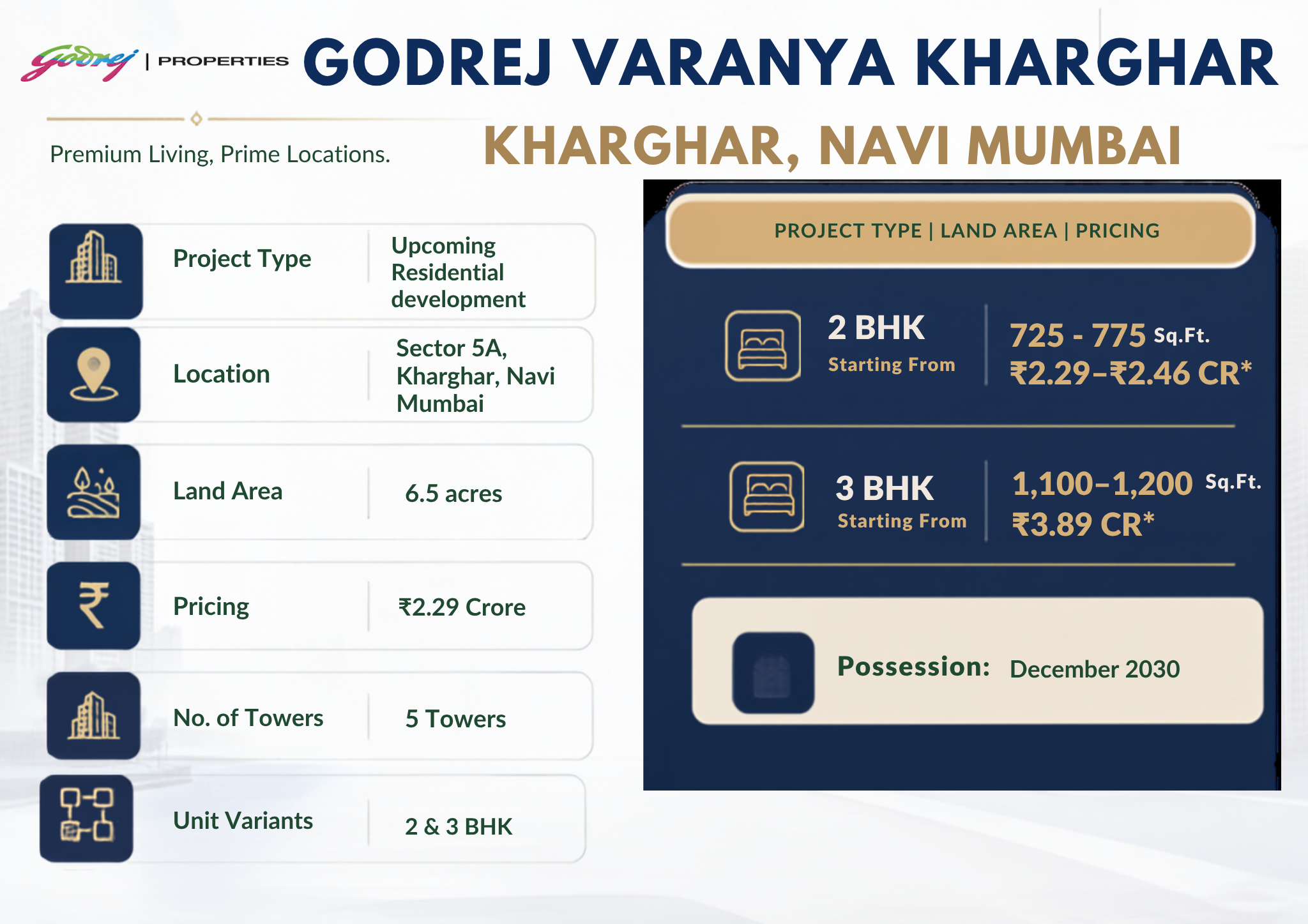
Godrej Nest in Kandivali East is a completed project with its occupancy certificate in place, with ready homes from about Rs 1.21 crore. That suits a seller in Case A above, who could shelter most of a Rs 1.28 crore gain. In the central suburbs, Godrej The Trees in Vikhroli offers ready homes from about Rs 1.85 crore. Both are developed by Godrej Properties Limited, which has a long track record of handovers across MMR.
Frequently Asked Questions
Q: What is the capital gains tax on property sold in 2026?
If held for more than 24 months, the gain is long-term and taxed at 12.5% without indexation, plus 4% cess and any surcharge. Residents who bought before 23 July 2024 can choose 20% with indexation if that is lower. If held for 24 months or less, the gain is added to your income and taxed at slab rates.
Q: What is the cost inflation index for FY 2026-27?
The CBDT notified a CII of 384 for FY 2026-27 on 15 July 2026, up from 376 for FY 2025-26. It applies to sales from 1 April 2026 where indexation is still allowed, which means property bought before 23 July 2024 by a resident individual or HUF.
Q: Can I claim Section 54 on an under-construction flat?
Yes. Buying a flat in an under-construction project is treated as construction, so the house must be completed within 3 years of your sale. If the project is delayed beyond that, the exemption can be denied. Pick a project with a realistic possession date and a strong delivery record.
Q: How much can I invest in 54EC bonds?
Up to Rs 50 lakh in a financial year, within six months of the sale. The bonds of NHAI, REC, PFC, IRFC and HUDCO carry a 5-year lock-in, and the interest is taxable [VERIFY: current coupon rate]. Selling or pledging them early reverses the exemption.
Q: What happens if I don’t use my capital gains account scheme deposit?
Any amount left unused at the end of the 2-year (purchase) or 3-year (construction) period is treated as a long-term capital gain in the year the period ends. You pay tax on it then, and you can withdraw the balance with approval from your assessing officer.
Q: Do NRIs get the indexation option?
No. The choice between 12.5% and 20% with indexation is available only to resident individuals and HUFs. NRIs pay 12.5% without indexation on long-term gains, and the buyer must deduct TDS at that rate plus surcharge and cess. NRIs can still claim Section 54 and 54EC.
Conclusion
Capital gains tax on property in Mumbai comes down to three decisions: when you sell, which tax route you pick, and how you reinvest. For a flat bought before 23 July 2024, running both the 12.5% and the 20% indexed calculations can save lakhs. Reinvesting in a home through Section 54, or in bonds through Section 54EC, can remove the tax altogether if you respect the deadlines and lock-ins.
If you are selling to upgrade, our team can shortlist ready and near-ready homes that fit your exemption window. Browse current Godrej properties across MMR or ask us to arrange a site visit, and take your CA’s numbers along. If part of the new home will be funded with a loan, Section 54 looks at the amount invested, not where the money came from, and our guide to home loan tax benefits in 2026 explains how the interest deduction works alongside your exemption.