
Quick Answer
Related Godrej projects nearby:
Godrej Bandra Reclamation — Sea-Facing 4 BHK, Mumbai →Godrej Trilogy – Worli, Mumbai →Godrej Horizon – Wadala Mumbai →
A home loan balance transfer usually pays off in Mumbai when the new lender’s rate is at least 0.5% lower and 10 or more years remain on the loan. Switching costs, including processing fee, 0.3% Maharashtra stamp duty on the mortgage and legal charges, are typically recovered within two years. With a smaller gap, ask your current bank to reprice instead.
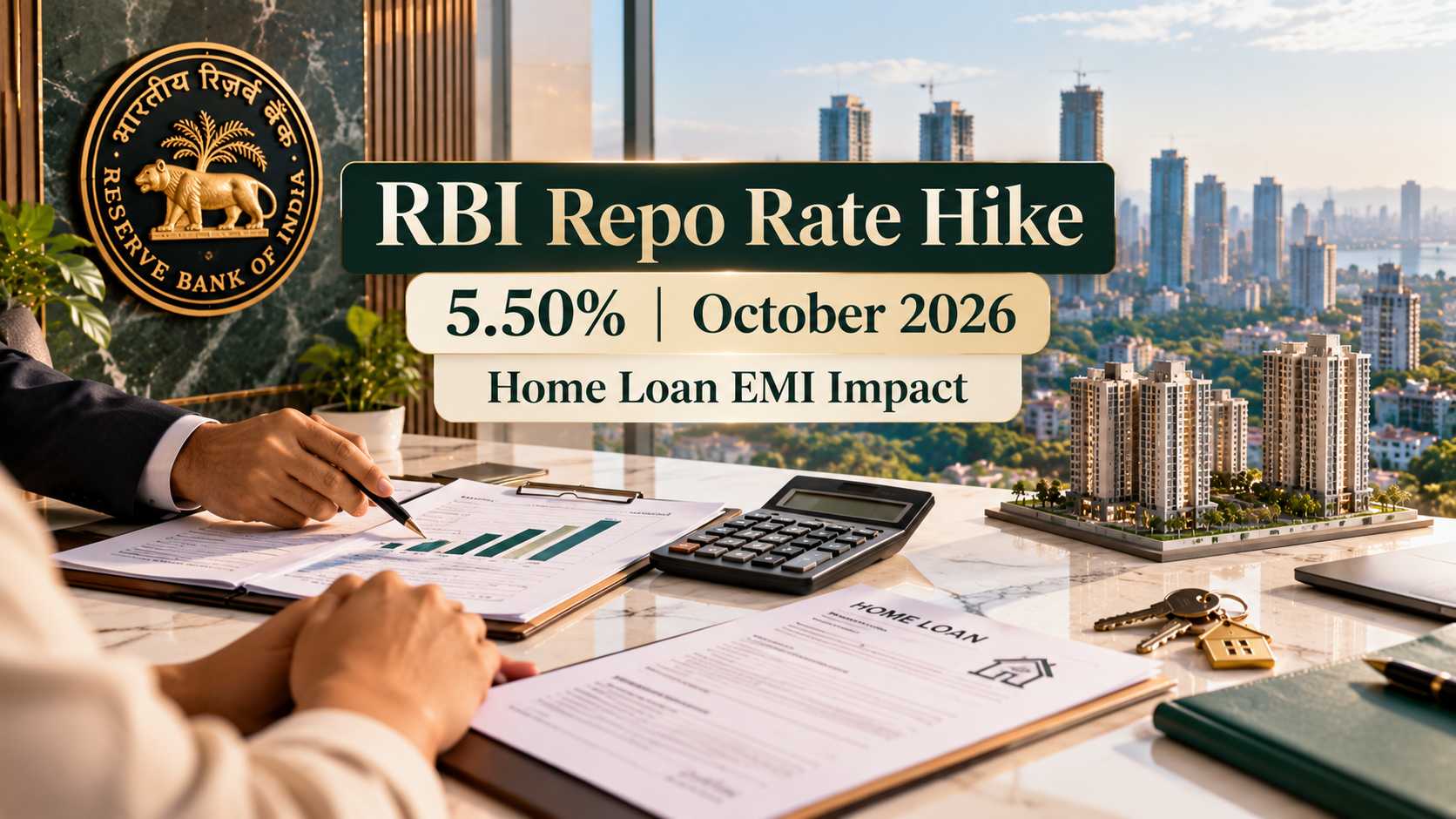
A home loan balance transfer has become a live question again for Mumbai borrowers. On 7 October 2026 the RBI raised the repo rate by 25 basis points to 5.50%, its first hike since February 2023. Banks moved fast. SBI’s revised repo-linked home loan rates of 7.50% to 8.80% took effect on 15 October 2026, Bank of Baroda’s repo-linked lending rate went from 7.90% to 8.15%, and Punjab National Bank’s from 8.10% to 8.35%.
A hike lifts every floating loan, so why switch now? Because the hike does not close the gap between lenders. A borrower who took a loan at repo plus 3.5% in 2022 is still paying far more than a new borrower at repo plus 2%, and that spread stays fixed for the life of the loan unless you change it. In the MMR, where a typical loan is Rs 75 lakh to Rs 1.5 crore, a 0.75% gap is worth several lakh rupees.
We at Godrej Properties MMR have worked through the numbers for Mumbai borrowers. This guide covers current lender rates, the real costs of switching in Maharashtra, the step-by-step process and the break-even math that tells you whether to move.
When a Home Loan Balance Transfer Pays Off
A balance transfer means a new lender pays off your existing loan and you start repaying the new lender at a lower rate. The outstanding amount and usually the remaining tenure stay the same. Only the rate, and the lender, change.
Whether it pays off depends on three things: the rate gap, the remaining tenure and the outstanding balance. Interest is front-loaded in a home loan, so the savings are largest early in the loan. Switching a loan with 18 years left saves far more than switching one with 5 years left, even at the same rate gap.
Our rule of thumb, also set out in our analysis of the RBI repo rate hike in October 2026, is simple. Consider a transfer when:
- The new rate is at least 0.5% lower than your current rate, after any concession your bank offers to retain you
- At least 10 years remain on the loan
- The outstanding balance is Rs 30 lakh or more, so fixed costs are spread over a meaningful saving
- Your credit score is strong, ideally 750 or above, so you actually qualify for the advertised rate
- You have a clean repayment record for at least 12 months
If you are on an old MCLR or base rate loan, the case is often stronger. These loans reset slowly and often carry a higher effective rate than current repo-linked loans. Moving to an external benchmark loan, with your own bank or a new one, also makes future rate cuts reach you faster.
Current Lender Rates in Mumbai After the October 2026 Hike
Rates are moving week by week as banks pass on the hike. The table shows what had been reported by late October 2026. The lowest rates go only to borrowers with high credit scores, often 800 and above.
| Lender | Rate (late Oct 2026) | Benchmark | Balance transfer processing fee |
|---|---|---|---|
| SBI | 7.50% to 8.80% (from 15 Oct 2026) | EBLR, repo-linked | Waived on transfers per aggregator listings [VERIFY: current offer] |
| Bank of Baroda | RLLR 8.15%; loans priced from this | Repo-linked | [VERIFY: not sourced] |
| Punjab National Bank | RLLR 8.35%; loans priced from this | Repo-linked | [VERIFY: not sourced] |
| HDFC Bank | From 8.50% [VERIFY: post-hike rate] | Repo-linked | Up to 0.50% or Rs 3,000, whichever is higher, plus GST |
| Kotak Mahindra Bank | About 8.70% to 8.95% [VERIFY: post-hike rate] | Repo-linked | Up to 0.50% plus GST |
| ICICI Bank | About 9.00% to 10.05% [VERIFY: post-hike rate] | Repo-linked | 0.50% to 2.00% or Rs 3,000, whichever is higher, plus GST |
Two points stand out. Public sector banks are still the cheapest headline lenders after the hike, often by 0.5% to 1%. And the private bank figures above are drawn from aggregator listings, which lag official rate cards. Always get a written sanction offer before you act on any number.
The repo-linked structure also means the rate you switch to will move with future RBI decisions. You are buying a lower spread, not a fixed rate. That is still valuable, because the spread is the part you control.
What a Balance Transfer Costs in Maharashtra
Switching is not free, and Maharashtra adds a cost many borrowers miss: stamp duty on the new mortgage. When you deposit your title deeds with the new bank, the mortgage by deposit of title deeds attracts stamp duty of 0.3% of the loan amount under the Maharashtra Stamp Act, subject to a statutory cap [VERIFY: current cap, reported as Rs 10 lakh or Rs 20 lakh]. On an Rs 80 lakh loan, that is Rs 24,000.
Here is a typical cost sheet for an Rs 80 lakh balance transfer in Mumbai:
| Cost item | Typical amount | Notes |
|---|---|---|
| Processing fee (0.35% + 18% GST) | About Rs 33,000 | Negotiable; some PSU banks waive it |
| Stamp duty on mortgage (0.3%) | Rs 24,000 | Maharashtra rate on deposit of title deeds |
| Legal and technical valuation | Rs 5,000 to Rs 10,000 [VERIFY: varies by lender] | Often folded into the processing fee |
| Notice of intimation filing and CERSAI | About Rs 1,000 to Rs 2,000 [VERIFY: not sourced] | Registers the new mortgage |
| Foreclosure charge at old lender | Nil | RBI bars it on floating-rate loans to individuals |
| Total | About Rs 65,000 to Rs 70,000 | Roughly 0.8% to 0.9% of the loan |
The foreclosure point is important. Under the RBI’s Pre-payment Charges on Loans Directions, 2025, effective 1 January 2026, lenders cannot charge prepayment or foreclosure fees on floating-rate loans taken by individuals, whatever the source of the money. Individual floating-rate home loans were largely protected under earlier RBI rules too. Fixed-rate loans can still carry a foreclosure fee if it is disclosed in your agreement.
Break-Even Math: Does Switching Save You Money?
The test is simple: divide your total switching cost by your monthly EMI saving. That gives the number of months before the transfer starts paying you. If the break-even is under 24 months and you plan to keep the loan well beyond that, switch.
We ran three scenarios on an Rs 80 lakh outstanding balance, using about Rs 70,000 as the switching cost.
| Scenario | Old EMI | New EMI | Monthly saving | Total saving | Break-even |
|---|---|---|---|---|---|
| 15 years left, 9.00% to 8.25% | Rs 81,141 | Rs 77,611 | Rs 3,530 | Rs 6.35 lakh | About 20 months |
| 15 years left, 9.15% to 8.15% | Rs 81,857 | Rs 77,147 | Rs 4,710 | Rs 8.48 lakh | About 15 months |
| 15 years left, 8.65% to 8.40% | Rs 79,484 | Rs 78,311 | Rs 1,173 | Rs 2.11 lakh | About 60 months |
| 10 years left, 9.00% to 8.25% | Rs 1,01,341 | Rs 98,122 | Rs 3,219 | Rs 3.86 lakh | About 22 months |
A 0.75% to 1% gap on a 15-year, Rs 80 lakh loan saves Rs 6 lakh to Rs 8.5 lakh. A 0.25% gap saves about Rs 2 lakh, takes five years to recover its costs, and is better handled by asking your own bank to reprice.
Total savings above are before switching costs and assume you keep the same tenure. If you keep paying your old EMI after switching, the loan closes earlier and the saving is larger. Our verdict: in the third scenario, ask your current lender for a spread conversion first. Most banks will lower the spread for an existing customer for a one-time fee [VERIFY: fee varies by bank], with no stamp duty and no new paperwork.
Step-by-Step Home Loan Balance Transfer Process
A home loan balance transfer in Mumbai usually takes two to four weeks from application to disbursement [VERIFY: varies by lender]. Follow these steps in order.
- Ask your current bank to match. Write to your bank with the competing offer. If it reprices to within 0.25%, stay.
- Get your loan statement and list of documents (LOD). The LOD lists the original title papers your bank holds, such as the agreement for sale, index II, share certificate and OC.
- Get a foreclosure letter showing the exact outstanding amount, valid to a date.
- Apply to the new lender with KYC, income proof, six months of bank statements, the LOD and the foreclosure letter.
- Clear legal and technical checks. The new lender verifies title and values the flat. A clean OC and society NOC speed this up.
- Sign the sanction and pay the costs, including processing fee and stamp duty on the new mortgage.
- New lender pays the old lender directly. Collect your original documents and the no-dues certificate from the old bank.
- Deposit the originals with the new lender and confirm the mortgage is registered and the old charge is removed on CERSAI.
Keep paying your old EMI until the old loan is formally closed. A missed EMI during the switch can hurt your credit score and your new rate.
Why It Matters for Godrej Home Owners in MMR
Many owners of Godrej homes across Mumbai took loans in 2022 and 2023, when spreads were wider. Buyers at Godrej Urban Park in Chandivali, where possession is under way, and at Godrej Bliss in Kandivali East are good examples of borrowers who should check their spread now. A project by Godrej Properties Limited is usually approved by most major banks, which makes the new lender’s legal check faster.
Possession is also a natural moment to switch. Once the OC is issued and the loan is fully disbursed, you can compare offers on the full outstanding amount.
Frequently Asked Questions
Q: Is a home loan balance transfer worth it after the October 2026 repo hike?
It can be. The hike raised all repo-linked loans by 0.25%, but it did not change the spread your lender charges. If your spread is 0.5% or more above what a new lender offers and you have 10 or more years left, switching usually saves several lakh rupees even after costs.
Q: Do I pay stamp duty again on a balance transfer in Maharashtra?
Yes. The new lender takes a fresh mortgage by deposit of title deeds, which attracts stamp duty of 0.3% of the loan amount in Maharashtra, subject to a cap. On an Rs 80 lakh loan, that is Rs 24,000. You do not pay stamp duty on the property itself again.
Q: Will my old bank charge a foreclosure penalty?
Not on a floating-rate home loan taken as an individual. The RBI’s prepayment charges directions, effective 1 January 2026, bar foreclosure and prepayment fees on these loans. Fixed-rate loans may still carry a fee if your agreement discloses one, so check your sanction letter.
Q: Can I take a top-up loan with a balance transfer?
Yes. Most lenders offer a top-up along with the transfer, subject to your income and the flat’s current value. Top-up rates are often slightly higher than the home loan rate [VERIFY: varies by lender], and the interest qualifies for tax deduction only if the money is used for the house. A transfer itself does not affect your deductions, as our guide to home loan tax benefits in 2026 explains.
Q: How often can I transfer a home loan?
There is no legal limit, but each switch costs about 0.8% to 0.9% of the loan in Maharashtra, and lenders prefer at least 12 months of clean repayments. Frequent switching also adds hard enquiries to your credit report. Once every few years, when a clear rate gap opens, is reasonable.
Q: Does a balance transfer affect my credit score?
The new lender’s credit check causes a small, temporary dip. Closing the old loan on time and paying the new EMIs regularly restores it within a few months. The bigger risk is a missed EMI during the switch, so keep paying the old lender until the loan is closed.
Conclusion
The October 2026 repo hike is a good prompt to check your spread, not a reason to panic. A home loan balance transfer makes sense when the rate gap is 0.5% or more, at least 10 years remain, and your costs, including Maharashtra’s 0.3% stamp duty on the mortgage, can be recovered within about two years. With a smaller gap, ask your own bank to reprice first.
If you are planning a purchase or nearing possession, our team can walk you through lender options alongside the right home. Explore Godrej projects across MMR or book a site visit with us.