Quick Answer
Godrej City Panvel rental income runs about Rs 18,000–24,000 a month for a 1 BHK, Rs 28,000–35,000 for a 2 BHK and Rs 42,000–52,000 for a 3 BHK in 2026. Gross yields work out to 2.6–3.3%, and roughly 2.1–2.6% net after maintenance, vacancy and tax. The rental case here rests on tenant quality and low vacancy, not on headline yield.
Investors evaluating Godrej City Panvel rental income usually arrive with one number in their head: the 3.5–4.5% gross yield widely quoted for Panvel as a whole. That figure is real, but it describes the average Panvel property — typically a smaller, unbranded building bought at Rs 90–95 lakh. Apply the same rent to a township unit priced above the locality average and the arithmetic changes. Understanding why, and whether the trade-off is worth it, is the point of this analysis.
The demand side has genuinely improved. Navi Mumbai International Airport opened on 25 December 2025, roughly 12–15 km from the township. The Atal Setu sea bridge cut travel time to South Mumbai and pushed corridor values up 20–25%. Panvel now carries three distinct tenant pools — airport and aviation-services staff, logistics and warehousing employees along the expressway, and Mumbai commuters priced out of Kharghar and Ulwe. That breadth is what protects occupancy.
What follows is the configuration-wise rental maths at Godrej City Panvel, the costs that erode gross yield into net, and an honest read on where this asset does and does not work as a rental play.
Godrej City Panvel Rental Income by Configuration
Rents below reflect furnished-to-semi-furnished units in a township with a functioning clubhouse and on-site school — a package that commands a premium over standalone Panvel buildings. Purchase prices are the current base figures from the developer’s price list.
| Configuration | Purchase Price | Monthly Rent | Annual Rent | Gross Yield |
|---|---|---|---|---|
| 1 BHK (375–440 sq ft) | Rs 79 Lakh | Rs 18,000–24,000 | Rs 2.16–2.88 L | 2.7–3.6% |
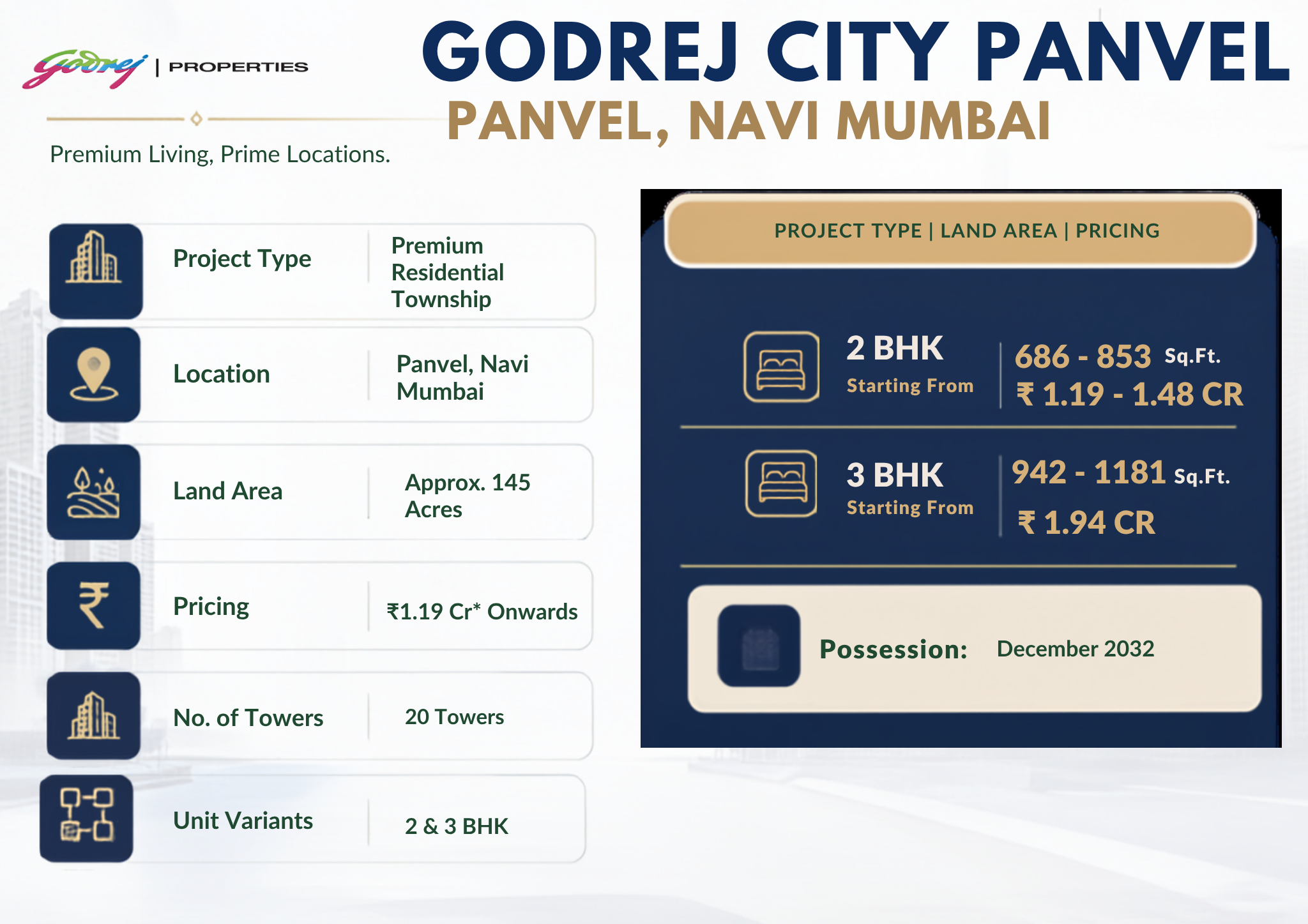
| 2 BHK (686–853 sq ft) | Rs 1.19 Cr | Rs 28,000–35,000 | Rs 3.36–4.20 L | 2.8–3.5% |
| 3 BHK (942–1,181 sq ft) | Rs 1.94 Cr | Rs 42,000–52,000 | Rs 5.04–6.24 L | 2.6–3.2% |
The 1 BHK produces the strongest yield at the top of its rent band, and it is also the configuration with the deepest tenant pool. Single professionals and couples working at the airport or in the logistics belt want a secure, amenity-backed address at under Rs 25,000 a month, and there is limited branded supply meeting that brief in Panvel. The 3 BHK sits at the bottom of the yield table — as it does almost everywhere in MMR — because tenants willing to pay Rs 50,000 a month in Panvel are scarce relative to the number of such units.
Panvel 2 BHK units across the locality rent for Rs 22,000–35,000 a month against typical purchase prices around Rs 95 lakh, producing gross yields of 3.5–4.5%. A township unit priced at Rs 1.19 crore earns rent near the top of that band but on a materially higher base — trading yield for tenant quality and occupancy.
Gross to Net — What Actually Reaches Your Account
Gross yield is a marketing number. Net yield is what funds your EMI. Township living carries higher recurring costs than a standalone building, and any honest rental projection has to carry them.
| Line Item | 1 BHK | 2 BHK | Notes |
|---|---|---|---|
| Annual rent (mid-band) | Rs 2.52 L | Rs 3.78 L | Rs 21,000 / Rs 31,500 per month |
| Society maintenance | Rs 36,000 | Rs 54,000 | Township amenities cost more to run |
| Property tax | Rs 9,000 | Rs 14,000 | Panvel Municipal Corporation |
| Vacancy (1 month) | Rs 21,000 | Rs 31,500 | Realistic between tenants |
| Repairs and broker | Rs 18,000 | Rs 26,000 | Annualised |
| Net annual income | Rs 1.68 L | Rs 2.52 L | — |
| Net yield | 2.1% | 2.1% | On base price |
Around 33% of gross rent disappears into costs. That is normal for MMR and slightly higher than average here because township maintenance is a real expense — a 30,000 sq ft clubhouse, a 1.2 km jogging track and landscaped commons do not maintain themselves. Investors who model Panvel on a standalone-building cost base consistently overestimate their net return by 40–60 basis points.
The Honest Framing
At 2.1% net, rental income at Godrej City Panvel will not service a home loan on its own — an 80% loan at 8.4% costs far more than the rent brings in. This is a capital-appreciation asset with rental income as a partial carry, and it should be underwritten that way. Anyone told otherwise is being sold, not advised.
Who Actually Rents in Panvel Now
Tenant mix determines vacancy risk, and Panvel’s has broadened considerably since 2024. Three pools now compete for the same inventory, which is the structural reason occupancy has held up even as new supply arrived.
- Airport and aviation services: Ground handling, cargo, airline back-office and hospitality staff serving Navi Mumbai International Airport, 12–15 km away. Demand is strongest in Pushpak Nagar and the Panvel belt, and it is growing as terminal operations scale
- Logistics and warehousing: The Mumbai–Pune Expressway corridor, roughly 3 km from the township, supports a large warehousing and distribution employment base with steady mid-management rental demand
- Mumbai commuters: Professionals working in Kharghar, Belapur and increasingly South Mumbai via Atal Setu, who find Panvel affordable relative to Kharghar’s repricing
- Families seeking schooling: The on-site school campus is a genuine differentiator; families with young children sign longer leases and renew more reliably than any other segment
That fourth group deserves emphasis. A tenant whose child attends school inside the township does not move for a Rs 2,000 rent difference. Landlords who target family tenants over transient single professionals report meaningfully lower turnover, and turnover — not headline rent — is what determines realised yield over a five-year hold.
Appreciation Versus Yield — Where the Return Really Comes From
Panvel rates currently sit in the Rs 13,350–15,000 per sq ft band after 20–23% year-on-year growth, with prices up roughly 74% over the airport development cycle. Analysts project 8–12% annual appreciation over the next five to seven years as airport operations mature. Set that against a 2.1% net yield and the composition of returns becomes obvious.
| Return Component | Annual Contribution | Reliability |
|---|---|---|
| Net rental yield | ~2.1% | High — contractual, predictable |
| Capital appreciation (projected) | 8–12% | Moderate — infrastructure-dependent |
| Blended expectation | 10–14% | Subject to delivery of airport phases |
The risk sits entirely in the second row. Panvel’s appreciation forecast is built on airport ramp-up, expressway upgrades and continued corridor investment. Those are largely committed, but timelines in Indian infrastructure slip, and a two-year delay in terminal expansion would flatten the appreciation curve while your 2.1% yield keeps grinding on. Investors with a five-year-plus horizon can absorb that. Investors needing an exit in 24 months should not be in this trade. We work through the full return scenario in our analysis of whether Godrej City Panvel is a good investment.
Six Steps to Maximise Rental Return Here
- Buy the 1 BHK or compact 2 BHK — both sit at the top of the yield table and have the deepest tenant pools in Panvel
- Choose a tower close to the clubhouse and school; these units let faster and hold rent better than peripheral towers
- Furnish to a semi-furnished standard — wardrobes, modular kitchen, air conditioning. It adds Rs 3,000–5,000 a month in Panvel and cuts vacancy days
- Target family tenants over transient professionals; the school on campus is your strongest pitch and it lowers turnover
- Register a formal leave-and-licence agreement and budget the stamp duty — informal arrangements are unenforceable and complicate resale
- Reprice at every renewal rather than every third year; Panvel rents are moving, and stale leases are the most common cause of underperformance
Why the Godrej Address Matters to a Landlord
A developer’s brand does not directly raise rent, but it changes who applies. Corporate HR departments arranging accommodation for relocated staff, and families vetting a building before enrolling a child in its school, both screen on developer reputation. In practice that shows up as shorter listing times and a better tenant credit profile rather than a higher headline number.
Godrej Properties Limited posted FY26 sales bookings of Rs 34,171 crore across 17,515 homes, with Rs 10,313 crore from the Mumbai Metropolitan Region — its largest single regional contribution. For an investor in a township still delivering phases through 2028, that balance sheet is what underwrites the completion of the amenities your rent depends on. The company’s corporate disclosures are published at Godrej Properties Limited.
The developer also runs a plotted development nearby at Godrej Golf Side Estate Panvel, though land parcels generate no rental income and serve a purely appreciation-led strategy. Investors wanting monthly cash flow should stay with the apartment format.
Frequently Asked Questions
Q: What rental income can I expect from a 2 BHK at Godrej City Panvel?
A 686–853 sq ft 2 BHK rents for Rs 28,000–35,000 a month in 2026, or Rs 3.36–4.20 lakh annually. Against a Rs 1.19 crore purchase price that is a 2.8–3.5% gross yield, falling to roughly 2.1% net after maintenance, tax, vacancy and repairs.
Q: Which configuration gives the best rental yield?
The 1 BHK, at 2.7–3.6% gross. It has the deepest tenant pool in Panvel — airport staff, logistics employees and single professionals — and the least competing branded supply. The 3 BHK is weakest at 2.6–3.2% because Rs 50,000-a-month tenants are scarce in this micro-market.
Q: Will rental income cover my home loan EMI?
No. At roughly 2.1% net yield, rent covers only a fraction of an EMI on an 80% loan at current rates near 8.4%. This is a capital-appreciation asset with rent as partial carry, and it should be underwritten on that basis.
Q: Has the new Navi Mumbai airport increased rents in Panvel?
Yes, indirectly. The airport opened on 25 December 2025 and has added airport and aviation-services staff to the tenant pool. The larger effect so far has been on capital values — Panvel prices are up roughly 74% over the development cycle — with rents following more gradually.
Q: What is the realistic vacancy period between tenants?
Budget one month per year. Well-positioned 1 and 2 BHK units near the clubhouse and school typically let faster, while peripheral towers and 3 BHK units take longer. Family tenants using the on-site school renew most reliably and are worth targeting.
Q: How much does township maintenance cost a landlord?
Expect roughly Rs 36,000 a year on a 1 BHK and Rs 54,000 on a 2 BHK. Township maintenance runs above standalone-building rates because of the 30,000 sq ft clubhouse, 1.2 km track and landscaped commons. Model this before projecting net yield.
Q: Should I furnish the flat before renting it out?
Semi-furnished is the sweet spot in Panvel — wardrobes, a modular kitchen and air conditioning. It supports Rs 3,000–5,000 a month in additional rent and materially reduces vacancy days. Fully furnished rarely recovers its cost in this micro-market.
Our Verdict
Godrej City Panvel rental income is dependable rather than generous. At 2.1% net, it will not service debt, and any investor buying primarily for cash flow should look at a lower price point elsewhere in Panvel where the yield maths is kinder. What this asset offers instead is low vacancy, a broad and broadening tenant base, and exposure to a corridor with 8–12% projected annual appreciation.
The right buyer here is someone with a five-year-plus horizon who wants the appreciation and treats rent as a partial carry on holding costs. If that describes you, the 1 BHK and compact 2 BHK are the configurations to focus on. Our team can share current rent comparables from within the township and the surrounding Panvel belt — and the Panvel locality guide covers what tenants are actually moving here for.