Quick Answer
Related Godrej projects nearby:
Godrej Bandra Reclamation — Sea-Facing 4 BHK, Mumbai →Godrej Trilogy – Worli, Mumbai →Godrej Horizon – Wadala Mumbai →
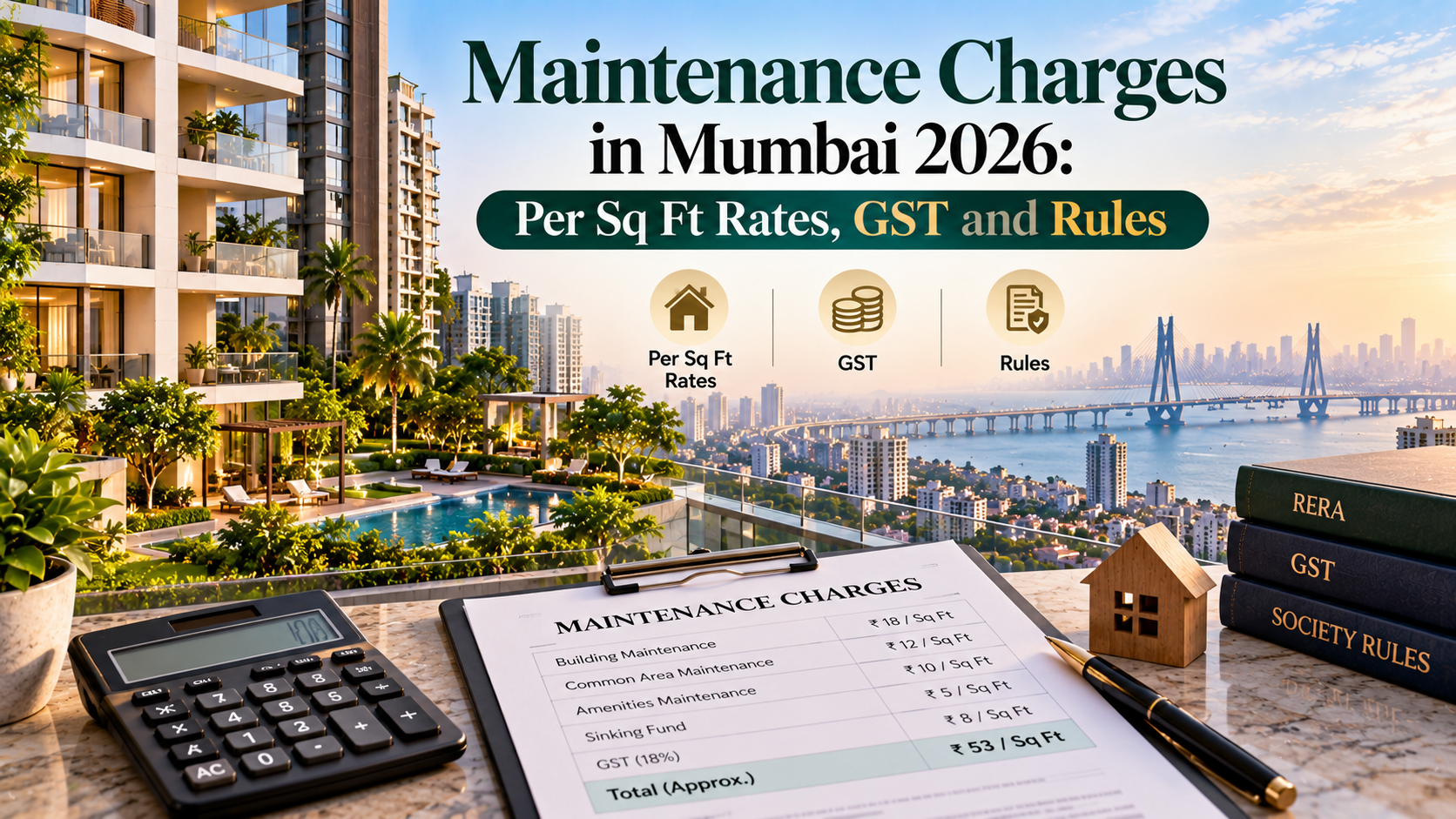
Most Mumbai flats pay roughly Rs 3 to Rs 15 per sq ft a month in maintenance, depending on the building. Older societies sit at the low end, amenity-heavy towers and townships higher. Bills above Rs 7,500 a month can attract 18% GST, and new projects usually collect 12 to 24 months of maintenance in advance at possession.
Maintenance charges in Mumbai are the cost most buyers check last and pay longest. You pay the EMI for 20 years, but you pay maintenance for as long as you own the flat. In 2026 the gap between buildings is wide. A standalone cooperative society typically runs at about Rs 7 per sq ft a month, according to a July 2025 Free Press Journal report, while integrated townships can cost 30 to 50% more for the same flat size. A Sewri buyer in a new building reported an implied rate of Rs 23 to Rs 34 per sq ft.
The rules have also been shifting. In 2026 the Maharashtra State Co-operative Appellate Court ruled against societies billing service charges purely by flat size, and the state has released a draft of new model bye-laws for housing societies. GST on bills above Rs 7,500 a month still catches many owners in newer towers by surprise.
We at Godrej Properties MMR ask for the maintenance figure on every flat we shortlist. This guide covers typical bills by building type, what each line means, GST, possession-stage costs and the checks to run before you buy.
Maintenance Charges in Mumbai by Building Type (2026)
There is no official rate card for maintenance charges in Mumbai. Each society or developer sets its own bill, based on its actual costs. Still, buildings of the same type tend to land in similar bands, because the cost drivers are similar: staff, lifts, security, common electricity, amenities and repairs.
| Building type | Typical monthly rate | Monthly bill, 800 sq ft flat | What drives the cost |
|---|---|---|---|
| Older cooperative society (no lifts or one lift, few amenities) | Rs 2 to Rs 5 per sq ft [VERIFY: our estimate] | Rs 1,600 to Rs 4,000 | Watchmen, cleaning, property tax, repair fund |
| Mid-segment tower (lifts, gym, small clubhouse) | Rs 3 to Rs 8 per sq ft | Rs 2,400 to Rs 6,400 | Lift maintenance, security agency, common power, DG backup |
| Large township (multiple towers, clubhouse, landscaping) | Rs 6 to Rs 12 per sq ft [VERIFY: our estimate] | Rs 4,800 to Rs 9,600 | Estate staff, internal roads, pools, sports facilities |
| Luxury tower (concierge, valet, high-end clubhouse) | Rs 12 to Rs 30+ per sq ft [VERIFY: not sourced] | Rs 9,600 to Rs 24,000+ | Concierge and facility management, high-spec lifts, larger staff |
Some sourced reference points sit behind these bands. A Tata Capital explainer notes that Mumbai maintenance has been trending above Rs 10 per sq ft, and cites examples of Rs 6 in a Goregaon East project and Rs 8 in a Lokhandwala project. A Vile Parle West society was reported charging Rs 13 per sq ft for smaller flats and Rs 5 for the largest. In Kandivali East, Godrej Nest’s published maintenance works out to about Rs 3 to Rs 5 per sq ft, which shows that a dense, single-tower project can keep the per-flat cost down.
What Makes Up Your Society Maintenance Bill
A Mumbai maintenance bill is a bundle of separate charges. Cooperative housing societies follow the 2014 model bye-laws, which split charges into two groups. Some are levied in proportion to flat area, such as property tax, repairs, the sinking fund, insurance and lease rent. Others, such as service charges, are meant to be shared equally among members, whatever the flat size.
- Service charges. Salaries of watchmen, cleaners and the society office, common electricity, lift upkeep and water pumps. This is usually the largest part of the bill.
- Repair and maintenance fund. At least 0.75% a year of the flat’s construction cost under bye-law 67(a)(iii), for normal recurring repairs.
- Sinking fund. At least 0.25% a year of the construction cost, set aside for major repairs or reconstruction later.
- Property tax. The BMC’s tax on your flat, which the society collects and pays on your behalf.
- Water charges. Usually billed by the BMC to the society and split among members.
- Non-occupancy charges. Paid only if you let out your flat (more on this below).
- Others. Building insurance, lease rent and parking charges.
The two funds can add up. Take an 800 sq ft flat with a certified construction cost of Rs 3,500 per sq ft [VERIFY: assumption, varies by building], so Rs 28 lakh. The repair fund at 0.75% is Rs 21,000 a year, or Rs 1,750 a month. The sinking fund at 0.25% is Rs 7,000 a year, or about Rs 583 a month. These are our illustrative calculations, not figures from any one society.
Billing by area is now contested. In July 2026 the Maharashtra State Co-operative Appellate Court rejected a society’s square-foot formula for maintenance, and in an August 2026 Worli case it held that service charges cannot rise just because a flat is larger when residents get the same services. These rulings apply to cooperative societies. A Bombay High Court ruling from August 2025 held that condominiums under the Maharashtra Apartment Ownership Act may still charge in proportion to each flat’s undivided share.
GST and Non-Occupancy Charges: The Two Rules That Cause Disputes
GST. Under a 2019 CBIC circular, a housing society registered for GST must charge 18% GST when a member’s monthly maintenance contribution exceeds Rs 7,500. The tax applies to the whole amount, not only the part above Rs 7,500. The society’s annual turnover must also exceed Rs 20 lakh for GST to apply, though sources read that condition differently. Property tax, electricity charges and other statutory levies collected through the society are excluded when working out whether the Rs 7,500 limit is crossed.
Here is how it plays out. A 1,000 sq ft flat billed Rs 8,000 a month in service charges crosses the limit. GST at 18% on the full Rs 8,000 adds Rs 1,440, taking the bill to Rs 9,440. A flat billed Rs 7,400 pays no GST at all. The Maharashtra Authority for Advance Ruling has held that repair and sinking fund contributions also count towards the bill when deciding if GST applies.
A Rs 100 difference in the monthly bill can decide whether you pay Rs 1,440 a month in GST or nothing. Ask the society how it calculates the Rs 7,500 limit before you assume you are below it.
Non-occupancy charges. If you rent out your flat, the society can charge a non-occupancy charge. A 2001 state government order caps it at 10% of the service charges, excluding municipal taxes, and the Bombay High Court upheld that cap in the Mont Blanc Co-operative Housing Society case. So if your service charge is Rs 3,000 a month, the maximum non-occupancy charge is Rs 300. Flats occupied by close relatives such as parents, children or siblings are generally exempt.
What You Pay at Possession in a New Project
Buyers of new flats meet a separate set of maintenance costs before the society is even formed. Until the developer hands the building to the society, the developer or its facility manager runs it and bills owners directly, usually at a per sq ft rate.
Most developers collect this in advance at possession, typically 12 or 24 months. On an 800 sq ft flat at Rs 8 per sq ft, 24 months of advance maintenance is Rs 1,53,600. If 18% GST is charged on it, the total is about Rs 1,81,248 [VERIFY: GST treatment of developer-collected advance maintenance varies by agreement].
Other charges often collected at possession include share money and society formation costs, an initial sinking fund contribution, a corpus fund in some projects, electricity and water meter deposits, and land-under-construction (LUC) tax arrears. Our review of Godrej Nest Kandivali maintenance and LUC charges shows how these items surface at handover in a real project, so we won’t repeat that detail here. For the full purchase budget, our guide to ready reckoner rates, stamp duty and the total cost of buying in 2026-27 covers the rest.
Key takeaway: The advance maintenance figure is negotiable in writing before booking and almost never at the handover desk. Get the per sq ft rate, the number of months, the GST treatment and the corpus amount into the allotment letter or agreement.
How to Check Maintenance Charges Before You Buy
Checking maintenance charges in Mumbai takes an hour or two of document reading. A cheap flat with a high bill can cost more over ten years than a dearer flat with a low one.
- Ask for the last three maintenance bills on a resale flat, and check each line item, not just the total.
- Ask for the society’s latest audited accounts and look at the sinking and repair fund balances. Low balances in an older building mean a special levy is likely when repairs fall due.
- Check for pending dues by asking the society for a no-dues certificate before you pay the balance amount.
- Ask whether GST is charged and how the society works out the Rs 7,500 limit.
- Find out about planned repairs or redevelopment. Structural repairs, waterproofing or lift replacement can mean a one-time levy of lakhs of rupees per flat [VERIFY: not sourced, varies widely].
- For a new project, get the possession-stage charges itemised in writing, including the months of advance maintenance and the rate expected after the society takes over.
- If you plan to rent the flat out, ask for the non-occupancy charge and check it against the 10% cap.
For ready flats, pair this with the occupancy certificate check in our occupancy certificate guide, because buildings without an OC often pay higher water charges and property tax, which then flow into the maintenance bill.
Why It Matters for Godrej Projects in Mumbai
Maintenance matters most on ready flats, because the bill starts the day you take possession. Large projects by Godrej Properties Limited usually run through a professional facility manager in the early years, which makes the bill predictable but not necessarily low.
Godrej Nest in Kandivali East is a useful benchmark. Its published maintenance is about Rs 5,000 a month for a 1 BHK, Rs 7,200 for a 2 BHK and Rs 10,300 for a 3 BHK, which keeps the 2 BHK just under the Rs 7,500 GST limit. In Vikhroli, Godrej The Trees is a ready, larger-format option where the bill will be higher in absolute terms simply because the flats are bigger [VERIFY: current maintenance rate not sourced]. Project details are published by Godrej Properties Limited, and we recommend getting the current rate in writing from the developer before you book.
Our verdict: compare maintenance as a share of the flat’s value, not as a rupee figure. At Nest, a 2 BHK pays about 0.7% of a Rs 1.21 crore entry price each year in maintenance, which is a normal level for Mumbai.
Frequently Asked Questions
Q: What are normal maintenance charges in Mumbai per sq ft?
Most flats pay roughly Rs 3 to Rs 15 per sq ft a month. Older societies with few amenities are at the lower end, standalone societies average around Rs 7, and townships cost 30 to 50% more. Luxury towers with concierge services can go well above Rs 15.
Q: Is GST charged on society maintenance in Maharashtra?
Yes, if the society is registered for GST and your monthly contribution exceeds Rs 7,500. GST is then 18% on the whole amount, not just the excess. Property tax, electricity and other statutory levies are left out when checking the limit. Bills at or below Rs 7,500 a month are exempt.
Q: How much can a society charge for a rented flat?
The non-occupancy charge is capped at 10% of the service charges, excluding municipal taxes, under a 2001 Maharashtra government order upheld by the Bombay High Court. If your service charge is Rs 3,000 a month, the most the society can add is Rs 300. Flats used by close family are generally exempt.
Q: Can a society charge maintenance by flat size?
Some charges, such as property tax, the repair fund and the sinking fund, can be levied by area under the model bye-laws. Service charges should be shared equally. 2026 appellate court rulings rejected purely size-based service charges in cooperative societies. Condominiums under the Apartment Act follow different rules.
Q: How many months of advance maintenance do builders take?
Usually 12 or 24 months, collected at possession, plus GST where it applies. On an 800 sq ft flat at Rs 8 per sq ft, 24 months comes to about Rs 1.54 lakh before tax.
Q: What is the sinking fund in a Mumbai society?
It is a reserve for major future repairs or reconstruction. Under the 2014 model bye-laws it is at least 0.25% a year of the flat’s construction cost, as certified by an architect. A separate repair and maintenance fund is collected at a minimum of 0.75% a year.
Conclusion
Maintenance charges in Mumbai range from a few thousand rupees a month in an older society to well over Rs 20,000 in a luxury tower. The total depends on the building type, the density of the project, the size of the reserve funds and whether GST applies. Check the bills, the audited accounts and the possession-stage charges before you commit.
If you would like help comparing running costs across ready Godrej homes, explore the listings on Godrej Properties MMR or ask our team to arrange a site visit with the maintenance schedule in hand.