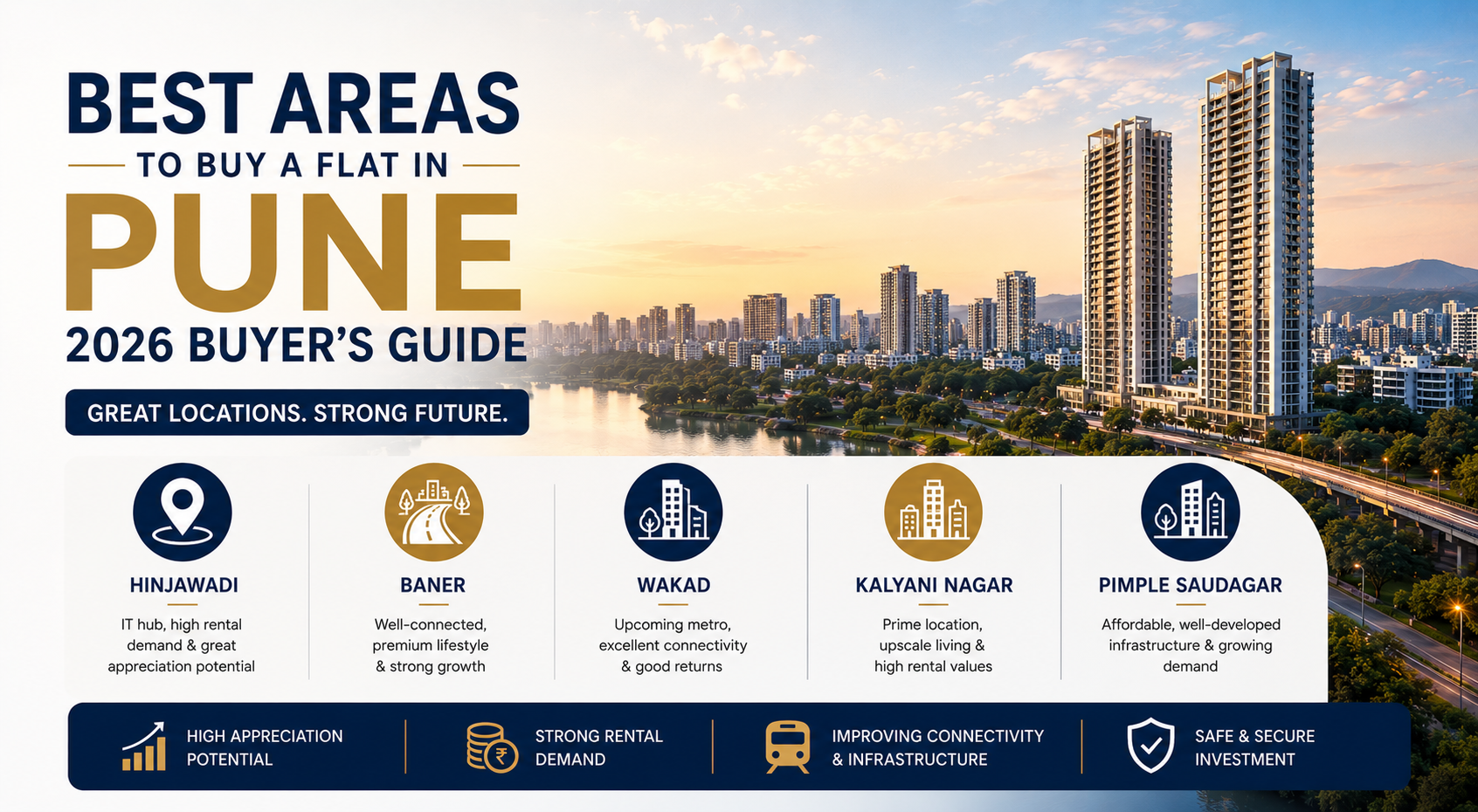
Best Areas to Buy a Flat in Pune — 2026 Buyer’s Guide
PCMC · Hinjewadi · Kharadi · Hadapsar-East · Wagholi | ₹8,500–₹15,000/sqft
In short: match the area to your job and horizon — PCMC/Pimpri for connectivity and value, Hinjewadi/Kharadi for IT proximity, eastern belts for growth headroom.
Where should you buy a flat in Pune in 2026?
The best area to buy a flat in Pune in 2026 depends on your workplace, budget and investment horizon, but the strongest all-round micro-markets are the PCMC belt (including Pimpri), Hinjewadi-Wakad, Kharadi, the Hadapsar-east corridor and Wagholi, spanning rates from roughly ₹8,500 to ₹15,000 per square foot. Each balances connectivity, employment proximity and value differently. This guide compares the leading localities so buyers can match an area to their needs rather than chase a generic “best” tag. Our team has framed it around the practical drivers — jobs, transit and price — that determine where a flat holds value.
For buyers prioritising connectivity and relative value, the metro-connected PCMC belt — anchored by premium projects like Godrej Properties Limited’s Palazzo at Godrej Emerald Waters in Pimpri — is among the strongest picks. The sections below compare it against Pune’s other leading localities.
Background — what drives Pune’s geography
Pune’s residential map is shaped primarily by its employment hubs and transit corridors. The IT clusters at Hinjewadi in the west and Kharadi-EON in the east anchor the two largest demand pools, while the PCMC industrial-and-IT belt in the north-west adds a third. The Pune Metro has begun re-rating the corridors it serves, much as it did for the PCMC belt, making metro proximity an increasingly important variable. Buyers who align their purchase with a job hub and a transit corridor tend to see the most durable value.
Developer activity follows these fundamentals, with branded names concentrating launches in the high-demand corridors; you can see Godrej’s spread across the city at godrejproperties.com. The result is a layered market where mature, connected belts command premiums and emerging eastern corridors offer growth headroom. Choosing well means reading both the current connectivity and the forward pipeline.
Key data — Pune localities compared
The table below summarises the leading localities by rate band and primary draw.
| Locality | Rate (₹/sqft) | Primary draw |
|---|---|---|
| Pimpri / PCMC | ~9,500–13,000 | Metro + value |
| Hinjewadi / Wakad | ~11,000–14,000 | IT hub west |
| Kharadi | ~11,000–15,000 | IT hub east |
| Hadapsar-east | ~9,000–12,000 | Connectivity + growth |
| Wagholi / Moshi | ~8,500–11,000 | Emerging value |
The pattern is clear: the IT-hub-adjacent belts (Hinjewadi, Kharadi) command the highest rates, the metro-connected PCMC belt offers connectivity at relatively better value, and the emerging eastern corridors trade lowest with the most growth headroom. There is no single “cheapest-and-best” — each area optimises a different mix of price, jobs and transit. The right choice is the one whose mix matches your priorities.
Market analysis — matching area to buyer
The table below maps buyer profiles to their best-fit localities.
| Buyer profile | Best-fit area | Why |
|---|---|---|
| West-IT professional | Hinjewadi/Wakad/PCMC | Short commute |
| East-IT professional | Kharadi/Hadapsar | Short commute |
| Connectivity-first | Pimpri/PCMC | Metro + rail + expressway |
| Value/growth investor | Wagholi/Moshi | Lower entry, upside |
Matching area to buyer profile is the single most useful exercise in choosing where to buy. A west-side IT professional saves hours weekly by living in or near PCMC or Hinjewadi, while an east-side one is better served by Kharadi or Hadapsar. Connectivity-first buyers who commute across the city favour the metro-connected PCMC belt, and value-or-growth investors look to the emerging eastern corridors. The “best area” is therefore personal, not absolute.
Deep dive — why PCMC/Pimpri stands out
Among Pune’s localities, the PCMC belt and Pimpri specifically stand out for offering mature infrastructure and redundant connectivity — metro, suburban rail and expressway — at relatively better value than the priciest IT belts. This combination makes it a strong default for connectivity-first buyers and a practical base for west-side IT professionals. The presence of branded, amenity-rich projects adds a premium lifestyle layer within an already-serviced address.
Godrej Emerald Waters exemplifies what the premium end of this belt offers: 80%-plus open space, twin clubhouses and low density in a metro-connected Pimpri location. For buyers weighing this belt against the alternatives, our Emerald Waters review and our investment analysis detail the value case. The belt’s redundancy of connectivity is its quiet edge over single-catalyst corridors.
Area takeaway: PCMC/Pimpri offers the best blend of mature connectivity and relative value, making it a strong default for connectivity-first buyers and west-side professionals.
Investment lens — yields and growth by area
The table below frames the investment profile of the leading belts.
| Belt | Yield | Growth profile |
|---|---|---|
| PCMC / Pimpri | ~3–3.5% | Steady, metro-led |
| Hinjewadi / Kharadi | ~3–3.5% | IT-demand resilient |
| Eastern emerging | ~3.5%+ | Higher beta, Ring Road |
Across Pune’s leading belts, gross yields cluster around 3–3.5%, with the emerging eastern corridors edging slightly higher and carrying more growth beta tied to the Ring Road. The mature IT and PCMC belts offer steadier, lower-risk appreciation, while the emerging belts trade higher potential for less-mature infrastructure. An investor’s choice between them comes down to risk appetite and horizon, much as it does for the PCMC micro-markets specifically.
Buyer guidance — picking your area
Start from your workplace and commute, since that constraint eliminates most of the map quickly, then layer in budget and horizon to choose among the survivors. Connectivity-first and west-side buyers should look hard at the metro-connected PCMC belt; east-side workers at Kharadi-Hadapsar; and patient investors at the emerging eastern corridors. Whichever area you pick, verify the project’s RERA carpet area and compare loan offers across major banks.
For buyers exploring Godrej options across these belts, the range spans premium high-rises, mid-tier apartments and plotted formats — from Godrej Sky Greens at Manjari Khurd to the plotted Godrej Eden Estate, Hinjewadi. The disciplined approach is to let job, transit and budget — not marketing — decide your area.
Bottom line: choose your Pune area by workplace first, then budget and horizon — PCMC/Pimpri for connectivity and value, IT belts for commute, eastern corridors for growth.
Conclusion
The best area to buy a flat in Pune in 2026 is the one that aligns with your workplace, budget and horizon — there is no universal winner, only a best fit. The metro-connected PCMC belt, anchored by Pimpri, stands out for blending mature connectivity with relative value, while the IT belts and emerging eastern corridors each serve distinct buyer profiles. Read connectivity and the forward pipeline together, and buy on fundamentals.
To go deeper on the standout PCMC option, read our Emerald Waters review and the project listing. At Godrej Properties MMR, our team can match the right Pune locality and project to your job, budget and goals.
FAQs
Q1. Which is the best area to buy a flat in Pune?
It depends on your workplace and budget, but the PCMC belt (including Pimpri), Hinjewadi-Wakad, Kharadi, Hadapsar-east and Wagholi are the strongest all-round localities. PCMC stands out for blending mature connectivity with relative value. Match the area to your commute and horizon.
Q2. Which Pune area is best for IT professionals?
West-side IT professionals working at Hinjewadi are best served by Hinjewadi, Wakad or the PCMC belt; east-side professionals at EON-Kharadi by Kharadi or Hadapsar. The priority is minimising commute. The metro adds flexibility for cross-city travel.
Q3. Which Pune area offers the best value?
Emerging eastern corridors like Wagholi and Moshi offer the lowest entry rates (~₹8,500–11,000/sqft) with growth tied to the Ring Road. The PCMC belt offers connectivity at relatively better value than the priciest IT belts. Value depends on your tolerance for less-mature infrastructure.
Q4. Is Pimpri a good area to buy in Pune?
Yes — Pimpri offers mature infrastructure, redundant metro-rail-expressway connectivity and relatively better value than the priciest IT belts. It suits connectivity-first buyers and west-side professionals especially well. Premium branded projects add a lifestyle layer to the serviced address.
Q5. What yields can I expect across Pune?
Gross rental yields across Pune’s leading belts cluster around 3–3.5%, with emerging eastern corridors edging slightly higher. Mature IT and PCMC belts offer steadier appreciation; emerging belts carry more growth beta. Choice depends on risk appetite and horizon.