
Quick Answer
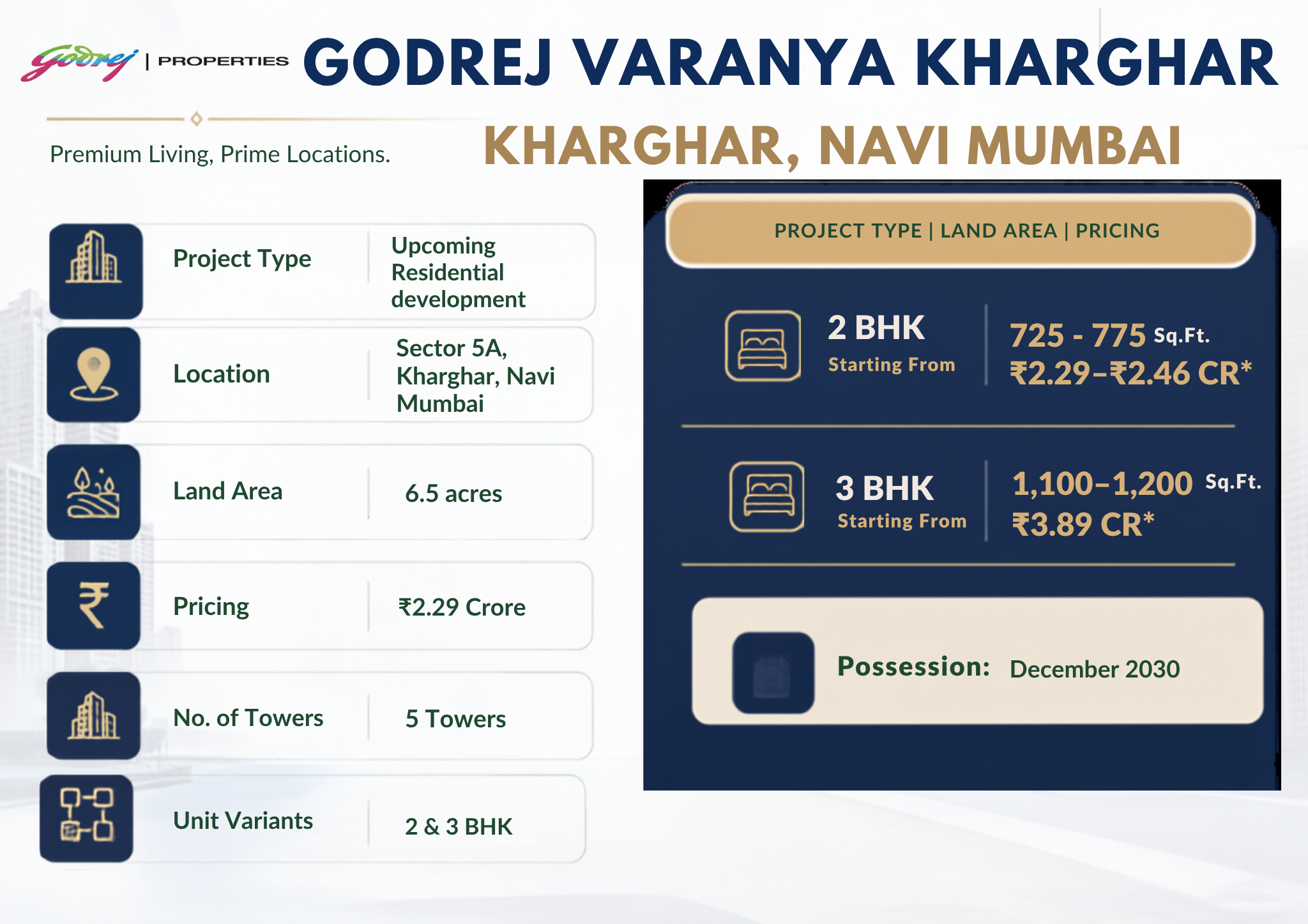
Godrej Varanya Kharghar reviews turn on one number. The project prices at Rs 30,500–33,000 per sq ft while Kharghar averages around Rs 18,500 — a premium of roughly 65–70%. You get 305 homes on 6.5 acres, a December 2030 handover, and a Sector 5A address minutes from the metro and Navi Mumbai International Airport.
Godrej Varanya is the best-designed project in Kharghar and also the most expensive by a wide margin. Both statements are true, and any honest review has to hold them together rather than pick one.
Site assessments have rated it around 4.3 out of 5, with the strongest marks going to master-plan density, metro proximity and the developer’s Navi Mumbai delivery record. Those marks are deserved. What they do not settle is whether a buyer paying Rs 2.25 Cr for a 725 sq ft carpet 2 BHK in Kharghar — in a node where comparable 2 BHK stock sells at Rs 1.50–1.80 Cr — is buying quality or buying a brand.
Our team analysed the premium against Kharghar’s own rate history, the Navi Mumbai International Airport catalyst, and what a December 2030 handover means for anyone doing the arithmetic today.
Godrej Varanya Kharghar Reviews: What Is on Record
Varanya is registered with MahaRERA under PM1271012502176 and PM1271012502343, with a December 2030 possession timeline on record. The development spans 6.5 acres holding 305 apartments across 5 towers rising G+37, in 2 and 3 BHK configurations. Amenities run past 40 across a clubhouse of roughly 50,000 sq ft.
Pricing runs from about Rs 2.25 Cr for a 725 sq ft carpet 2 BHK to Rs 4.66 Cr for a 1,211 sq ft carpet 3 BHK, at rates of Rs 30,500–33,000 per sq ft.
The density figure is the project’s strongest technical credential. 305 homes on 6.5 acres is about 47 units per acre — dramatically lower than the 180-plus densities common in Navi Mumbai’s newer towers and far below the 500-plus of compact Mumbai launches. Five towers on 6.5 acres means genuine ground-level open space rather than podium substitution, and that is the single feature most likely to still be delivering value in 2040.
The Premium, Measured Against Kharghar Itself
Here is the comparison most Godrej Varanya Kharghar reviews avoid putting in a table.
| Segment | Rate per sq ft | 2 BHK Ticket | Gap to Varanya |
|---|---|---|---|
| Godrej Varanya, Sector 5A | Rs 30,500–33,000 | From Rs 2.25 Cr | — |
| Kharghar premium stock (park/golf facing) | Rs 19,000–32,000 | Varies | Varanya at the top of band |
| Kharghar standard apartments | Rs 12,000–18,000 | Rs 1.50–1.80 Cr | 20–35% cheaper |
| Kharghar node average | Rs 17,750–18,500 | — | Varanya ~65–70% above |
Varanya does not sit slightly above its market. It sits at roughly 1.7 times the node average and at or above the ceiling of Kharghar’s existing premium band — the golf-course and Central Park-facing stock that has historically defined the top of this market.
Kharghar’s own trajectory adds context. Flat rates in the node moved 3.8% over the past year, 17.9% over three years, 23.7% over five and 35.5% over ten. Values went from about Rs 14,750 per sq ft in 2021 to Rs 17,750 by 2025 — roughly 20% across four years. One tracker recorded the node essentially flat year-on-year through August 2026. This is a steady, infrastructure-led market, not a fast one.
For the Rs 30,500 per sq ft entry to look reasonable on resale in 2030, Kharghar’s average would need to close a substantial part of a 65–70% gap in four years. Its ten-year record is 35.5% in total.
What the Premium Genuinely Buys
The case for paying it is not weak, and it rests on four things that are real rather than promotional:
- Location within Kharghar — Sector 5A, one to two minutes from Utsav Chowk and Belpada metro station, with the Sion-Panvel Highway, Central Park Road, Kharghar railway station, the Mumbai-Pune Expressway and Atal Setu all feeding the node
- Airport proximity — Navi Mumbai International Airport roughly 15–16 minutes away, with NMIA now approaching full operation
- Low density — 47 units per acre, which no competing Kharghar project at Rs 1.50–1.80 Cr can match
- Delivery record — a developer with completed Navi Mumbai and Mumbai stock behind it, which matters on a build that will not hand over until 2030
Metro Line 1 extension work and NMIA’s commissioning are the two structural catalysts here, and most analysts project 5–12% annual appreciation across the airport-adjacent nodes depending on the pocket. If Kharghar delivers at the top of that range, the premium compresses. If it delivers at the bottom, the buyer at Rs 30,500 per sq ft is carrying the gap alone.
Yield check: Kharghar apartments rent at roughly Rs 50 per sq ft a month and the node’s rental yield sits near 3.11%. On a 725 sq ft carpet 2 BHK bought at Rs 2.25 Cr, that maths lands closer to 2% than 3%. Varanya is not a rental-income asset.
Eight Things to Verify Before Booking at Varanya
A 2030 handover is four years of exposure. Work through this before committing:
- Pull both MahaRERA registrations — PM1271012502176 and PM1271012502343 — and confirm which towers sit under which, plus the completion date shown on the portal
- Confirm the carpet area on the agreement; the 725 and 1,211 sq ft figures quoted are carpet, so check that the sales pitch is not switching to saleable
- Ask which tower and floor band your unit falls in, and what it will face once all five G+37 towers are up
- Visit two competing Kharghar projects the same week to price the 20–35% gap for yourself
- Tie the payment schedule to construction milestones rather than calendar dates on a build this long
- Budget the rent-plus-EMI overlap through to December 2030 honestly
- Ask what portion of the 50,000 sq ft clubhouse is delivered in phase one versus at final handover
- Check current Kharghar resale listings in the Rs 2 Cr-plus band to see how thin that buyer pool actually is
Point eight is the one we would stress most. Kharghar has a deep buyer market below Rs 1.8 Cr and a much thinner one above Rs 2.25 Cr. Exit liquidity, not construction risk, is the real question mark on Godrej Varanya Kharghar.
Where Varanya Fits in Godrej’s MMR Strategy
Godrej Properties Limited, as a third-party developer, is running its Mumbai portfolio across an enormous price range — sub-Rs 1 Cr compact launches in the western suburbs at one end, a sea-facing Bandra West redevelopment at the other. Varanya is the attempt to plant a Mumbai-grade premium product inside a Navi Mumbai node, at Navi Mumbai’s first real test of whether brand can carry a 65–70% price gap.
That is genuinely new territory for Kharghar. If it works, it resets the node’s ceiling and every later launch benefits. If it does not, the buyers who paid the premium absorb the correction. Our investment analysis of Varanya and our five-project Godrej Mumbai comparison work through both scenarios. Corporate project information is published by Godrej Properties Limited.
Frequently Asked Questions
Q: Is Godrej Varanya Kharghar worth the price?
It depends on your horizon. At Rs 30,500–33,000 per sq ft against a Kharghar average near Rs 18,500, you are paying 65–70% above the node for 47-units-per-acre density, Sector 5A metro access and airport proximity. For a long-hold end user that is defensible; for a five-year investor the gap is a real risk.
Q: What is the RERA number for Godrej Varanya?
The project carries two MahaRERA registrations, PM1271012502176 and PM1271012502343. Confirm on the portal which towers fall under each and check the registered completion date against the December 2030 timeline quoted by sales teams.
Q: When is possession for Godrej Varanya Kharghar?
December 2030 per the RERA registrations. That is a four-year-plus wait, so structure the payment plan around construction milestones and budget for rent-and-EMI overlap through the full period.
Q: How does Varanya compare with other Kharghar projects?
Competing projects in nearby sectors sell 2 BHK apartments at Rs 1.50–1.80 Cr against Varanya’s Rs 2.25 Cr entry — 20–35% cheaper. What they do not offer is 305 homes on 6.5 acres; most Navi Mumbai towers run three to four times that density.
Q: What rental yield can I expect at Godrej Varanya?
Kharghar’s rental yield averages 3.11% and apartments rent near Rs 50 per sq ft a month. On a Rs 2.25 Cr, 725 sq ft carpet 2 BHK, that works closer to 2%. Buy this for end use or capital appreciation, not for rental income.
Q: Will the Navi Mumbai airport push Kharghar prices up?
Most analysts project 5–12% annual appreciation across airport-adjacent nodes as NMIA becomes operational and Metro Line 1’s extension advances. Kharghar’s actual record is more measured — 3.8% over the past year and 35.5% across ten years — so treat the higher projections as an upside case, not a base case.
Our Verdict
Godrej Varanya is the best-planned residential product Kharghar has seen, and the 47-units-per-acre master plan will still be an advantage a decade from now. The Sector 5A position, minutes from Belpada metro and roughly a quarter-hour from NMIA, is the strongest address in the node. On product, the 4.3 out of 5 rating is fair.
On price, buyers should go in clear-eyed. A 65–70% premium over the node average is a bet that Kharghar’s ceiling rises to meet Varanya by 2030, in a market whose ten-year total appreciation is 35.5%. If you are buying to live in it for fifteen years, that bet barely matters. If you are buying to exit in five, it is the whole investment case. Our team can share tower-wise availability, current pricing and comparative numbers from competing Kharghar projects if you want to price the gap yourself.