
Quick Answer
Related Godrej projects nearby:
Godrej Bandra Reclamation — Sea-Facing 4 BHK, Mumbai →Godrej Trilogy – Worli, Mumbai →Godrej Horizon – Wadala Mumbai →
Carpet area is the usable floor inside your flat’s walls, as defined in Section 2(k) of RERA. Built-up area adds the walls and usually the balcony. Super built-up area adds a share of the lobbies, lifts and clubhouse. In Maharashtra a developer must price and register the flat on RERA carpet area, so compare every quote on the carpet figure.
Carpet area vs built up area is the first number game every Mumbai homebuyer meets, and in 2026 it still catches people out. A flat advertised as “1,050 sq ft” can turn out to have about 720 sq ft of carpet area. The rest is walls, balconies and a share of the building’s common areas. ANAROCK measured the average loading in the Mumbai Metropolitan Region at 43% in Q1 2025, up from 33% in 2019. That is the highest of India’s seven largest housing markets.
The Real Estate (Regulation and Development) Act, 2016 was meant to end this confusion. It fixed one legal definition of carpet area and made developers sell on that figure. Brochures, broker messages and resale listings still mix all three terms, though, and resale flats in particular are often quoted in built-up or super built-up area.
We at Godrej Properties MMR see this confusion on almost every site visit. This guide sets out what each term means under Maharashtra law and how MahaRERA treats balconies. It also shows how to convert a price per sq ft from one basis to another, and what to check in your agreement before you pay the booking amount.
Carpet Area vs Built Up Area: The Three Definitions
The three terms measure the same flat in three different ways. Only one of them, RERA carpet area, has a legal definition that binds a developer in Maharashtra.
RERA carpet area. Section 2(k) of the RERA Act defines carpet area as the net usable floor area of an apartment. It excludes the area covered by external walls, service shafts, the exclusive balcony or verandah, and the exclusive open terrace. It includes the area covered by internal partition walls. In practice that is the floor you can walk on, plus the thin walls between your rooms.
Built-up area. This adds the thickness of the external walls, and usually the balcony and any dry or utility area, to the carpet area. It has no single statutory definition, so each developer or broker calculates it a little differently. A common rule of thumb is that built-up area is about 10 to 20% larger than carpet area [VERIFY: not sourced, industry rule of thumb].
Super built-up area. This adds a proportionate share of common areas to the built-up area. Those areas include lobbies, staircases, lift wells, corridors, the clubhouse and sometimes landscaped podiums. Because there is no legal formula, two projects with the same carpet area can quote very different super built-up figures.
RERA requires carpet area to be disclosed, but no law caps the loading factor. In the MMR, loading reached 43% in Q1 2025, so a buyer paying for 1,000 sq ft of super built-up area could be getting about 700 sq ft of usable carpet. (Source: ANAROCK, Q1 2025)
Loading is calculated as (super built-up area minus carpet area) divided by carpet area, multiplied by 100. A 1,000 sq ft carpet flat quoted at 1,300 sq ft super built-up therefore carries 30% loading. The higher the loading, the less of your money buys space you can live in.
How MahaRERA Treats Balconies, Terraces and Enclosed Spaces
Balconies cause most of the disputes, because the rules changed. Under the older Maharashtra Ownership Flats Act (MOFA), developers commonly disclosed carpet area including balcony space. RERA takes the opposite approach. An exclusive balcony, verandah or open terrace sits outside the carpet area, even though only you can use it. MahaRERA orders have noted that the two Acts define carpet area differently. That is why a flat bought before 2017 and a similar flat bought today can show different carpet figures for the same layout.
Under RERA the balcony is not lost. It is disclosed as a separate exclusive area next to the carpet area, and the developer cannot fold it into the carpet figure to make the flat look bigger. Some commentators read the law as banning any “loading” of common areas into the declared carpet area.
Enclosed balconies and older Mumbai terms such as “EDA”, flower beds and niches are less clear. If a balcony has been glazed and merged into a room, the plan approved by the municipal corporation decides whether it counts as habitable floor area. A developer’s brochure does not. We have not found a MahaRERA circular that settles enclosed balconies across all projects [VERIFY: not sourced]. Ask for the approved plan and get the classification in writing.
Key takeaway: Your agreement should show the RERA carpet area and each exclusive area (balcony, terrace, dry balcony) as separate figures. If the brochure shows one combined number, ask for the split before you pay anything.
The MahaRERA model agreement for sale also controls how far the final flat may differ from the promise. Clause 1(g) allows a variation of up to 3% in carpet area. If the flat is larger by up to 3%, you pay for the extra area at the agreed rate. If it is smaller by any amount within that limit, the promoter must refund the excess within 45 days, with annual interest at the rate set in the Rules. A 2026 consumer column in the Free Press Journal noted that developers sometimes claim a small shortfall needs no refund. The model agreement says otherwise.
The protection has limits. In one MahaRERA order, buyers who had signed a letter confirming they were satisfied with the carpet area were refused a refund. Do not sign a possession or “area accepted” letter until you have measured the flat yourself.
Worked Example: Converting a Mumbai Price per Sq Ft
Converting between the three bases matters most when you compare a new launch, which is quoted on RERA carpet area, with a resale flat, which is often quoted on built-up or super built-up area. Mixing them can make a costlier flat look cheaper.
Take a 700 sq ft carpet flat at Rs 30,000 per sq ft of carpet. That rate is roughly where premium Navi Mumbai and suburban Mumbai launches sit in 2026. The agreement value is Rs 2.10 crore. The table shows the same flat and the same price on each basis, assuming 15% for walls and balcony and the 43% MMR average loading.
| Basis | Area quoted | Rate per sq ft | Total price |
|---|---|---|---|
| RERA carpet area | 700 sq ft | Rs 30,000 | Rs 2.10 crore |
| Built-up area (+15%) | 805 sq ft | About Rs 26,090 | Rs 2.10 crore |
| Super built-up (43% loading) | 1,001 sq ft | About Rs 20,980 | Rs 2.10 crore |
| Super built-up (30% loading) | 910 sq ft | About Rs 23,080 | Rs 2.10 crore |
The price never changes. Only the denominator does. A resale flat quoted at Rs 22,000 per sq ft “super built-up” can therefore cost more per usable sq ft than a new flat at Rs 30,000 per sq ft carpet. At 43% loading, Rs 22,000 on super built-up works out to about Rs 31,460 per sq ft of carpet.
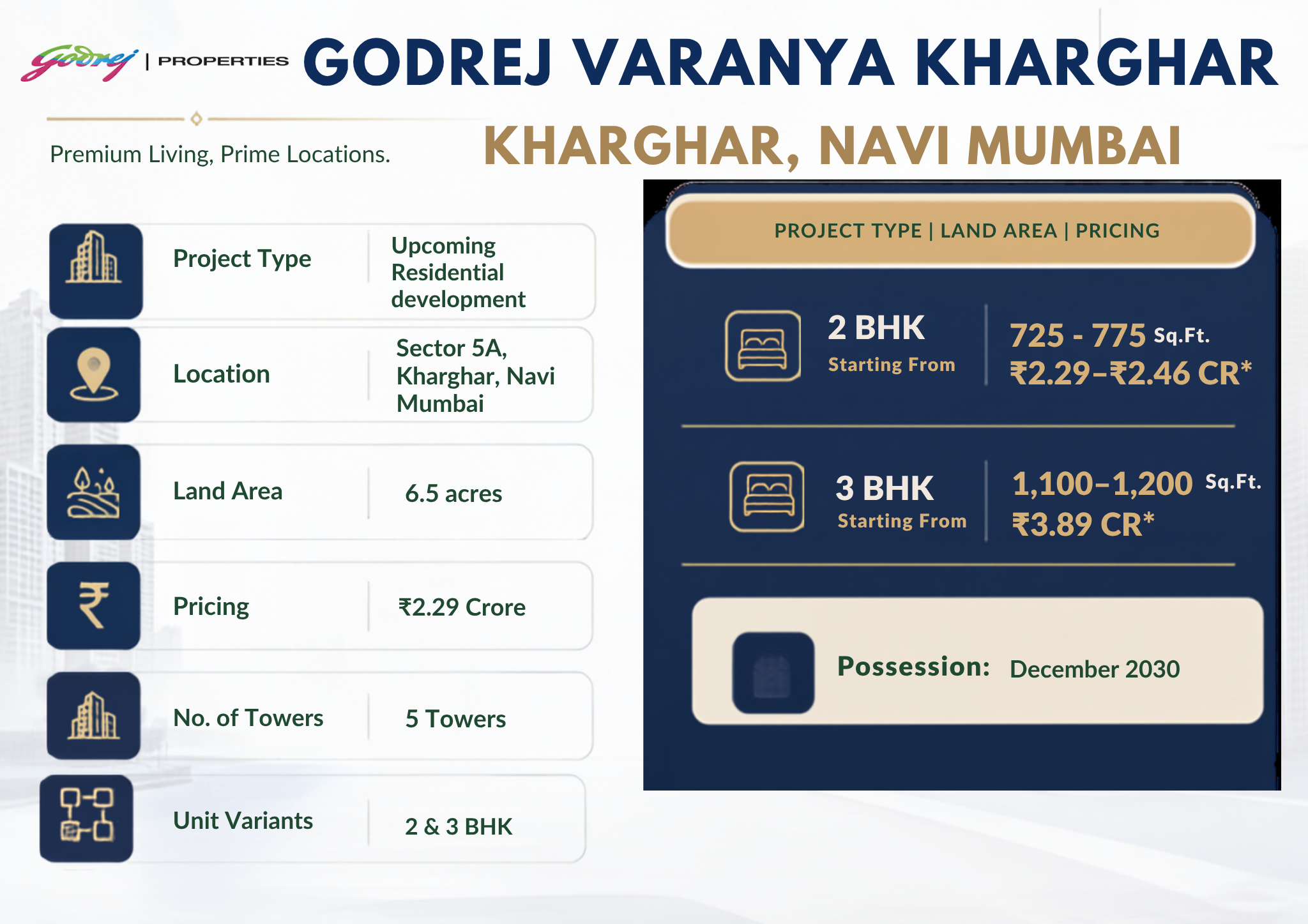
A real case shows the scale. Godrej Varanya in Kharghar offers 2 and 3 BHK homes of 775 to 1,200 sq ft carpet, at about Rs 30,500 to Rs 33,000 per sq ft of carpet. Our Godrej Varanya Kharghar reviews compare that rate with the wider Kharghar market. Many older Kharghar listings are quoted on super built-up area, so the gap can look wider than it really is. Convert both sides to carpet before you judge it.
How to Check Carpet Area on MahaRERA
Every registered project in Maharashtra uploads its unit inventory to the MahaRERA portal. That gives you an independent check on the carpet area the developer registered, before you rely on a brochure or a broker’s message. Here is the process.
- Get the RERA number for the exact phase or tower you are buying. Large projects often have separate registrations for each phase.
- Search the project on the MahaRERA website (maharera.maharashtra.gov.in) using the registration number.
- Open the building and apartment details. The registration lists each apartment type with its carpet area and the area of any exclusive balcony or terrace.
- Download the approved plans and the proforma agreement uploaded with the registration. The agreement should state carpet area in square metres as well as square feet.
- Match all three figures: the MahaRERA inventory, your allotment letter and your draft agreement. Any gap should be explained in writing.
- Measure at possession. Measure wall to wall with an architect or a laser meter, and compare against the agreement before you sign any acceptance letter.
For multi-phase projects, check that your tower falls under the registration you looked up. Our carpet area and RERA check for Varanya shows this phase-by-phase check on a live project. Our guide to MahaRERA homebuyer protections in 2026 covers the wider pre-booking checks.
Conversion Checklist Before You Book
Most carpet-area disputes come from two documents that never matched in the first place, usually a brochure and an agreement. These checks take an hour and can save a lakh or more.
- Ask “carpet or super built-up?” every time a price per sq ft is quoted, and write the answer down.
- Get the balcony and terrace areas separately, and confirm that none of them is counted in the carpet area.
- Calculate the loading on any resale or older project quote. Anything well above 40% deserves questions.
- Convert every option to a carpet-area rate before you compare a new launch with a resale flat.
- Check that stamp duty and the agreement use the same carpet figure. The registered document is what a court will read.
- Read clause 1(g) of the agreement for the 3% variation and refund terms.
- Don’t sign an “area accepted” letter until the flat has been measured.
Why It Matters for Godrej Projects in the MMR
Godrej Properties Limited registers its MMR projects with MahaRERA and quotes new inventory on RERA carpet area, as every Maharashtra developer must. That makes comparing Godrej projects with each other straightforward. The harder comparison is with resale flats and older buildings nearby, which are still often marketed on super built-up area.
That comparison is where our team spends most of its time. A buyer weighing a ready flat in Kandivali East against a new Godrej launch, or a Kharghar resale against Varanya, needs both prices on the same basis before the premium or discount means anything. Our Godrej Mumbai project reviews hub lists carpet-area ranges for each project, so you can run the conversion yourself.
Frequently Asked Questions
Q: What is the difference between carpet area and built-up area?
Carpet area is the usable floor inside your flat, including internal partition walls, as defined in Section 2(k) of RERA. Built-up area adds the external walls and usually the balcony or utility area. It is typically 10 to 20% larger than carpet area, but it has no fixed legal formula.
Q: Is the balcony included in RERA carpet area?
No. RERA excludes exclusive balconies, verandahs and open terraces from carpet area, even if only you can use them. They are disclosed separately. Under the older MOFA framework, balconies were often included, which is why pre-2017 and current figures for similar flats can differ.
Q: What is a normal loading percentage in Mumbai?
ANAROCK put average loading in the MMR at 43% in Q1 2025, up from 33% in 2019 and 39% in 2022. Individual projects vary widely. No law caps loading, so calculate it yourself on every super built-up quote.
Q: Can a developer charge on super built-up area under RERA?
No. In Maharashtra, the sale price in the agreement must be based on RERA carpet area. Developers may still mention super built-up figures in marketing, but the registered agreement must state the carpet area, and that is the figure you are paying for.
Q: What happens if my flat is smaller than the agreement says?
Under clause 1(g) of the MahaRERA model agreement, carpet area may vary by up to 3%. Any reduction within that limit must be refunded within 45 days with interest. A larger shortfall is a breach you can take to MahaRERA. Don’t sign an area acceptance letter before measuring.
Q: How do I convert a super built-up rate to a carpet rate?
Multiply the super built-up rate by (1 + loading). At 43% loading, Rs 22,000 per sq ft super built-up equals about Rs 31,460 per sq ft of carpet. If you don’t know the loading, divide the total price by the RERA carpet area.
Conclusion
The carpet area vs built up area question comes down to one habit: convert every quote to RERA carpet area before you compare. Built-up and super built-up figures aren’t wrong, but they aren’t standardised, and in the MMR the gap between super built-up and carpet area averaged 43% in Q1 2025. Check the MahaRERA inventory, get balconies listed separately, and measure the flat before you accept it.
If you are comparing projects in Mumbai, Thane or Navi Mumbai, start at Godrej Properties MMR. Our team can set out carpet areas and per-sq-ft rates on a like-for-like basis and arrange a site visit.