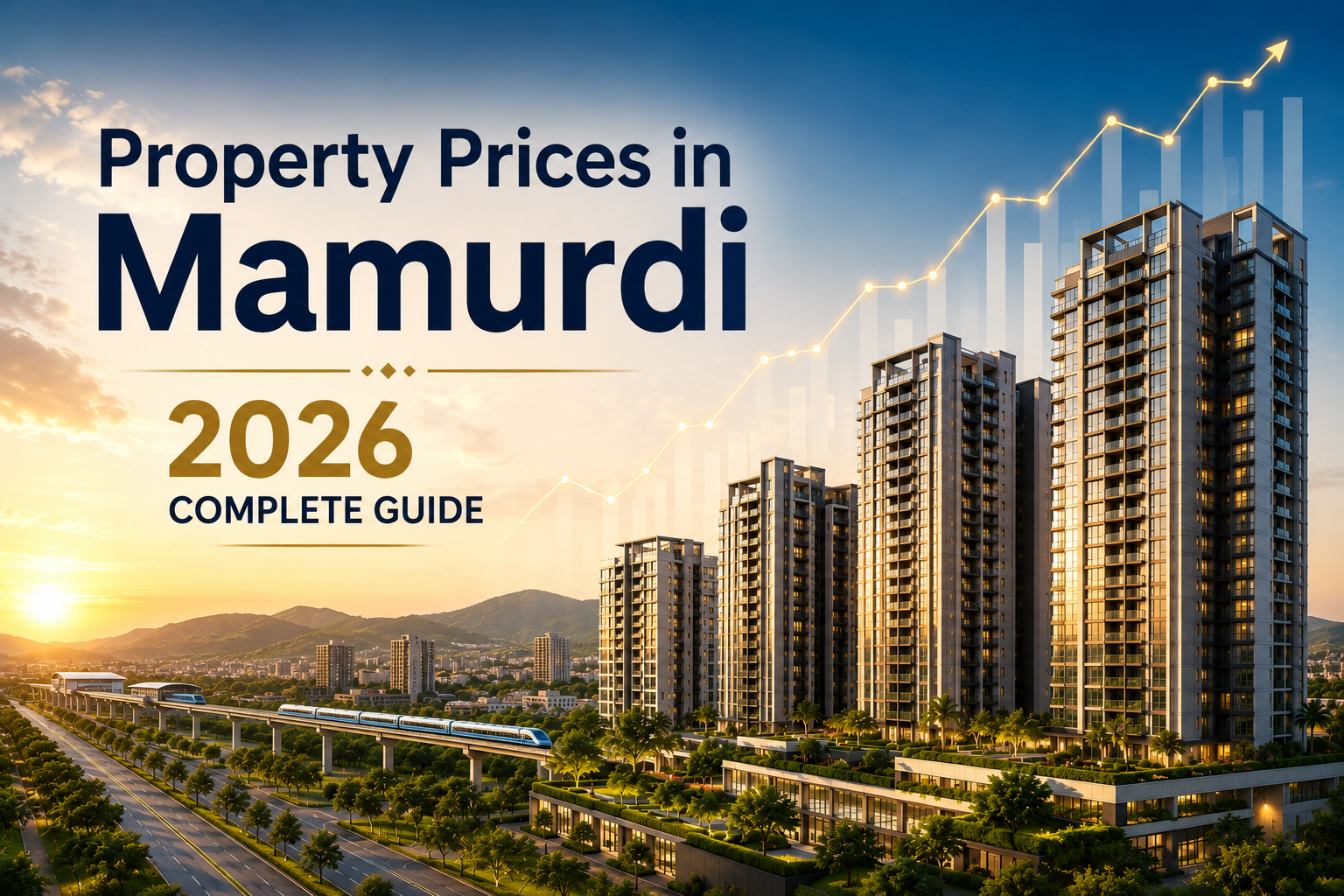
Property prices in Mamurdi — 2026 complete guide
Mamurdi’s average residential rate sits around ₹10,100/sqft in 2026 — below Wakad (₹11,000–13,000+) and Baner (₹13,000+), comparable to Ravet and Kiwale. Branded supply like Grande at Godrej Serene (from ₹52 Lakh, RERA P52100047405) is anchoring the corridor’s pricing.
Our take: a value micro-market with appreciation tied to the Ravet corridor’s continued build-out.
Is Mamurdi property getting expensive in 2026?
Property pricing in Mamurdi has firmed up as the Ravet corridor matured, but it remains one of the more affordable branded-housing micro-markets on Pune’s western belt. The average residential rate sits around ₹10,100 per sq ft in 2026, which is materially below Wakad’s ₹11,000–13,000+ and Baner’s higher band, while tracking close to neighbouring Ravet and Kiwale. For buyers, the question is less “is it expensive?” and more “how much corridor-driven appreciation is still ahead?”
This guide breaks down current rates, the drivers behind them, and how Mamurdi compares with its neighbours, using branded supply as the clearest pricing signal. The arrival of Godrej Properties Limited with Grande at Godrej Serene is itself a marker of where the corridor is heading. We reference real configuration pricing from our Grande at Godrej Serene listing throughout.
Background — what drives Mamurdi pricing
Three forces set Mamurdi’s price level. First, connectivity: proximity to the Mumbai–Pune corridor and the Hinjewadi IT belt via Ravet underpins steady end-user and tenant demand. Second, employment: the Chinchwad–Pimpri industrial base and the IT corridor provide a broad buyer pool. Third, branded supply: when a developer such as Godrej Properties Limited enters at a defined rate, it anchors expectations for surrounding stock — you can see the developer’s national footprint at Godrej Properties.
The counterweight keeping prices accessible is the locality’s still-maturing social infrastructure. Until schools, hospitals and large-format retail densify, Mamurdi trades at a discount to fully-formed suburbs — which is precisely the gap that creates appreciation potential for early buyers.
Current price data
| Configuration (Serene) | Indicative price |
|---|---|
| 1 BHK (455–501 sq ft) | ~₹52 Lakh |
| 2 BHK (747–767 sq ft) | ~₹76.90 Lakh |
| 3 BHK (~947 sq ft) | ~₹95.90 Lakh |
| Average rate | ~₹10,100 / sq ft |
These figures are indicative and should be confirmed against the developer’s current price list and recent registered transactions. They illustrate the locality’s core proposition: a branded two-bedroom under ₹80 Lakh, which is increasingly rare across PCMC’s better-connected pockets.
Market analysis — Mamurdi vs neighbours
Set against neighbouring micro-markets, Mamurdi’s value position is clear. It undercuts Wakad and Baner meaningfully while offering comparable corridor access, and it tracks close to Ravet and Kiwale, which have appreciated as the western ring infrastructure built out. Localities along this belt have broadly recorded mid-single to low-double-digit annual appreciation over recent cycles, though past performance is a guide rather than a promise.
| Locality | Indicative rate (₹/sqft) | Relative position |
|---|---|---|
| Mamurdi | ~10,100 | Value base |
| Ravet / Kiwale | ~10,000–11,500 | Comparable |
| Punawale | ~10,500–12,000 | Slightly higher |
| Wakad | ~11,000–13,000+ | Premium |
| Baner | ~13,000+ | Significantly higher |
The pattern that matters for buyers is the price ladder: as Ravet and Kiwale have densified and risen, demand has spilled into still-affordable Mamurdi. An under-construction project here, with June 2027 possession, captures the entry discount before that catch-up fully plays out.
Deep dive — under-construction vs ready pricing
Under-construction stock like Grande at Godrej Serene typically prices below comparable ready inventory, reflecting the time value and construction risk a buyer absorbs. That discount, combined with a construction-linked payment plan, is the main lever for capturing appreciation between booking and the June 2027 handover. The trade-off is that buyers carry cost before they can occupy or let the home.
For price-sensitive buyers, this is where configuration choice intersects with the market: the 1 BHK from ₹52 Lakh minimises capital at risk, while the 2 BHK from ₹76.90 Lakh balances ticket size against the deepest demand. Our full project review works through how each configuration sits against the market.
Price outlook & appreciation drivers
| Driver | Direction | Implication for prices |
|---|---|---|
| Ravet corridor build-out | Positive | Supports steady appreciation |
| Hinjewadi employment | Positive | Sustains tenant/buyer demand |
| Social infra maturing | Positive (gradual) | Narrows discount to suburbs |
| New supply volume | Mixed | Can cap near-term price spikes |
On balance, the drivers point toward gradual appreciation rather than a sharp spike, with the pace tied to how quickly the corridor’s infrastructure and social fabric mature. Buyers should treat Mamurdi as a steady medium-term play, not a quick flip, and verify current rates against registered transactions before acting.
Buyer guidance
Before buying, pull recent registered transaction rates for Mamurdi and the specific project, since portal averages can lag the market in either direction. Budget the all-in cost — headline price plus 7–8% statutory charges — and confirm floor-rise and parking on the cost sheet. For the lived-experience side of pricing, our Mamurdi living guide explains what the neighbourhood actually offers at this price point.
Conclusion
Mamurdi in 2026 is a value micro-market: ~₹10,100 per sq ft buys branded, well-connected housing at a clear discount to Wakad and Baner. Prices have firmed but are not stretched, and the appreciation case rests on the Ravet corridor continuing to build out. For buyers willing to take a medium-term view, an under-construction branded project here offers an entry discount worth weighing — provided every figure is verified against live transaction data.
FAQ 1 — What is the average property rate in Mamurdi?
The average residential rate is around ₹10,100 per sq ft in 2026, below Wakad and Baner but comparable to Ravet and Kiwale. Branded under-construction stock such as Grande at Godrej Serene prices in line with this. Confirm against recent registered transactions before buying.
FAQ 2 — Are Mamurdi prices rising?
Prices have firmed as the Ravet corridor matured, with the belt broadly recording mid-single to low-double-digit annual appreciation over recent cycles. The outlook points to gradual rather than sharp gains, tied to infrastructure build-out. Past performance is a guide, not a guarantee.
FAQ 3 — Why is Mamurdi cheaper than Wakad?
Mamurdi trades at a discount mainly because its social infrastructure — schools, hospitals, large-format retail — is still developing, whereas Wakad is established. The two share corridor connectivity, which is what creates the catch-up appreciation potential. The discount is the early buyer’s opportunity.
FAQ 4 — Is under-construction cheaper than ready property?
Yes — under-construction stock like Grande at Godrej Serene typically prices below comparable ready inventory, reflecting time value and construction risk. A construction-linked payment plan helps capture appreciation to the June 2027 handover. The trade-off is carrying cost before occupancy.
FAQ 5 — What will drive future Mamurdi prices?
The main drivers are the Ravet corridor build-out, Hinjewadi employment demand and the gradual maturing of social infrastructure, partly offset by new supply volume. Together they point to steady medium-term appreciation. Treat Mamurdi as a medium-term hold rather than a quick flip.