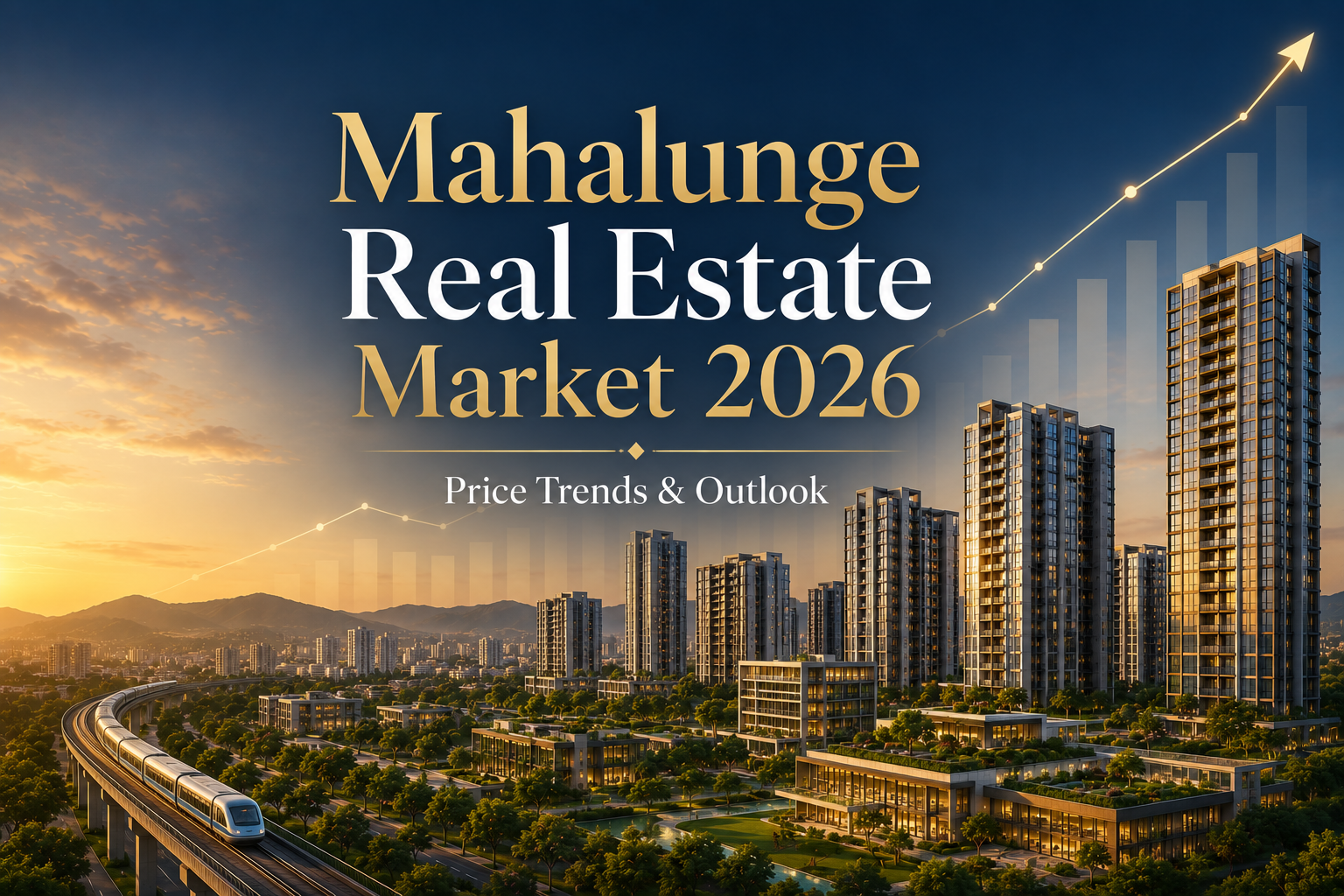
Mahalunge Market 2026: West Pune’s Fastest-Maturing Address
Average ~₹11,669/sqft • ~90% price growth over 5 years • gross rental yield ~4%
Mahalunge has shifted from an overflow zone for Hinjewadi into a priced-in destination of its own; with the Hinjewadi-Shivajinagar metro arriving in 2026, our team expects steady 5-7% annual appreciation rather than another explosive run.
1. Mahalunge in 2026: The Market Snapshot
Mahalunge enters 2026 trading at an average of roughly ₹11,669 per square foot on carpet, with most live inventory falling between ₹10,200 and ₹13,400 depending on tower, view and possession date. That puts this West Pune pocket firmly in the upper-mid tier, above Wakad and standard Hinjewadi but a notch below Baner. The clearest reference point in the new-launch segment is Godrej Hillside 3 (RERA P52100050939) on Nande Road, where 2 and 3 BHK homes of 657 to 902 sqft are priced from ₹70 Lakh to ₹1.10 Cr. At those configurations the effective rate lands near ₹10,500-12,200 per sqft, which sits comfortably inside the prevailing Mahalunge band.
What makes 2026 a genuine inflection point is not a single price spike but the convergence of three things: delivered supply, infrastructure timelines and a deeper buyer pool. Mahalunge has already absorbed two completed Godrej phases, so the area is no longer selling on promise alone. Our team reads the current data as a maturing market where the speculative froth of 2019-2024 has given way to end-user-led demand. For buyers, that means fewer easy flips but a more dependable hold.
The headline number worth internalising is the 5-year appreciation of roughly 90%, from about ₹7,020/sqft in 2019 to near ₹13,400 at the 2024 peak for premium stock. That kind of move is hard to repeat from a higher base, and we will return to why a 5-7% annual trajectory is the more realistic 2026-2028 expectation. This post is a forward-looking read on those dynamics, not a generic price list. We will work through the demand drivers, three data tables and clear timing guidance below.
2. What’s Driving the Mahalunge Market
The single biggest force behind Mahalunge’s rise is spillover. Hinjewadi, Baner and Balewadi have effectively saturated on land and pricing, pushing both developers and buyers a few kilometres west into Mahalunge’s relatively open Nande belt. As Baner pushed past ₹12,000-14,000/sqft, the value gap made Mahalunge’s ₹10,200-13,400 range look like the sensible alternative for the same employment catchment. This is classic ring-expansion: the core gets expensive, the next ring inherits the demand.
Developer conviction matters here, and Godrej Properties Limited has put real weight behind the micro-market by delivering Hillside 1 and 2 and then launching Hillside 3 as a 31-floor, 493-unit single tower. A developer that returns for a third phase on the same road is signalling confidence in absorption, and that track record reassures end-users who fear stranded projects. You can review the developer’s national portfolio and disclosures directly at godrejproperties.com. For the live Mahalunge product, the Godrej Hillside 3 listing sets out the 657-902 sqft configurations and the February 2028 possession schedule.
The third driver is connectivity that is finally moving from plan to pour. The Nande-Balewadi and Balewadi-Mahalunge link roads are tightening the area’s access to the Mumbai-Pune corridor and to Balewadi’s sports and commercial cluster. Layered on top is the Hinjewadi-Shivajinagar metro, whose first stretch of roughly 11 km is slated to be operational in 2026 ahead of the full 23 km line. Each of these is a measurable catalyst, and together they explain why Mahalunge’s fundamentals look sturdier in 2026 than in any prior cycle.
3. Mahalunge Price Bands & Trend
The table below frames where Mahalunge pricing sits in 2026 and how it got there. The 90% five-year jump is real, but note that the steepest part of that climb is behind us; the forward expectation is a measured 5-7% per year. Godrej Hillside 3’s ₹70 Lakh entry point is one of the more accessible ways into the area’s new-launch segment at the 657 sqft 2 BHK size.
| Metric | 2019 | 2024 Peak | 2026 Range |
|---|---|---|---|
| Avg carpet rate (₹/sqft) | ~7,020 | ~13,400 | ~10,200-13,400 |
| Mahalunge blended average | – | – | ~11,669 |
| 5-year appreciation | Base | ~90% | Realised |
| Forward annual growth (est.) | – | – | ~5-7% |
| Godrej Hillside 3 effective rate | – | – | ~10,500-12,200 |
| Entry ticket (2 BHK, 657 sqft) | – | – | From ₹70 Lakh |
Two patterns stand out from this trend. First, the spread between the floor and ceiling rate, about ₹3,200/sqft, is wide for a single micro-market, which tells you that tower quality, floor height and possession timing carry a real premium here. Second, a new-launch product entering near the lower-to-middle of the band, as Hillside 3 does, leaves room for the natural construction-stage to ready-possession uplift through 2028. We see that gap as the main near-term value lever for patient buyers.
4. Mahalunge vs Neighbouring Micro-Markets
Mahalunge does not exist in isolation; it is priced relative to four established neighbours, and understanding that ladder is essential before committing capital. Baner and Balewadi sit above it, Wakad and standard Hinjewadi below, and Mahalunge occupies the value-rich middle. The comparison below uses 2026 carpet ranges so you can see exactly where the gaps lie.
| Micro-market | 2026 Rate (₹/sqft) | Positioning | Primary draw |
|---|---|---|---|
| Baner | ~12,000-14,000 | Premium | Established social infra |
| Balewadi | ~11,500-14,000 | Premium | Sports city & high street |
| Mahalunge | ~10,200-13,400 | Value-growth | New supply + metro upside |
| Wakad | ~9,500-11,500 | Mid | Mature rental demand |
| Hinjewadi (standard) | ~9,000-11,500 | Mid | IT employment core |
The takeaway is that Mahalunge buys you Baner-Balewadi adjacency at a discount of roughly ₹1,500-3,000/sqft versus those two. That discount is the area’s core investment thesis: as link roads and the metro narrow the convenience gap, the price gap tends to compress. For comparison shoppers, our Hillside 3 versus Kolte-Patil Life Republic comparison breaks down how Mahalunge stacks against another large West Pune township. Just be aware the same compression logic also caps how far above ₹13,400 Mahalunge can run while Baner is still near ₹14,000.
5. Deep Dive: The Demand Drivers
Start with the employment engine. Hinjewadi’s IT parks generate a daily workforce in the hundreds of thousands, and as that core saturated on housing, the natural overflow moved into Mahalunge, just a short commute west. This spillover is the demand floor under the entire micro-market; it is why even a 90% historical run has not produced the vacancy you would expect from pure speculation. Tenants and end-users from the same IT pool keep absorption healthy.
Next, the Balewadi adjacency adds lifestyle gravity. The Shree Shiv Chhatrapati sports complex and the surrounding high street sit right beside Mahalunge, and a planned high-street and sports-city expansion deepens that pull. Where Hinjewadi offers jobs, Balewadi offers the weekend infrastructure, and Mahalunge is the residential wedge that taps both within a few kilometres. That dual access is rare and is a meaningful part of the 5-7% forward growth case.
Infrastructure is the third leg, and it is the one with hard 2026 dates. The first ~11 km of the Hinjewadi-Shivajinagar metro is targeted for operation in 2026, with the full 23 km following, which would directly shorten the journey from Mahalunge’s catchment to central Pune. The Nande-Balewadi and Balewadi-Mahalunge link roads further cut local travel friction. Buyers who want delivered proof rather than a pipeline can look at the ready-to-move Godrej Hillside 1 and 2 homes from ₹51 Lakh, which show how the earlier phases on this road have already settled in.
6. Rental & Investment Outlook
Mahalunge’s rental story is steady rather than spectacular, which is exactly what end-user-led markets produce. Gross yields sit in the 3-4% band, hovering near 4%, supported by a reliable tenant pool drawn from Hinjewadi’s IT workforce. Three-bedroom homes command ₹25,000-45,000 a month, while 2 and 3 BHK units broadly transact in the ₹22,000-35,000 range. The table below summarises the investment metrics that matter for 2026.
| Parameter | 2026 Figure | Notes |
|---|---|---|
| Gross rental yield | ~3-4% (≈4%) | Typical for end-user micro-markets |
| 3 BHK monthly rent | ₹25,000-45,000 | Floor/view dependent |
| 2/3 BHK monthly rent | ₹22,000-35,000 | Hinjewadi tenant pool |
| Expected capital growth | ~5-7% p.a. | Steady, not explosive |
| Key 2026 catalyst | Metro phase 1 (~11 km) | Re-rates accessibility |
For an investor, the combined return picture is roughly a 4% yield plus 5-7% appreciation, giving a blended pre-cost return in the high single digits. That profile favours holders over flippers, particularly given Hillside 3’s February 2028 possession, which front-loads the holding period into the construction phase. Our detailed long-term returns analysis for Godrej Hillside 3 works through the cash-flow math in full. The honest caveat is that yields near 4% mean rent alone will not carry the investment; appreciation has to do the heavy lifting.
7. Buyer Guidance: Timing & What to Watch
On timing, 2026 is attractive precisely because the metro’s first 11 km is expected to go live within the year, and pricing has not yet fully re-rated for that. Buying a construction-stage home such as Hillside 3 ahead of the catalyst captures the gap between today’s ₹10,500-12,200/sqft effective rate and the likely ready-possession value in 2028. That said, this is a 5-7% market, so the entry price you negotiate matters more than trying to time the exact bottom. Discipline on rate beats speculation on momentum here.
The single biggest thing to watch is the new-supply pipeline. Mahalunge’s fundamentals are strong, but a wave of simultaneous launches can flatten appreciation for a year or two even in a healthy area, and a 493-unit tower is itself sizeable inventory. Track how many competing units enter the Nande belt over 2026-2027 and weigh that against the metro’s absorption boost. A second checkpoint is delivery credibility: the fact that Hillside 1 and 2 are already delivered is a tangible de-risking signal.
Finally, match the product to your goal. End-users should prioritise possession certainty and the February 2028 timeline, while investors should anchor on the 4% yield plus 5-7% growth blend and the ₹70 Lakh entry ticket. Cross-check Mahalunge against Wakad’s ₹9,500-11,500 band if budget is the binding constraint, since that pocket offers mature rental demand at a lower entry. The right answer depends on whether you are buying a home to live in or a position to hold.
8. Conclusion: The 2026-2028 Outlook
Mahalunge in 2026 is a maturing West Pune address that has already done the hard work of proving demand, with an average near ₹11,669/sqft and two delivered Godrej phases behind it. The next two years should reward patient capital with steady 5-7% annual appreciation rather than another 90% surge, and a rental yield near 4% to cushion the hold. The metro’s first 11 km is the catalyst that defines 2026, while the new-supply pipeline is the risk that defines whether growth lands at the top or bottom of that range. Our team’s view is that the fundamentals justify a constructive but disciplined stance through 2028.
For buyers acting on this outlook, the framework is simple: negotiate hard on entry rate, prefer delivery-proven developers, and treat the metro and link-road timelines as the value triggers worth monitoring. Mahalunge has earned its place in the value-growth middle of West Pune’s price ladder, and at a ₹1,500-3,000/sqft discount to Baner and Balewadi, that middle is where the better risk-adjusted returns tend to sit.
Q. What is the average property rate in Mahalunge in 2026?
Mahalunge averages roughly ₹11,669 per square foot on carpet in 2026, with live inventory ranging from about ₹10,200 to ₹13,400 depending on tower quality, floor height and possession timing. That places it in West Pune’s value-growth middle tier.
Q. How much has Mahalunge appreciated over the last five years?
Mahalunge prices climbed roughly 90% over five years, moving from about ₹7,020/sqft in 2019 to near ₹13,400 at the 2024 peak for premium stock. From this higher base, our team expects a more measured 5-7% annual growth rather than a repeat surge.
Q. What rental yield can investors expect in Mahalunge?
Gross rental yields sit in the 3-4% band, hovering near 4%, with 3 BHK homes fetching ₹25,000-45,000 monthly and 2/3 BHK units ₹22,000-35,000. The tenant pool is anchored by Hinjewadi’s IT workforce, which keeps absorption dependable.
Q. What is the key catalyst for Mahalunge in 2026?
The Hinjewadi-Shivajinagar metro is the defining catalyst, with its first stretch of roughly 11 km expected to be operational in 2026 and the full 23 km line following. It directly shortens the commute from Mahalunge’s catchment to central Pune.
Q. Is Godrej Hillside 3 a good entry point into Mahalunge?
Godrej Hillside 3 (RERA P52100050939) offers 2/3 BHK homes of 657-902 sqft from ₹70 Lakh to ₹1.10 Cr, an effective ₹10,500-12,200/sqft that sits inside the prevailing band. Its February 2028 possession and delivered earlier phases make it a credible construction-stage entry.