
Home Loan Guide for Godrej Varanya — Banks, EMI and Process
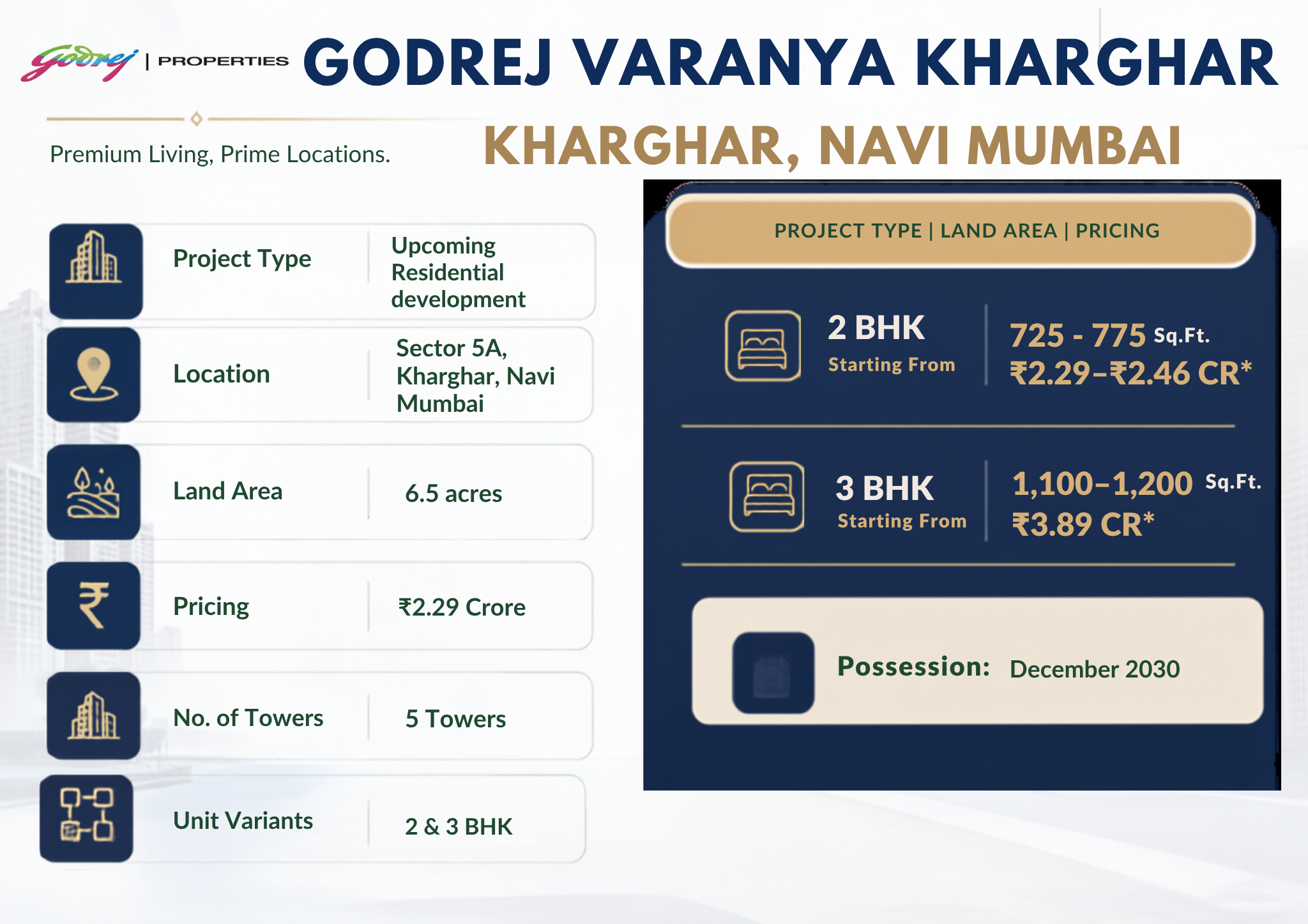
Project: Godrej Varanya, Sector 5A, Kharghar | 2 BHK from ₹2.29 Cr | 3 BHK from ₹3.89 Cr | RERA: P51271012502176 / P51271012502343
Bottom line: Godrej Varanya qualifies for home loans from all major banks at rates starting from 8.25–8.75% in 2026. A ₹2.29 Crore 2 BHK with 80% LTV requires approximately ₹46 Lakh down payment, with construction-linked disbursement keeping pre-possession interest costs lower than a lump-sum drawdown. Here is the complete financing playbook.
1. Introduction — Financing Your Godrej Varanya Purchase
The purchase decision and the financing decision are two separate analyses, and too many buyers collapse them into one. You may be convinced that Godrej Varanya at Sector 5A, Kharghar is the right project — the location, the developer credibility of Godrej Properties Limited (NSE: GODREJPROP) and the 305-unit low-density design all check out. But the financing structure you choose determines your actual cost of ownership over 20–25 years, your monthly cash-flow impact and your total interest outflow. Getting the project right and the loan wrong can cost you ₹15–30 Lakh in avoidable interest over the loan tenure.
This guide covers every aspect of home-loan financing for Godrej Varanya: which banks offer the best rates, how the construction-linked disbursement works, what EMI to expect at different loan amounts, the documentation process, tax benefits and the specific considerations for under-construction property financing. The RERA registrations — P51271012502176 and P51271012502343 — confirm the project’s regulatory compliance, which is a prerequisite for bank approvals. We present verified 2026 rate data and calculation frameworks so you can model your specific scenario accurately.
A key point upfront: Godrej Properties is among India’s top-three listed developers, and its projects universally receive approvals from all major lending institutions. This means you have full choice across SBI, HDFC, ICICI, Axis, Bank of Baroda, Kotak and others — unlike projects from smaller developers where lender options may be limited. That competitive lending environment is itself a financial advantage, because you can negotiate rates across multiple banks and choose the best offer for your profile.
2. Home Loan Basics for Under-Construction Property
Financing an under-construction property like Godrej Varanya (possession December 2030) works differently from financing a ready-to-move-in flat, and understanding these differences is critical to managing your cash flow correctly. The loan is sanctioned for the full amount at booking, but the disbursement is phased — the bank releases funds in tranches aligned with construction milestones (foundation, ground floor, slab completion at various levels, finishing). You pay interest only on the amount disbursed, not the full sanctioned amount, during the construction period. For the developer’s full project portfolio and corporate background, visit Godrej Properties.
This construction-linked disbursement is financially favourable compared to a full disbursement at booking. If your sanctioned loan is ₹1.83 Crore (80% of a ₹2.29 Crore 2 BHK) and the first tranche is ₹35 Lakh, you pay interest on ₹35 Lakh — approximately ₹24,000–26,000 per month at current rates — rather than the full EMI of approximately ₹1.45–1.55 Lakh that kicks in after the full amount is disbursed. As construction progresses and more tranches are released, the pre-EMI interest increases incrementally, giving you time to adjust your budget.
The trade-off is that pre-EMI interest is a cost with no principal reduction. You are paying interest to the bank while the building is being constructed, and none of that payment reduces your loan balance. Some banks offer a “full EMI” option during construction where you start paying full EMIs from the first tranche itself, which does reduce the principal and lowers the total interest outflow over the loan tenure — but increases your monthly outflow during the construction period. We cover both options in the EMI calculation section below.
3. Bank Rates & Eligibility — 2026 Snapshot
The table below lists the major banks offering home loans for Godrej Varanya with their current interest rates, processing fees and maximum loan-to-value (LTV) ratios as of mid-2026. Rates are indicative and vary based on borrower profile, CIBIL score and loan amount.
| Bank | Interest Rate (2026) | Processing Fee | Max LTV | Max Tenure |
|---|---|---|---|---|
| SBI | 8.25–9.15% | ₹10,000–30,000 | 80% | 30 years |
| HDFC (via HDFC Bank) | 8.50–9.25% | 0.50% of loan (max ₹10,000) | 80% | 30 years |
| ICICI Bank | 8.50–9.30% | 0.50–1% of loan | 80% | 30 years |
| Axis Bank | 8.60–9.35% | ₹10,000–25,000 | 80% | 30 years |
| Bank of Baroda | 8.30–9.10% | ₹8,500–25,000 | 80% | 30 years |
| Kotak Mahindra Bank | 8.65–9.40% | 0.50% of loan | 75% | 20 years |
| Punjab National Bank | 8.35–9.20% | ₹10,000–20,000 | 80% | 30 years |
SBI and Bank of Baroda currently offer the most competitive rates in the 8.25–8.35% range for borrowers with CIBIL scores above 750 and strong income documentation. HDFC Bank and ICICI Bank are typically 15–25 basis points higher but offer faster processing, more flexible documentation norms and dedicated relationship managers for high-value loans above ₹1.50 Crore. The rate difference of 0.25% on a ₹1.83 Crore loan over 20 years translates to approximately ₹3.5–4 Lakh in total interest — meaningful enough to justify rate shopping across 3–4 banks.
For Godrej Varanya specifically, the maximum LTV of 80% means you need a minimum down payment of 20% of the property value. For a ₹2.29 Crore 2 BHK, that is approximately ₹46 Lakh; for a ₹3.89 Crore 3 BHK, approximately ₹78 Lakh. These down-payment amounts are exclusive of registration charges, GST (currently 5% on under-construction property without input tax credit) and stamp duty. Budget an additional 8–10% of the property value for these transaction costs, bringing the total upfront capital requirement to approximately 28–30% of the apartment price.
4. EMI Calculator — Monthly Outflow for Godrej Varanya Units
The most common question buyers ask is “what will my EMI be?” The table below answers it for both Godrej Varanya configurations at different interest rates and tenures. All calculations assume 80% LTV (maximum bank financing).
| Unit Type | Price | Loan (80% LTV) | EMI @ 8.50% / 20 yrs | EMI @ 8.50% / 25 yrs | EMI @ 8.50% / 30 yrs |
|---|---|---|---|---|---|
| 2 BHK (725 sqft) | ₹2.29 Cr | ₹1.83 Cr | ₹1,58,700 | ₹1,46,400 | ₹1,40,800 |
| 2 BHK (775 sqft) | ₹2.46 Cr | ₹1.97 Cr | ₹1,70,800 | ₹1,57,600 | ₹1,51,600 |
| 3 BHK (1,100–1,200 sqft) | ₹3.89 Cr | ₹3.11 Cr | ₹2,69,600 | ₹2,48,800 | ₹2,39,400 |
These EMI figures represent the full EMI that applies after the entire loan is disbursed and the repayment period begins — which for Godrej Varanya will be around the December 2030 possession date. During the construction period (2026–2030), you pay pre-EMI interest only on the disbursed tranches, which starts much lower and ramps up as construction progresses. A realistic cash-flow plan should model the pre-EMI phase separately from the full-EMI phase.
The tenure choice involves a clear trade-off. A 20-year tenure at 8.50% on a ₹1.83 Crore loan results in total interest of approximately ₹1.98 Crore. Extending to 30 years reduces the monthly EMI by approximately ₹18,000 but increases total interest to approximately ₹3.26 Crore — an additional ₹1.28 Crore in interest for the comfort of a lower monthly payment. Our recommendation: start with the longest tenure for cash-flow comfort, but make periodic prepayments whenever you have surplus cash. Most banks allow penalty-free prepayment on floating-rate loans, and every prepayment reduces both the tenure and the total interest.
5. Deep Dive — Construction-Linked Disbursement and Pre-EMI Interest
Understanding the construction-linked disbursement schedule is critical for accurate financial planning during the 2026–2030 build period at Godrej Varanya. The bank releases funds to the developer in tranches as construction milestones are achieved, and you pay interest only on the cumulative disbursed amount. Here is a typical disbursement pattern for a ₹1.83 Crore loan (80% LTV on a ₹2.29 Crore 2 BHK).
At booking, the first tranche of approximately 10–15% of the loan amount (₹18–27 Lakh) is disbursed. Your monthly pre-EMI interest at this stage is approximately ₹13,000–19,000. As the project progresses through foundation, podium and slab-by-slab construction, additional tranches of 10–15% each are released at each milestone. By the mid-point of construction (approximately mid-2028), you may have 40–50% of the loan disbursed, with pre-EMI interest of approximately ₹52,000–65,000 per month. The remaining tranches are released through the finishing and handover stages, with the full EMI of ₹1,40,800–1,58,700 kicking in upon possession.
The total pre-EMI interest paid during the 4-year construction period on a ₹1.83 Crore loan at 8.50% is approximately ₹30–38 Lakh, depending on the exact disbursement schedule and timing. This is a real cost that reduces your net return on the investment, and it should be factored into any investment-return calculation. Buyers who have the option of paying full EMIs during construction can reduce total interest by approximately ₹8–12 Lakh over the construction period, but this requires a higher monthly outflow (₹1.40–1.58 Lakh from day one versus the incremental pre-EMI path).
We recommend discussing the full-EMI-during-construction option with your lender if your monthly income supports it. The interest savings over the 4-year build period are significant and compound further over the remaining loan tenure because your principal is being reduced during construction. For the investment return analysis that should inform this financing decision, see our Godrej Varanya investment guide.
6. Tax Benefits & Total Cost of Ownership
Home loans for Godrej Varanya qualify for tax benefits under three sections of the Income Tax Act, which reduce the effective cost of financing significantly for salaried and self-employed buyers.
| Tax Benefit | Section | Annual Limit | Applicable Period |
|---|---|---|---|
| Interest on home loan (self-occupied) | Section 24(b) | ₹2,00,000 per year | From possession year onwards |
| Principal repayment | Section 80C | ₹1,50,000 per year (shared limit) | From EMI start |
| Pre-construction interest | Section 24(b) | Deducted in 5 equal instalments post-possession | 5 years from possession |
| Stamp duty & registration | Section 80C | ₹1,50,000 per year (shared limit) | Year of payment |
| Additional interest (first-time buyer) | Section 80EEA (if extended) | ₹1,50,000 per year | Subject to value cap & scheme status |
The most valuable benefit is Section 24(b), which allows you to deduct up to ₹2 Lakh per year in home-loan interest from your taxable income if the property is self-occupied. For a buyer in the 30% tax bracket, this translates to an annual tax saving of approximately ₹60,000 — or ₹5,000 per month effectively reducing your net EMI. Over 20 years, this ₹2 Lakh annual deduction can save ₹12–15 Lakh in taxes, depending on your bracket and actual interest paid.
The pre-construction interest benefit is particularly relevant for Godrej Varanya buyers. All the pre-EMI interest you pay during the 2026–2030 construction period (approximately ₹30–38 Lakh) can be claimed as a deduction in five equal annual instalments starting from the year of possession. This means your tax benefit in the first five years after possession effectively covers both the ongoing interest deduction (up to ₹2 Lakh) and one-fifth of the pre-construction interest — increasing your total annual deduction significantly during those years.
For buyers evaluating the total cost of ownership at Godrej Varanya, the calculation should include: apartment price + GST (5%) + stamp duty (approximately 6% in Maharashtra for properties above ₹50 Lakh, with possible concessions) + registration charges + home-loan processing fees + total interest over tenure. For a ₹2.29 Crore 2 BHK with a 20-year loan at 8.50%, the total cost of ownership (excluding tax benefits) is approximately ₹4.50–4.80 Crore. Net of tax benefits, that drops to approximately ₹4.20–4.50 Crore — a number every buyer should calculate before committing.
7. Buyer Guidance — Step-by-Step Home Loan Process
Our team has outlined the complete home-loan process for Godrej Varanya, from pre-approval to first disbursement. Following this sequence saves time and reduces the risk of unexpected delays.
Step 1: Get pre-approved before visiting the sales office. Approach 2–3 banks with your income documents (last 6 months salary slips, 2 years ITR, Form 16, bank statements) and get a pre-approval or in-principle sanction. This tells you your maximum loan eligibility before you commit to a unit. For a ₹2.29 Crore 2 BHK with 80% LTV, you need eligibility of at least ₹1.83 Crore — which typically requires a gross monthly income of approximately ₹3.50–4.00 Lakh (or combined income for joint applicants).
Step 2: Book your unit with the developer. Once pre-approved, book the unit at Godrej Varanya with the booking amount (typically 10% of the unit price, approximately ₹23 Lakh for a 2 BHK). Confirm the allotment letter, agreement terms and the construction-linked payment schedule with the developer. This documentation is required for the final loan sanction.
Step 3: Submit the complete loan application. After booking, submit the full loan application to your chosen bank with the allotment letter, payment schedule, RERA registration details (P51271012502176 / P51271012502343), property valuation and your complete KYC and income documentation. The bank will independently verify the property and developer through its legal and technical teams — a process that typically takes 2–3 weeks for a RERA-registered Godrej project.
Step 4: Loan sanction and first disbursement. Once the bank completes its verification, the loan sanction letter is issued confirming the approved amount, interest rate and tenure. The first tranche is then disbursed to the developer per the construction-linked schedule, and your pre-EMI interest payments begin. Ensure the sanction letter specifies a floating-rate structure (not fixed for a teaser period) and includes a clause for penalty-free prepayment — both are standard for most banks but should be verified in writing.
For buyers comparing Godrej Varanya against other options in the MMR, note that the home-loan process is identical regardless of which Godrej project you choose. Our Godrej Ascend Thane listing offers an alternative at a lower price point with the same developer backing and financing advantages.
8. Conclusion & FAQs
Financing Godrej Varanya is straightforward thanks to the developer’s top-tier bank approvals, the construction-linked payment structure and the competitive lending environment for Godrej-branded projects. The key decisions are: choose your lender based on rate and service (SBI and Bank of Baroda for lowest rates; HDFC and ICICI for faster processing); optimise your tenure and prepayment strategy to minimise total interest; and budget accurately for down payment, transaction costs and pre-EMI interest during the 2026–2030 construction period. The tax benefits under Sections 24(b) and 80C provide meaningful annual savings that reduce the effective cost of ownership by ₹12–15 Lakh over the loan tenure.
The financing decision should be finalised before the booking decision. Know your exact loan eligibility, compare rates across 3–4 banks, model the pre-EMI phase separately and calculate the total cost of ownership including all transaction costs. Then book with confidence, knowing the numbers work for your income and lifestyle.
What is the EMI for a 2 BHK at Godrej Varanya Kharghar?
For a ₹2.29 Crore 2 BHK with 80% LTV (₹1.83 Crore loan) at 8.50% interest, the EMI is approximately ₹1,58,700 per month on a 20-year tenure, ₹1,46,400 on a 25-year tenure and ₹1,40,800 on a 30-year tenure. During the construction period, you pay pre-EMI interest only on disbursed tranches, starting from approximately ₹13,000–19,000 per month.
Which bank offers the best home loan rate for Godrej Varanya?
SBI and Bank of Baroda currently offer the most competitive rates at 8.25–8.35% for borrowers with CIBIL scores above 750. HDFC Bank and ICICI Bank are 15–25 basis points higher but offer faster processing. We recommend getting quotes from at least 3 banks and comparing the total cost including processing fees, not just the headline rate.
What is the down payment required for Godrej Varanya?
The minimum down payment is 20% of the property value (banks finance up to 80% LTV). For a ₹2.29 Crore 2 BHK, that is approximately ₹46 Lakh. Additionally, budget 8–10% for GST (5%), stamp duty (approximately 6%) and registration charges, bringing total upfront capital to approximately ₹64–69 Lakh.
Can I claim tax benefits on Godrej Varanya home loan during construction?
Pre-construction interest paid during the 2026–2030 build period can be claimed as a deduction under Section 24(b) in five equal annual instalments starting from the year of possession (2030–2031). The annual interest deduction limit of ₹2 Lakh applies. Principal repayment under Section 80C (₹1.50 Lakh shared limit) is also available once full EMIs begin.
What income is needed to get a home loan for Godrej Varanya?
For a ₹1.83 Crore loan (80% of ₹2.29 Crore 2 BHK), banks typically require a gross monthly income of approximately ₹3.50–4.00 Lakh (or combined for joint applicants) to maintain the standard 40–50% FOIR (Fixed Obligation to Income Ratio). Higher income requirements apply for the 3 BHK at ₹3.89 Crore. Joint applications with a spouse or parent are common for this ticket size.