Quick Answer
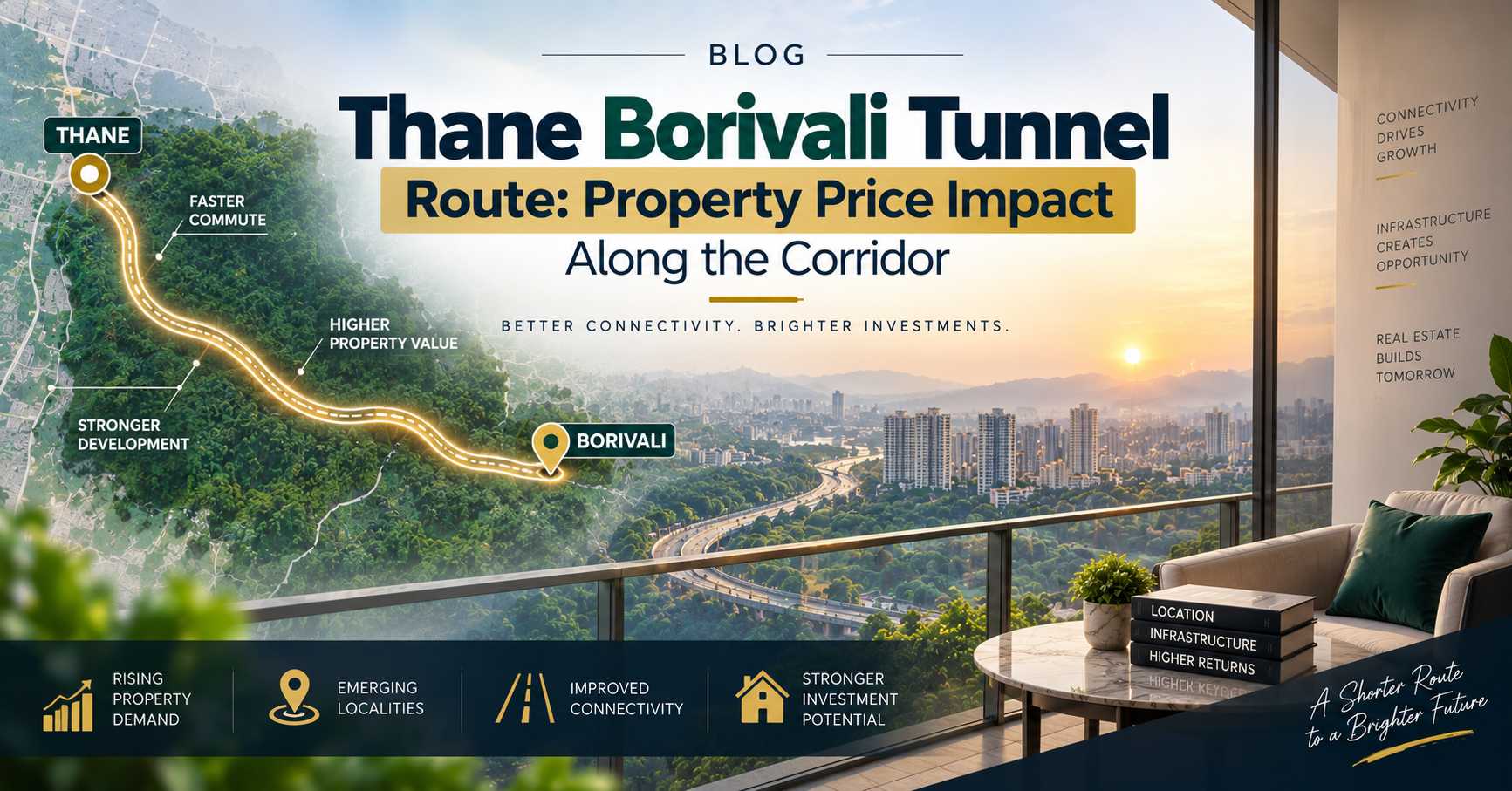
Property along the thane borivali tunnel route ranges from about Rs 15,000 per sq ft on Ghodbunder Road to roughly Rs 32,150 per sq ft in Borivali East — a gap of more than 2x across 12 km. With the tunnel targeted for mid-2028, that gap is the clearest repricing opportunity on the corridor.
Infrastructure does not raise prices everywhere equally. It raises them where it removes a specific constraint. That is the useful lens for looking at the Thane–Borivali twin tunnel, because the two ends of this route are in completely different market conditions right now and the tunnel does something different to each.
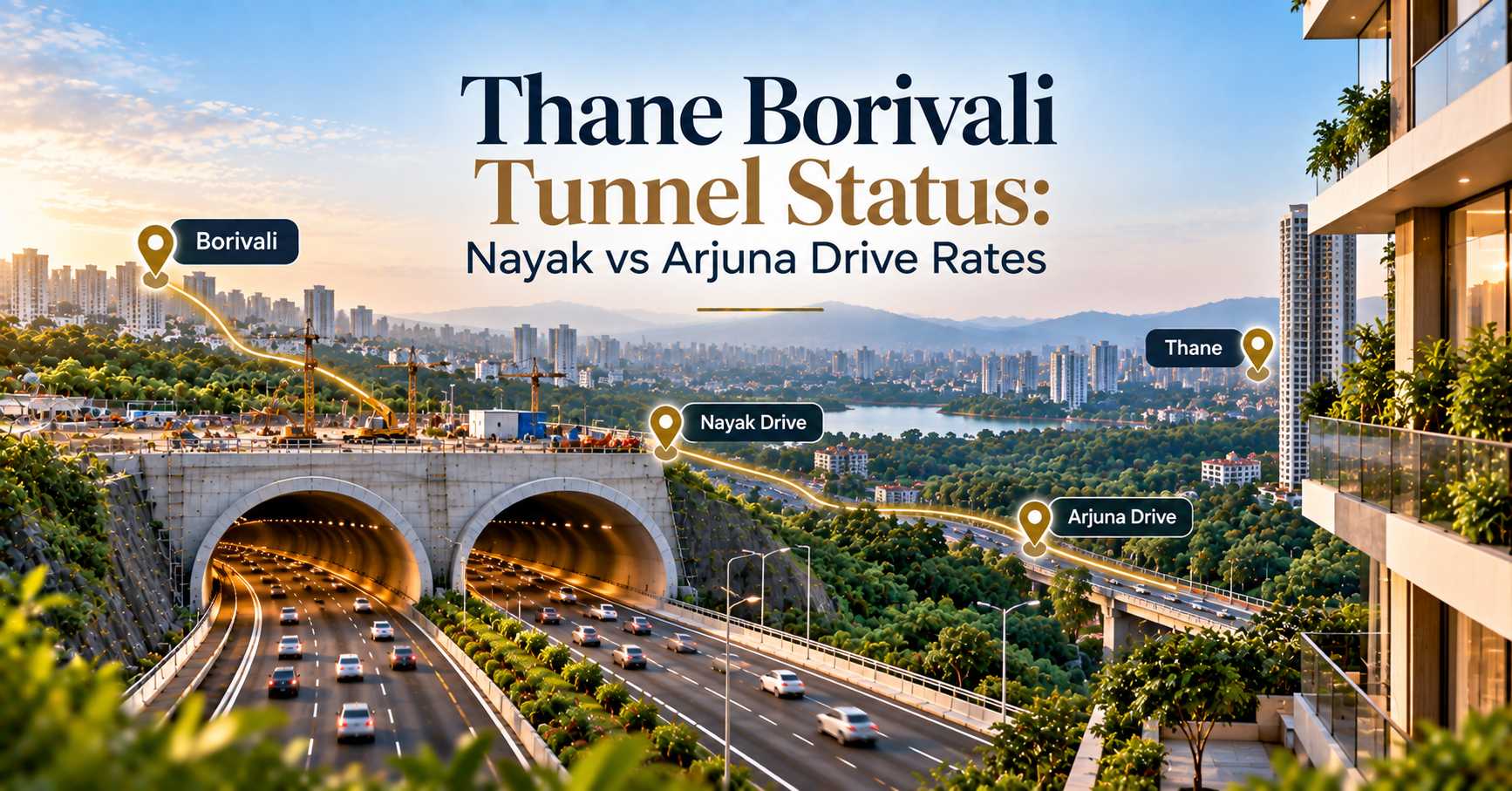
Borivali East is running hot — around Rs 32,150 per sq ft, up 11.2% year on year. Ghodbunder Road in Thane is running cold — around Rs 15,000 per sq ft, down roughly 2% over one year and 13.5% over three. These two micro-markets are 12 km apart in a straight line and are about to be connected by a 15-minute drive. The thane borivali tunnel route is, in price terms, a bridge between two very different markets.
Our team analysed the 2026 rate data along the full corridor to work out where the repricing is most likely to land, how much of it is already in the price, and what the realistic timing looks like. Here is what the numbers say.
Rates Along the Thane Borivali Tunnel Route Today
Start with the baseline. These are the September 2026 positions across the micro-markets the route touches or feeds.
| Micro-market | Average rate | Recent movement | Position on the route |
|---|---|---|---|
| Borivali East (Magathane) | About Rs 32,150 per sq ft | Up 11.2% year on year | At the Mumbai portal |
| Kandivali East | About Rs 30,950 per sq ft | Up 1.61% year on year | One stop south on the WEH |
| WEH frontage, Borivali East | About Rs 28,794 per sq ft | Steady as of August 2026 | Highway-facing stock at the portal |
| Ghodbunder Road, Thane | About Rs 15,000 per sq ft | Down 2% over 1 year, down 13.5% over 3 | At and along the Thane portal |
| Ghodbunder Road range | Rs 11,000 to Rs 22,100 per sq ft | Wide spread by pocket | Manpada to Kasarvadavali stretch |
Two things stand out. First, the headline gap: Borivali East trades at more than double Ghodbunder Road. Second, the internal spread on Ghodbunder Road is enormous — Rs 11,000 to Rs 22,100 per sq ft on the same arterial. That spread is where micro-location work pays for itself.
Why the Thane Side Carries the Asymmetry
Borivali East already prices in Mumbai access. It sits on the Western Express Highway, it has Metro Line 7 at Magathane, and it has Borivali station on the Western Line about 3 km west. The tunnel gives it faster access to Thane — useful, but Thane is not where most Borivali residents need to go.
Ghodbunder Road is the mirror image. It has good Thane access and effectively no western-suburb access, because every trip to Borivali or Andheri currently means a 23 to 26 km detour around the national park taking 60 to 90 minutes at peak. The tunnel does not improve that connection — it creates it.
A market that gains a connection it never had reprices differently from a market that gains a faster version of one it already had. That is the entire argument for the Thane side of this route, and it is visible in the 2x rate gap.
There is an honest counterweight. Ghodbunder Road’s discount is not purely about connectivity — a large under-construction pipeline is also holding rates down. The three-year decline of 13.5% reflects supply as much as access. The tunnel resolves the access half of that discount. It does nothing about supply. Expect the gap to narrow rather than disappear, and be sceptical of anyone projecting Borivali-equivalent rates for Ghodbunder Road.
Where the Repricing Is Likely to Concentrate
Not every address on Ghodbunder Road benefits equally. Distance to the Thane portal near Tikuji-ni-Wadi in Manpada is the single strongest variable, followed by carriageway orientation.
| Distance from Thane portal | Practical access | Likely uplift character |
|---|---|---|
| Under 1.5 km | Direct, minimal surface driving | Strongest — but check construction-phase disruption |
| 1.5 to 3 km | Short arterial run to the portal | Genuine catchment, cleaner living conditions |
| 3 to 6 km | Meaningful surface run in Ghodbunder traffic | Corridor sentiment rather than real access |
| Beyond 6 km | Portal approach becomes the bottleneck | Buying the story, not the benefit |
The under-1.5 km paradox
Closest is not automatically best. Residents near the original Thane portal location pushed back hard enough on dust and noise that MMRDA shifted the portal about 225 metres towards the Satyashankar wall. Portal-adjacent flats gain the most access and absorb the most construction disturbance between now and 2028. The 1.5 to 3 km band often reads better on a total-experience basis.
A Seven-Point Check Before You Buy on This Route
We walk every client through the same list. It takes an afternoon and it removes most of the ways this trade goes wrong.
- Measure the portal distance yourself. Use the published MMRDA alignment, not the brochure map. “Near the tunnel” is unregulated language.
- Check the rate against the Ghodbunder band, not the average. The Rs 11,000 to Rs 22,100 spread means the average of Rs 15,000 tells you very little about whether a specific project is fairly priced.
- Pull the MahaRERA registration and read the possession date. A 2028 or 2029 handover means you take possession into the tunnel benefit rather than waiting years for it.
- Ask which carriageway the portal approach favours. A daily U-turn is a permanent tax on commute quality and it does not show up in any price comparison.
- Find out if your access road is a construction diversion route. Year-long diversions around the work sites were notified from mid-May. Two to three difficult years is a real cost.
- Count the competing supply within 2 km. Ghodbunder’s discount is partly a supply story. Heavy nearby launches will cap your resale even after the tunnel opens.
- Stress-test at today’s connectivity. If the purchase only makes sense assuming a mid-2028 opening, it is priced too tightly. The tunnel should be upside, not the base case.
Godrej’s Position Across Both Ends of the Route
Godrej Properties Limited, the third-party developer whose MMR projects we track, holds land at both ends of this alignment — the Kandivali East cluster inside the Borivali portal catchment, and the Ghodbunder and Kolshet belt on the Thane side. On the Mumbai end that includes Godrej Bliss in Kandivali East; on the Thane end, established addresses such as Godrej Ascend on Kolshet Road, a short run off the arterial the Thane portal feeds.
We at Godrej Properties MMR read that dual positioning as corridor conviction rather than as a recommendation — it predates the July 2024 foundation stone. Developer portfolio detail is at Godrej Properties Limited. For a deeper look at whether the trade stacks up at current entry points, see our note on whether property near the Thane–Borivali tunnel is a good buy in 2026.
Our verdict: the route’s price story is a convergence trade, not a boom trade. The Thane end should close part of a 2x gap; the Borivali end should hold its premium. Buying the cheaper side, close to the portal, with possession timed near 2028, is where the arithmetic is cleanest.
Frequently Asked Questions
Q: How much do prices differ across the thane borivali tunnel route?
Ghodbunder Road in Thane averages around Rs 15,000 per sq ft against roughly Rs 32,150 per sq ft in Borivali East — more than double, across about 12 km of straight-line distance. The Western Express Highway frontage in Borivali East sits nearer Rs 28,794 per sq ft.
Q: Has the tunnel already been priced into Ghodbunder Road?
Very little of it. Ghodbunder Road rates are down about 2% over one year and 13.5% over three years, which is not the pattern of a market that has priced in a major connectivity upgrade. Heavy under-construction supply is holding rates down.
Q: Which side of the route will appreciate more?
On the available evidence, the Thane side. Borivali East gains a faster version of access it already has; Ghodbunder Road gains western-suburb access it has never had, from a base that has fallen for three years. Supply pressure means the gap narrows rather than closes.
Q: How close to the portal should I buy?
Under 3 km is genuine catchment. Beyond 6 km the surface approach becomes the bottleneck and you are buying corridor sentiment. The 1.5 to 3 km band often balances access against construction-phase dust and noise better than portal-adjacent stock.
Q: When will the price effect actually show up?
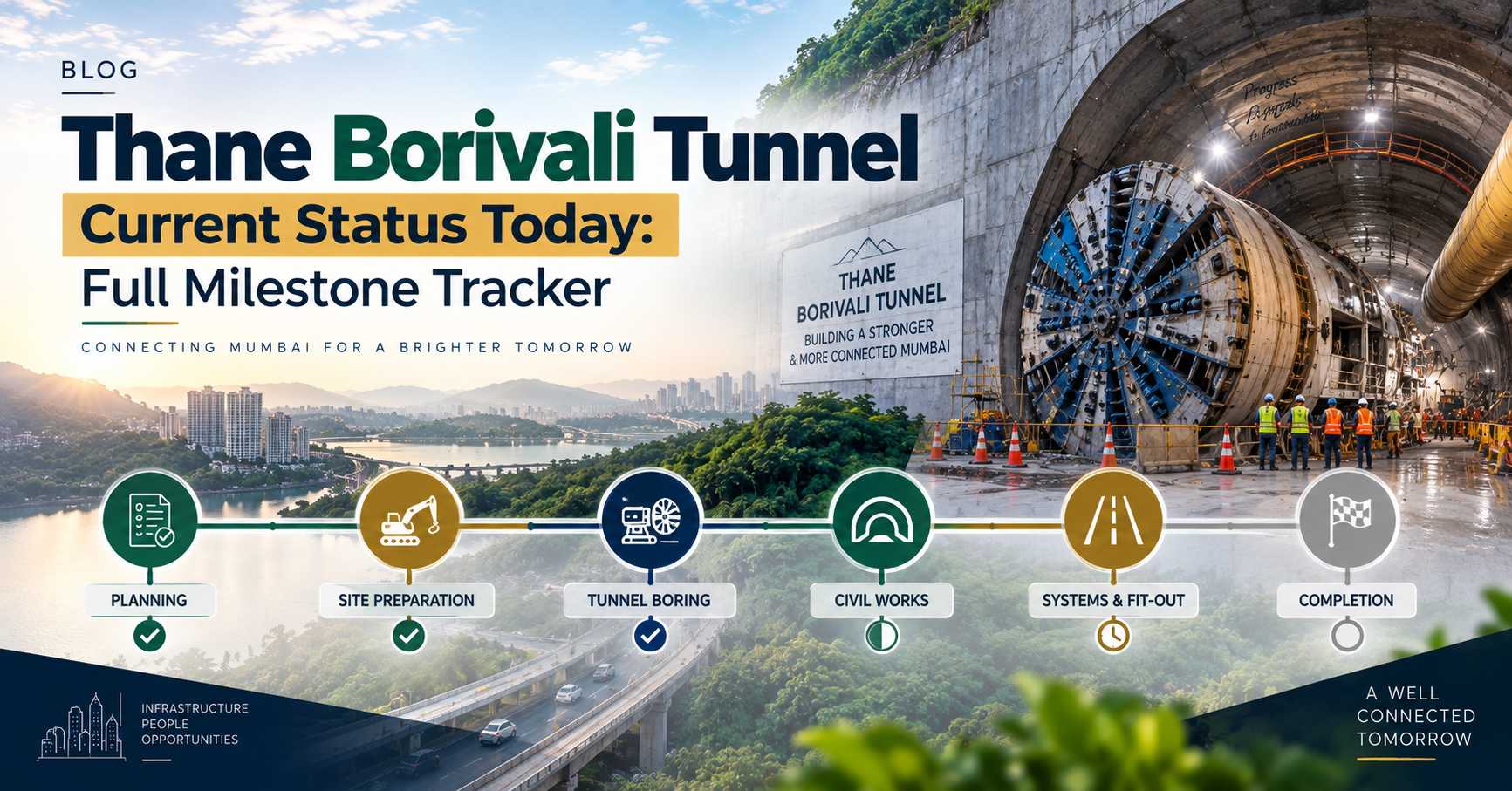
Repricing on infrastructure typically arrives in two waves — a partial move on visible construction milestones, and the larger move near commissioning. With a mid-2028 target and TBM Nayak boring since April 2026, the milestone-driven wave is already underway.
Q: What is the main risk to this thesis?
Timeline slippage and supply. The official target is mid-2028, but observers flag a possible move into 2029 on monsoon and geology. Separately, Ghodbunder Road’s large launch pipeline can cap resale gains even if the tunnel opens on schedule.
Q: Does Metro Line 4 change this calculation?
It adds to it rather than replacing it. Metro Line 4 from Wadala to Kasarvadavali runs along Ghodbunder Road and serves a north–south trip into central Mumbai. The tunnel serves an east–west road trip to the western suburbs. Count them separately.
The Practical Takeaway
The route connects a market at Rs 32,150 per sq ft to one at Rs 15,000 per sq ft with a 15-minute drive. Most of the opportunity sits on the cheaper end, close to the Thane portal, in projects whose possession lands near the tunnel’s own timeline — and most of the risk sits in supply and schedule rather than in the engineering.
If you want a specific project measured against the alignment, the local supply pipeline and its RERA dates, our team will do that with you rather than for you. Book a site visit on the Ghodbunder or Kolshet corridor and we will show you the numbers on the ground.