
Quick Answer
The Mumbai real estate market in 2026 is growing, but slowly and unevenly. MMR capital values are rising 4-7% a year, Mumbai city logged 80,221 registrations in H1 2026 (a 13-year high), and unsold stock in the Rs 2-5 crore band jumped 43%. Volume is strong; pricing power is not.
If you have been reading headlines about the Mumbai real estate market 2026 edition, you have probably seen two contradictory stories. One says registrations are at a 14-year high. The other says unsold inventory is piling up faster than developers can clear it. Both are true, and understanding why they are both true is the single most useful thing a buyer or investor in the Mumbai Metropolitan Region can do this year.
Here is the number that anchors everything else: Mumbai city recorded 80,221 property registrations in the first half of 2026, up 6% year-on-year and the highest first-half figure since 2013, generating Rs 6,968 crore in stamp duty for the Maharashtra government. August 2026 alone delivered an estimated 12,503 registrations and Rs 1,123 crore in duty — a 14-year high for that month. Demand, in other words, is not the problem.
Price growth is the problem, or at least the surprise. Knight Frank data puts MMR capital value growth at roughly 5% through 2025, and most micro-markets are tracking 4-7% annualised into the second half of 2026. That is a real return of close to zero once you account for inflation and the 6% stamp duty you paid on the way in. We at Godrej Properties MMR have spent the last eight months telling clients the same thing: 2026 rewards location selection far more than it rewards market timing.
Mumbai Real Estate Market 2026: The Numbers That Matter
Strip out the noise and the Mumbai real estate market in 2026 rests on five measurable facts. We track these monthly because they move independently of each other, and the gaps between them are where opportunity sits.
| Indicator | 2026 Reading | Direction | What It Means for You |
|---|---|---|---|
| Mumbai city registrations, H1 | 80,221 units | Up 6% YoY | Liquidity is healthy; resale exits are achievable |
| Stamp duty collected, H1 | Rs 6,968 crore | Up 4% YoY | Ticket sizes rising slower than volumes |
| MMR capital value growth | 4-7% annualised | Moderating | Flipping no longer works; hold 5+ years |
| Unsold stock, Rs 2-5 cr band | 65,671 units, up 43% | Rising sharply | Strong negotiating position in mid-premium |
| RBI repo rate | 5.25% (steady since April 2026) | Flat | EMI planning is predictable for once |
The 43% surge in unsold Rs 2-5 crore inventory is the most under-discussed statistic of the year. Developers spent 2023-25 chasing the premium buyer because margins were better there, and they collectively overbuilt the exact segment that a salaried Mumbai family finds hardest to finance. That imbalance is now a buyer’s asset — if you are shopping in that band, you have leverage you did not have eighteen months ago.
Why Demand Held Up Through 2026
Three forces kept the Mumbai real estate market moving when several other Indian metros stalled.
Rates finally stopped moving. The RBI cut the repo rate by a cumulative 125 basis points through 2025 and has held it at 5.25% since April 2026. Mumbai home loans now price between roughly 7.10% and 8.6% depending on your profile and lender. For a borrower who watched EMIs climb through 2022-23, a flat rate environment is less about cheap money and more about the ability to plan a 20-year commitment without guessing.
Infrastructure moved from promise to pavement. The Navi Mumbai International Airport began commercial operations on 25 December 2025. The Atal Setu (MTHL) has cut the Sewri-to-Nhava Sheva run from over an hour to 20-25 minutes. Metro Lines 2A, 7 and 9 are carrying real passenger loads across the western suburbs, and the Thane-Bhiwandi leg of Metro Line 5 is expected to open by December 2026. Buyers are no longer pricing in hypothetical connectivity.
Our team analysed 40-plus MMR micro-markets this year. The pattern is consistent: localities within two kilometres of a functioning metro station or the Atal Setu corridor outperformed the MMR average by 3-6 percentage points. Everything else clustered around inflation.
Supply of genuinely good land ran thin. Mumbai does not manufacture new land. In the established western and central suburbs, the developable parcels left are redevelopment plots with complicated consent processes. That scarcity is why Kandivali flats average around Rs 28,700 per sq ft and Vikhroli around Rs 24,550 per sq ft while Kalyan sits at Rs 9,750 per sq ft — and why the gap is unlikely to close.
Micro-Market Breakdown: Where MMR Prices Actually Sit
Averages hide more than they reveal in a region this fragmented. These are the working rates our team quotes to clients in September 2026, drawn from listing portals and cross-checked against registered transactions.
| Micro-Market | Avg Rate (Rs/sq ft) | 2026 Trend | Gross Rental Yield | Buyer Profile |
|---|---|---|---|---|
| South Mumbai (Worli, Prabhadevi) | 65,000 – 1,20,000 | Up 10-14% | 2.0 – 2.5% | HNI, trophy asset |
| Bandra Reclamation | 85,000 – 1,40,000 | Up 10-14% | 2.0 – 2.4% | HNI / NRI |
| Kandivali East | ~28,700 | Up 6-8% | 3.0 – 3.5% | End-user family |
| Vikhroli East | ~24,550 | Up 7-9% | 3.2 – 3.8% | Mid-premium end-user |
| Kharghar | 11,000 – 18,000 | Up 8-10% | 3.5 – 4.2% | Investor + end-user |
| Thane (avg) | ~15,350 | Up 5-7% | 4.0 – 5.0% | Value end-user |
| Panvel | 13,350 – 15,000 | Up 9-12% | 3.8 – 4.5% | Airport-play investor |
| Ulwe | 10,000 – 16,000 | Up 22-25% | 4.0 – 5.0% | Aggressive investor |
| Kalyan | ~9,750 | Flat to -0.4% | 5.0 – 6.0% | Yield buyer |
Two readings jump out. First, Ulwe’s 22-25% year-on-year appreciation is an outlier driven almost entirely by the airport becoming operational — that is a one-time repricing event, not a permanent growth rate, and anyone underwriting 22% into year three is going to be disappointed. Second, the inverse relationship between price and yield is almost perfectly linear. South Mumbai gives you 2%; Kalyan gives you 6%. You are choosing between capital growth and cash flow, and very few MMR addresses give you both.
What to Watch Out For in the Rest of 2026
Our verdict on the Mumbai real estate market 2026 is constructive, but there are four things we flag on every client call.
- Premium-segment oversupply. The Rs 2-5 crore inventory pile grew 43% in a single half-year. If you are selling in that band, expect a longer marketing period. If you are buying, ask for the price — not the freebies.
- Possession-date slippage on 2028-30 projects. A lot of currently-selling MMR towers are quoting handover four years out. Check the MahaRERA-registered completion date, not the brochure date, and check the developer’s last three delivered projects against their original commitments.
- Ready reckoner revisions. Annual RR rate increases feed directly into your stamp duty and registration outgo. Budget 7-8% of agreement value for stamp duty, registration, GST on under-construction units and legal costs — not 6%.
- Yield compression in airport belts. Panvel and Ulwe rents have not kept pace with the capital value jump. A property that yielded 5% in 2024 may yield 4% today simply because the denominator moved.
- Peripheral micro-markets that did not participate. Dombivli depreciated 4.95% and Bhiwandi 1.54% over the last year. Proximity to a growth corridor is not the same as being on it.
A 6-Step Framework for Buying in This Market
This is the sequence our team walks clients through before a single site visit is booked. It takes about a week and it removes most of the expensive mistakes.
- Fix your all-in budget, not your ticket size. Add 7-8% for stamp duty, registration and legal, plus 5% for interiors. A Rs 2 crore flat is a Rs 2.26 crore decision.
- Get a sanction letter before you shortlist. Pre-approval from two lenders tells you your real ceiling and gives you a negotiating clock the developer can see.
- Pick the micro-market before the project. Decide whether you are buying capital growth or rental cash flow, then use the table above to narrow to two or three localities.
- Verify on MahaRERA. Pull the registration number, the quarterly progress report and the declared completion date. Compare the declared date against what the sales team told you.
- Visit twice — once on a weekday at 9am. Commute reality, water pressure and construction noise do not show up on a Sunday afternoon walkthrough.
- Negotiate on price, then on payment schedule. In an oversupplied band, a 4-6% price correction is achievable. A construction-linked plan beats a subvention scheme almost every time.
Where Godrej Properties Sits in the 2026 MMR Market
Godrej Properties Limited, a third-party developer listed on the Indian exchanges, has one of the broadest MMR footprints of any single builder — and it spans nearly every price band discussed above. That breadth is useful for a buyer because it lets you compare like-for-like construction quality and handover practice across wildly different budgets.
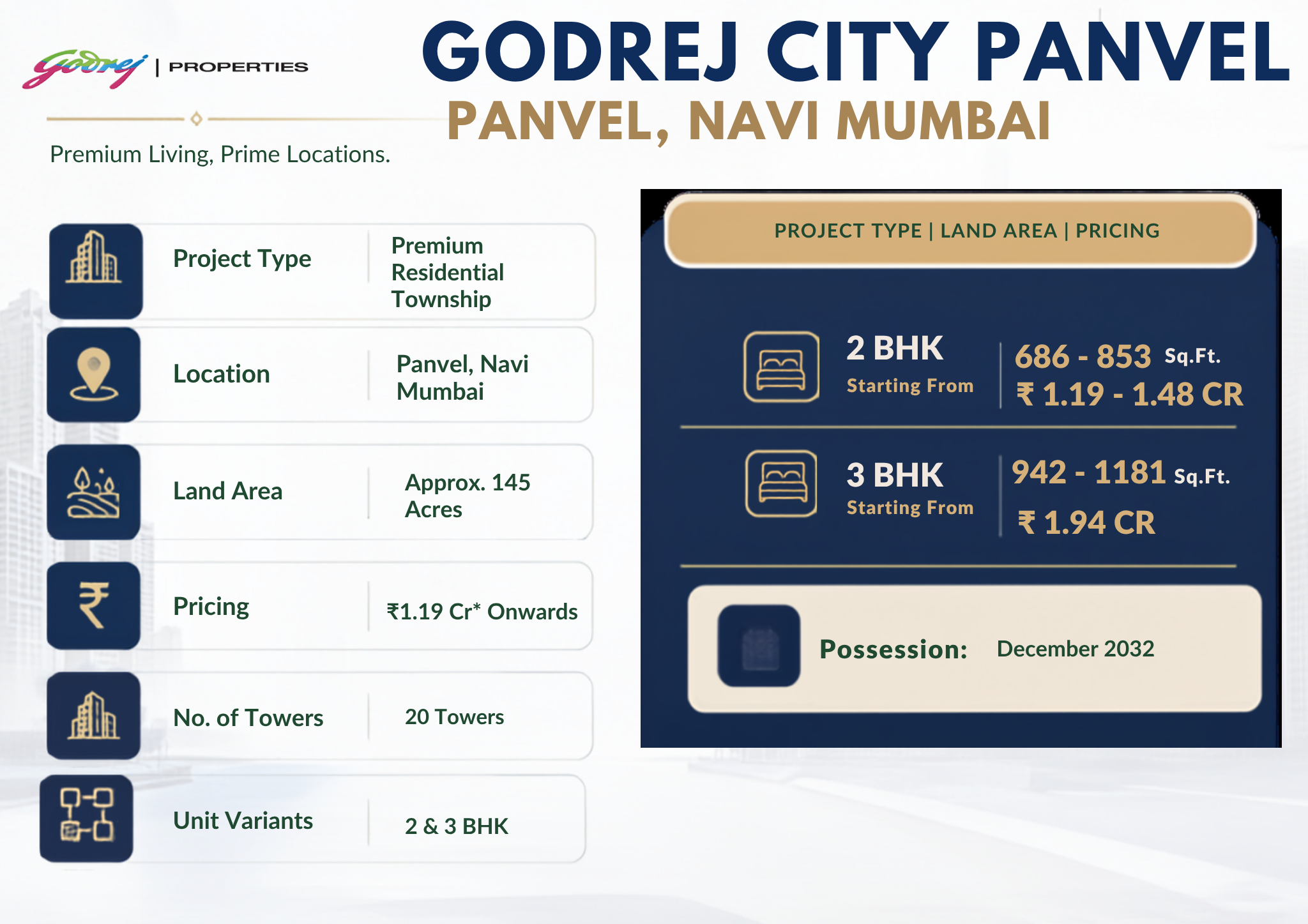
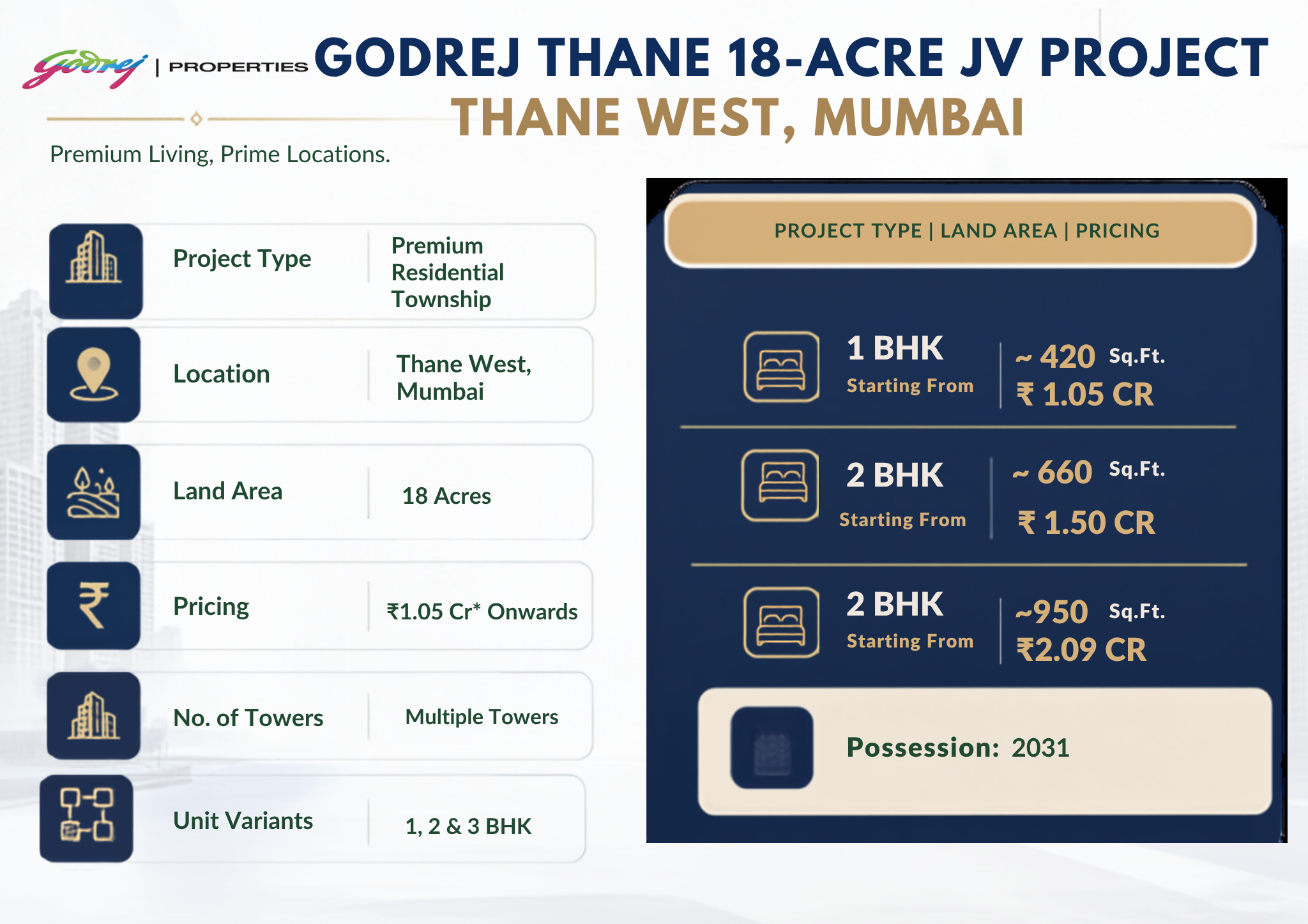
At the value end, Godrej City Panvel starts around Rs 79 lakh and sits squarely in the airport-driven Panvel corridor. In the mid-premium suburbs, Godrej The Trees in Vikhroli East is ready-to-move from about Rs 1.85 crore, and Godrej Ascend on Kolshet Road, Thane opens at roughly Rs 99 lakh. At the top of the market, Godrej Trilogy in Worli starts near Rs 13.88 crore for sea-facing 3 and 4 BHK homes, while the upcoming Godrej Bandra Reclamation launch is quoted from about Rs 19.5 crore.
We are an independent research and advisory resource covering these projects across the Mumbai Metropolitan Region. For the developer’s own corporate disclosures, see Godrej Properties Limited. For a deeper read on delivery history, our MMR track record analysis goes project by project.
Frequently Asked Questions
Q: Will Mumbai property prices fall in 2026?
A broad fall is unlikely. MMR capital values are tracking 4-7% growth and registration volumes are at a 13-year high, which does not describe a market about to correct. Individual segments can and do soften — the Rs 2-5 crore band, with 65,671 unsold units, is the one to watch for genuine price negotiation.
Q: Which is the best time of year to register a property in Mumbai?
Registration volumes spike around Navratri and Diwali and again in March, when buyers rush ahead of ready reckoner revisions. Counter-intuitively, the quieter May-July window often gets you better developer terms because quarterly sales targets are still open and footfall is low.
Q: Is the Mumbai real estate market better than Pune or Bengaluru in 2026?
Mumbai offers the deepest resale liquidity in India and the strongest capital appreciation in premium segments at 10-14% annually. Pune and Bengaluru deliver better gross rental yields — typically 3.5-4.5% versus Mumbai’s 2-3.5% in comparable premium stock. The right answer depends on whether you need income or growth.
Q: How much should I budget above the flat price in Mumbai?
Plan for 7-8% of agreement value. Stamp duty in Mumbai is 6% for men and 5% for women, registration is capped at Rs 30,000, and under-construction purchases attract GST. Add legal verification and society transfer charges on resale. Interiors typically add another 4-6%.
Q: Does the Navi Mumbai airport still have upside left for investors?
The easy money is gone. Ulwe appreciated 22-25% year-on-year and Panvel capital values rose roughly 74% between FY21 and FY25, most of it front-run before the December 2025 commercial launch. What remains is a slower second wave tied to Metro Line 8 and NAINA-area development, which is proposed rather than built.
Q: Are under-construction or ready-to-move homes the better buy in 2026?
Ready-to-move removes delivery risk and GST, and in a market with 43% more unsold premium inventory, the traditional 15-20% discount on under-construction stock has narrowed considerably. Unless you are buying at genuine pre-launch pricing from a developer with a clean handover record, ready-to-move is the safer trade this year.
Q: What rental yield should I expect in MMR?
Roughly 2-2.5% in South Mumbai, 3-3.5% in the western suburbs, 4-5% in Thane and Navi Mumbai, and up to 6% in Kalyan and the far periphery. Yield rises as you move outward and capital appreciation falls. Very few MMR addresses deliver both.
Our Verdict on the Mumbai Market in 2026
The Mumbai real estate market in 2026 is a stock-picker’s market, not an index market. Buying “Mumbai” gets you 5% a year and a stamp duty bill. Buying the right micro-market — on a functioning transit line, from a developer whose last three projects landed on time, in a segment where supply is tight rather than swollen — is what separates a 12% outcome from a 4% one.
If you are weighing a purchase this quarter, start by deciding whether you need income or growth, then let the data narrow your shortlist to two localities before you book a single site visit. Our team is happy to walk you through current inventory and pricing across the Godrej portfolio in MMR, or to arrange site visits at the projects that match your budget band.