Living in Pimpri — Complete Guide for Home Buyers 2026
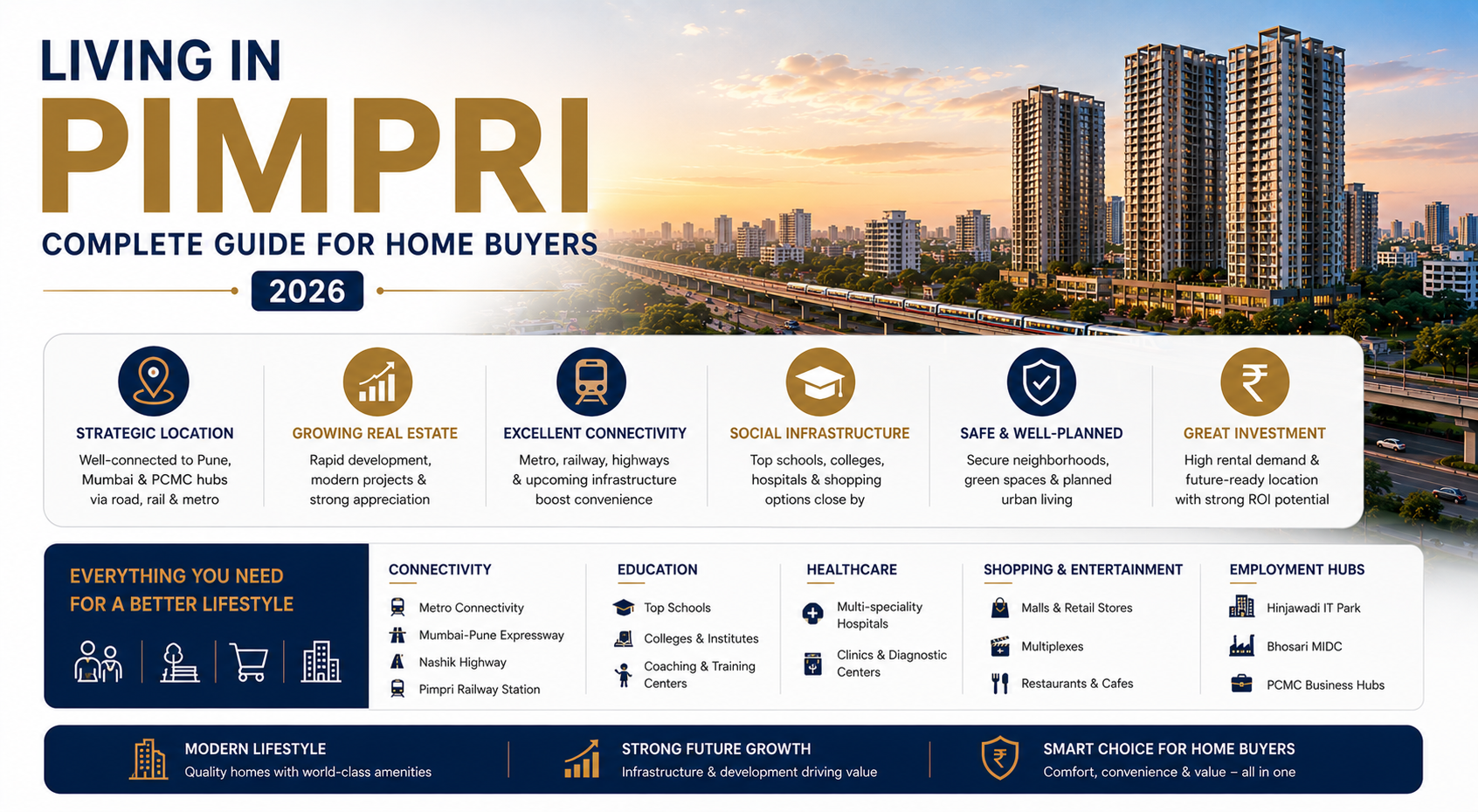
Metro + rail + expressway | Schools, hospitals, malls in place | Hinjewadi ~12–15 km
In short: Pimpri is a mature, fully-serviced PCMC address — strong daily convenience and connectivity, with the industrial legacy now balanced by retail, healthcare and green residential pockets.
What is it like to live in Pimpri in 2026?
Living in Pimpri, Pune in 2026 means settling into one of the most established and well-serviced micro-markets in the Pimpri Chinchwad (PCMC) belt. The area combines operational connectivity — the Pune Metro Purple Line, suburban rail and expressway access — with mature social infrastructure including reputed schools, multi-speciality hospitals, malls and the long-standing Pimpri market. This guide walks through commute, daily life, schools, healthcare, green spaces and the residential experience so prospective buyers know what to expect. Our team has built this from on-the-ground micro-market knowledge rather than brochure copy.
The defining feature of Pimpri life is that you are not waiting for the neighbourhood to develop — it already works. That maturity is exactly what makes premium residential launches here, such as Godrej Properties Limited’s Palazzo at Godrej Emerald Waters, attractive to end-users who value convenience over a greenfield promise. The sections below break down each part of daily life in the area.
Background — Pimpri’s character
Pimpri grew as part of one of India’s largest industrial townships, anchored by automotive and engineering units, which gave it a strong employment base and early urban infrastructure. Over the past decade it has rebalanced from a purely industrial identity into a mixed residential-commercial hub, with retail and healthcare layering onto the manufacturing core. The result is a neighbourhood with both blue-collar and white-collar depth, and a steady, non-speculative housing demand.
That industrial heritage also means wide arterial roads, established civic services and a dense network of daily-needs retail — practical advantages that newer suburbs often lack for years. Branded developers have responded by bringing green, amenity-rich residential formats into the municipal core, as the open-space-led planning of projects like Emerald Waters illustrates. You can see the spread of Godrej’s Pune developments at godrejproperties.com.
Key data — daily-life snapshot
The table below summarises the practical fixtures of life in Pimpri that buyers ask about most.
| Aspect | In Pimpri |
|---|---|
| Metro | Pune Metro Purple Line through PCMC |
| Rail | Pimpri suburban station nearby |
| Expressway | Mumbai–Pune Expressway access |
| Airport | Pune Intl ~15–18 km |
| IT hub | Hinjewadi ~12–15 km |
| Healthcare | Multi-speciality hospitals nearby |
| Retail | Malls + Pimpri market |
The standout is the redundancy of connectivity — metro, rail and expressway all serve the area, so residents are not dependent on any single mode or on a future project landing on time. Daily essentials, healthcare and schooling are already within a short radius, which is what gives Pimpri its everyday convenience. For a working professional, the ~12–15 km hop to Hinjewadi and the metro’s reach across the city make commuting manageable.
Market analysis — who lives here
The table below profiles the resident mix, which shapes everything from rental demand to the character of the neighbourhood.
| Resident segment | Driver | Implication |
|---|---|---|
| IT professionals | Hinjewadi commute | Strong rental demand |
| Manufacturing workforce | PCMC industry | Stable base demand |
| Local business families | Pimpri trade | End-user ownership depth |
| Upgraders | Older PCMC stock | Premium-project demand |
This diverse resident mix is Pimpri’s quiet strength: demand does not hinge on a single industry, so the neighbourhood is resilient across cycles. The blend of IT renters, industrial workers, local business families and upgraders keeps both the rental and ownership markets active. For buyers, that means good liquidity when it is time to sell or let, and a settled, family-oriented community character.
Deep dive — schools, healthcare, green space
Pimpri and the surrounding PCMC area host a range of established schools and colleges, putting reputed education within a manageable distance for families — a key reason end-users choose to settle rather than rent here. Healthcare is similarly well-covered, with multi-speciality hospitals and clinics operating across the belt, which removes one of the bigger uncertainties of moving to a newer suburb. Day-to-day retail, from neighbourhood markets to organised malls, is dense and walkable in parts.
Green and recreational space is where the newer premium projects add the most value, since the industrial core itself is built-up. Developments like Godrej Emerald Waters answer this with 80%-plus open space, podium gardens, fruit orchards and twin clubhouses, effectively importing resort-grade greenery into a mature address. For families weighing the lifestyle a specific project adds on top of the neighbourhood, our Emerald Waters review details the amenity set.
Daily-life takeaway: Pimpri delivers ready schools, healthcare and retail with strong connectivity; premium projects add the green, amenity-rich layer the built-up core otherwise lacks.
Investment lens — living and letting
The table below connects the living experience to the rental economics that matter if you may let the home later.
| Factor | Pimpri read | Why it matters |
|---|---|---|
| Rental demand | Deep, diverse | Low vacancy |
| Gross yield | ~3–3.5% | Above central Pune |
| Tenant quality | Salaried IT + industry | Longer leases, fewer defaults |
| Liquidity | Strong | Easier resale/exit |
The same factors that make Pimpri pleasant to live in — connectivity, services and a diverse resident base — also make it a dependable place to let a home, with gross yields around 3–3.5% and low vacancy. Tenant quality skews toward salaried professionals, which means longer leases and fewer payment issues for owners. For a full investment-side breakdown on a premium Pimpri address, see our Emerald Waters investment analysis.
Buyer guidance — is Pimpri right for you?
Pimpri suits buyers who want a settled, fully-serviced address with strong connectivity and don’t want to gamble on a neighbourhood maturing over years. It is especially well-matched to families who value ready schools and healthcare, and to professionals commuting to Hinjewadi or across the city via the metro. If you prefer a quieter, greener building experience within this mature setting, a premium open-space-led project is the way to get both.
It is a weaker fit for buyers chasing the absolute lowest entry price, who may find better headline rates in emerging belts like Chikhali or Moshi — at the cost of less mature infrastructure. Before buying, confirm the specific project’s amenity timelines, verify the RERA carpet area, and compare loan offers across major banks. For a lower-ticket Godrej alternative elsewhere in Pune, see Godrej Sky Greens, Manjari Khurd.
Bottom line: pick Pimpri if you value a ready-made, well-connected address with services in place — and add a premium open-space project if you want greenery and amenities on top.
Conclusion
Living in Pimpri in 2026 offers the rare combination of mature infrastructure, redundant connectivity and a diverse, resilient community — a low-risk place to settle for both families and professionals. The industrial legacy now sits alongside retail, healthcare and green residential pockets, and premium projects fill the one gap the built-up core leaves: open space and resort amenities. For most end-users, it is a convenience-first choice that holds value.
To see how a specific premium project layers onto this neighbourhood, read our Emerald Waters review and the project listing. At Godrej Properties MMR, our team can map any Pimpri address against your commute, schools and budget.
FAQs
Q1. Is Pimpri a good place to live?
Yes — Pimpri is a mature PCMC micro-market with operational metro, rail and expressway access plus established schools, hospitals and retail. Daily life is convenient because the infrastructure is already in place. The diverse resident base gives it a settled, family-oriented character.
Q2. How far is Pimpri from Hinjewadi?
Hinjewadi’s IT park is roughly 12–15 km from Pimpri, typically a 30–45 minute drive depending on traffic. The Pune Metro and proposed Ring Road are expected to reduce this over time. This proximity drives strong rental demand from IT professionals.
Q3. Does Pimpri have good schools and hospitals?
Yes — the PCMC belt hosts a range of established schools, colleges and multi-speciality hospitals within a manageable distance. This mature social infrastructure is a key reason families choose to settle here. It removes much of the uncertainty of moving to a newer suburb.
Q4. What is the connectivity like?
Pimpri enjoys redundant connectivity via the Pune Metro Purple Line, the suburban railway and Mumbai–Pune Expressway access, with the airport around 15–18 km away. This means residents are not dependent on any single transport mode. It is one of the area’s biggest practical advantages.
Q5. Is Pimpri better for families or investors?
It works well for both. Families benefit from ready schools, healthcare and connectivity, while investors benefit from deep, diverse rental demand and ~3–3.5% yields with low vacancy. The diverse resident mix supports both ownership and letting.