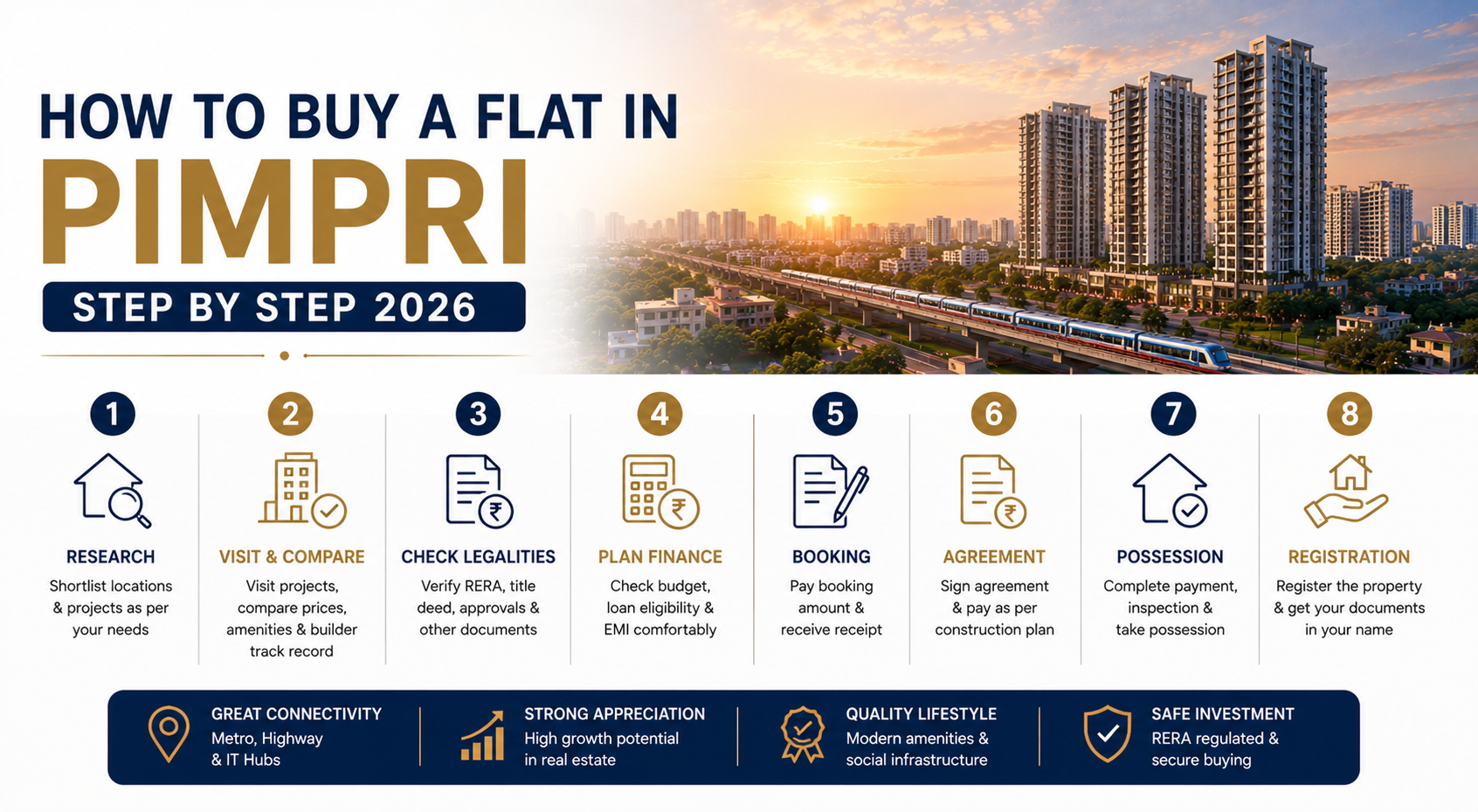
How to Buy a Flat in Pimpri — Step by Step 2026
RERA check → budget → shortlist → loan → agreement → registration → possession
In short: a disciplined seven-step process — verify RERA, fix your true budget including stamp duty and GST, finance at the keenest rate, and confirm carpet area before you sign.
How do you buy a flat in Pimpri in 2026?
Buying a flat in Pimpri, Pune in 2026 follows a clear seven-step path: verify RERA registration, set a realistic all-in budget, shortlist projects, arrange financing, sign the agreement, register the property, and take possession. With premium PCMC rates around ₹9,500–₹13,000 per square foot, getting each step right materially affects what you pay and what you own. This guide lays out the process end to end, with the documentation and checks that protect a buyer. Our team has structured it to be practical for both first-time and repeat buyers.
The single most important habit is verification: confirm the RERA number, the registered carpet area and the title before money changes hands. A branded, RERA-registered project such as Godrej Properties Limited’s Palazzo at Godrej Emerald Waters (RERA P52100051200) simplifies these checks, but the buyer should still do them. The steps below explain how.
Background — why process discipline matters
A home is most buyers’ largest single purchase, and in an under-construction market the buyer commits capital well ahead of delivery — making developer credibility and legal verification central. RERA registration, introduced to protect buyers, legally commits the carpet area, layout and possession timeline, and gives recourse if the developer deviates. Choosing a developer with a strong delivery record, like Godrej Properties Limited (founded 1990, listed 2010), reduces the biggest risk in an under-construction buy; you can review that record at godrejproperties.com.
Process discipline also protects the buyer financially. Understanding the difference between the headline price and the all-in cost — which adds stamp duty, GST, registration and floor-rise premiums — prevents budget surprises late in the transaction. Equally, comparing loan offers rather than accepting the first one can save lakhs over a 20-year tenure. The structured approach below builds these protections in.
Key data — the seven steps
The table below lays out the buying sequence and what each step involves.
| Step | What to do |
|---|---|
| 1. Verify RERA | Confirm registration, carpet area, timeline |
| 2. Set budget | Include stamp duty, GST, registration |
| 3. Shortlist | Compare projects, configs, connectivity |
| 4. Arrange loan | Compare lenders, get sanction |
| 5. Agreement | Sign sale agreement, pay booking |
| 6. Registration | Pay stamp duty, register the flat |
| 7. Possession | Inspect, take handover, snag-list |
Each step has a verification component, but steps 1, 2 and 4 are where buyers most often save or lose money. Confirming RERA and the registered carpet area protects what you own; building the true all-in budget protects what you pay; and comparing loans protects your long-run cost. The later steps are largely procedural once the first three are done well.
Market analysis — budgeting the real cost
The table below breaks down the all-in cost components beyond the sticker price for an indicative ₹1.59 Cr ticket.
| Cost component | Indicative | Note |
|---|---|---|
| Base price | ₹1.59 Cr | Carpet × rate |
| Stamp duty | ~5–6% | Maharashtra slab |
| GST (under-construction) | ~5% | On agreement value |
| Registration | ~1% (capped) | State charge |
| Floor-rise / other | Varies | Confirm with developer |
The all-in cost of a flat is meaningfully above the quoted base price once stamp duty, GST, registration and floor-rise are added — typically a 10–12% uplift on an under-construction purchase. Budgeting for the true figure upfront prevents the common mistake of stretching to the sticker price and being caught short at registration. Buyers should ask the developer for a written all-inclusive cost sheet before booking, and verify the GST and stamp-duty rates applicable at the time of agreement.
Deep dive — documents and verification
The core documents to verify are the RERA registration, the title and 7/12 or property card, the sanctioned building plan, the commencement certificate and the sale agreement itself. For a RERA-registered project, much of this is on the public MahaRERA portal, where the buyer can confirm the registration number, approved plans and committed timeline. Always cross-check that the carpet area in the agreement matches the RERA-registered figure rather than relying on super built-up numbers in marketing material.
For the home loan, the lender conducts its own legal and technical due diligence, which adds a layer of protection — but the buyer should still read the sale agreement carefully, ideally with a lawyer, before signing. Pay particular attention to the possession date, the penalty clauses for delay, and the schedule of payments tied to construction stages. A trusted developer and a clean RERA record make this smoother, as our Emerald Waters review discusses for that specific project.
Verification takeaway: confirm RERA registration, title and the registered carpet area, and read the sale agreement’s possession and penalty clauses before paying beyond the token amount.
Financing — getting the loan right
The table below frames the home-loan decision that shapes your long-run cost.
| Loan factor | Guidance | Why |
|---|---|---|
| Lenders to compare | HDFC, ICICI, SBI, Axis, Kotak | Rates vary 25–50 bps |
| Down payment | ~20%+ | Lowers EMI and rate |
| Tenure | Up to 20–25 yrs | Balances EMI vs interest |
| Pre-approval | Before shortlisting | Sets realistic budget |
Comparing at least three lenders — typically among HDFC, ICICI Bank, SBI, Axis Bank and Kotak Mahindra Bank — is the single highest-return step in financing, since even a 25–50 basis-point rate difference compounds into lakhs over a 20-year loan. A pre-approval before shortlisting sets a realistic budget and strengthens your negotiating position. For an under-construction flat with a March-2028-style possession, a construction-linked payment plan spreads outflow across the build period; our investment analysis covers the carry implications.
Buyer guidance — common mistakes to avoid
The most common mistakes are budgeting to the sticker price instead of the all-in cost, skipping the RERA and carpet-area verification, and accepting the first loan offer. Buyers also under-weight amenity phasing in under-construction projects — confirm which facilities are ready at possession rather than assuming the full brochure is delivered on day one. Finally, do not skip a physical snag inspection at handover; document defects in writing before taking keys.
Do the opposite of each mistake: build the true budget, verify RERA and carpet area, compare loans, confirm amenity timelines, and inspect at possession. For comparison shopping across Godrej’s Pune range at different price points, see Godrej Sky Greens, Manjari Khurd. A disciplined process turns a large, anxious purchase into a controlled one.
Buying bottom line: verify RERA and carpet area, budget the all-in cost, compare three lenders, and inspect at handover — that sequence protects both what you pay and what you own.
Conclusion
Buying a flat in Pimpri is straightforward when approached as a disciplined seven-step process anchored on verification and honest budgeting. RERA registration and a credible developer remove much of the risk, but the buyer still owns the responsibility to check carpet area, build the all-in budget and finance at the keenest rate. Get the first three steps right and the rest is procedure.
To apply this to a specific project, read our Emerald Waters review and the project listing. At Godrej Properties MMR, our team can guide you through RERA verification, cost-sheet review and loan comparison for any Pimpri purchase.
FAQs
Q1. What is the first step to buy a flat in Pimpri?
Start by verifying the project’s RERA registration, which legally commits the carpet area, layout and possession timeline. The MahaRERA portal lets you confirm the registration number and approved plans. This protects you before any money changes hands.
Q2. What extra costs are there beyond the flat price?
Beyond the base price, budget for stamp duty (~5–6%), GST (~5% on under-construction), registration (~1%, capped) and any floor-rise premium. Together these typically add 10–12% to the sticker price. Always ask for a written all-inclusive cost sheet.
Q3. How much down payment do I need?
Lenders typically finance up to about 80% of the value, so plan for a 20%-plus down payment plus the registration and tax costs. A larger down payment lowers both your EMI and often your interest rate. Arrange a pre-approval to set a realistic budget.
Q4. Which banks should I compare for a home loan?
Compare offers from at least three of HDFC, ICICI Bank, SBI, Axis Bank and Kotak Mahindra Bank. Even a 25–50 basis-point rate difference compounds into lakhs over a 20-year loan. Pre-approval before shortlisting strengthens your position.
Q5. What should I check at possession?
Conduct a physical snag inspection, documenting any defects in writing before taking keys, and confirm that committed amenities are delivered. Verify the carpet area matches the agreement. Only complete handover once issues are logged for rectification.