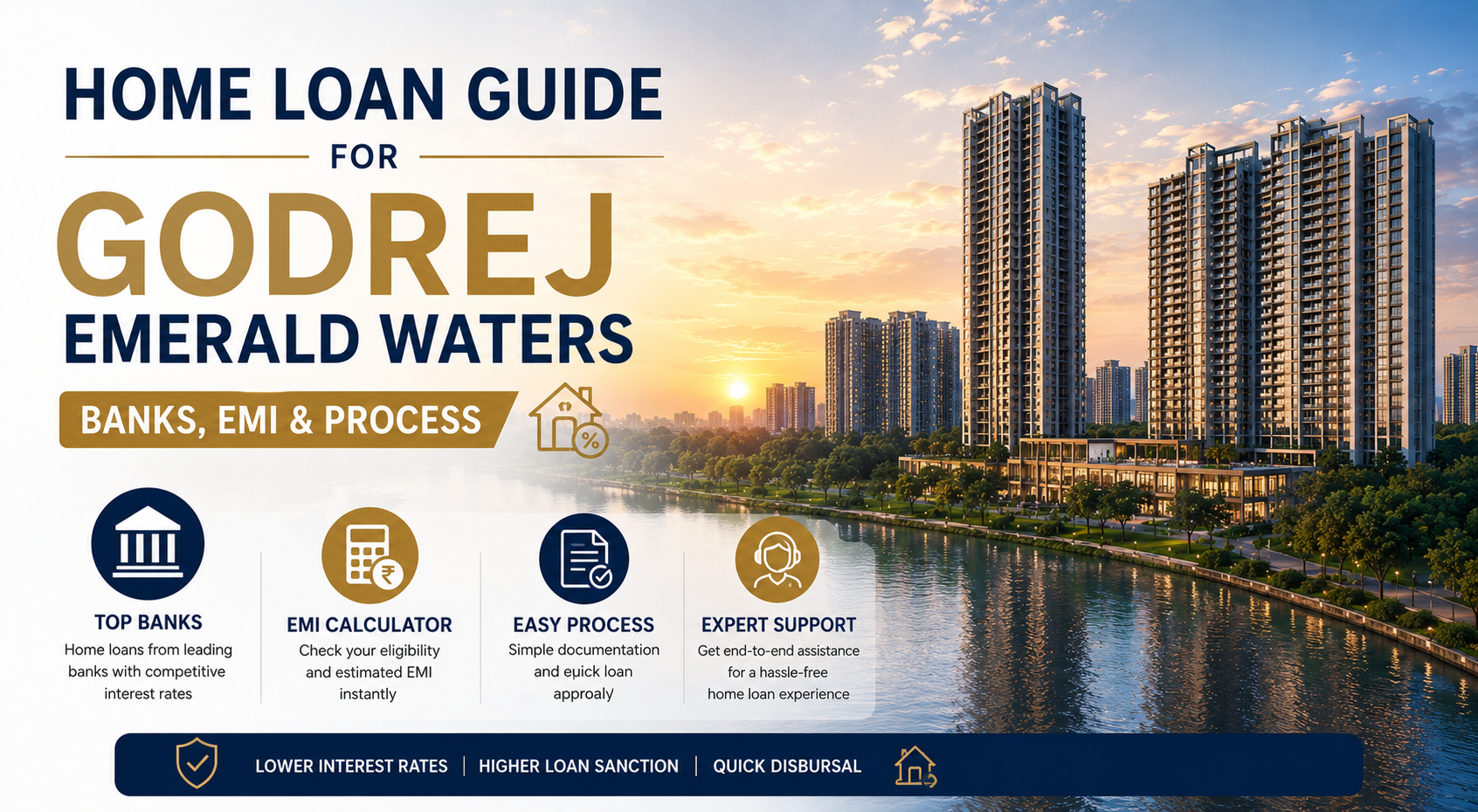
Home Loan Guide for Godrej Emerald Waters — Banks, EMI & Process
Ticket from ₹1.59 Cr | ~20% down | Indicative EMI ~₹1.10 lakh/month | CLP to Mar 2028
In short: compare three lenders, put down ~20%+, use a construction-linked plan to Mar 2028, and remember a 25–50 bps rate gap is worth lakhs over the tenure.
How do you finance a flat at Godrej Emerald Waters?
Financing a flat at Godrej Emerald Waters in Pimpri — priced from ₹1.59 Cr — typically involves a roughly 20% down payment, a home loan from a major lender, and a construction-linked payment plan running to the March 2028 possession. With an indicative EMI near ₹1.10 lakh a month on the entry configuration, getting the loan structure right materially affects affordability. This guide covers the banks to compare, the documentation, the EMI math and the disbursement process. Our team has built it to be a practical financing checklist for this specific project.
The single highest-value step is comparing lenders, since even a 25–50 basis-point rate difference compounds into lakhs over a 20-year tenure. The project’s RERA registration (P52100051200) and Godrej Properties Limited’s track record make it readily financeable by major banks. For the full pricing and configuration context, see the Palazzo at Godrej Emerald Waters listing.
Background — why financing structure matters
For an under-construction flat with a 2028 possession, the financing structure shapes both your monthly outflow during construction and your total interest cost over the life of the loan. A construction-linked payment plan (CLP) ties disbursement to build progress, so you pay interest only on the amount disbursed at each stage rather than the full loan upfront. This spreads the cash-flow burden across the build period, which is gentler than a front-loaded structure. Understanding this is central to budgeting realistically.
The developer’s credibility also matters to lenders: a RERA-registered project from Godrej Properties Limited (founded 1990, listed 2010) clears bank due-diligence more smoothly, often translating into faster sanctions and competitive rates. You can review the developer’s record at godrejproperties.com. A clean project and a strong borrower profile together secure the best loan terms.
Key data — the financing snapshot
The table below sets out the core financing figures for the entry configuration.
| Item | Indicative |
|---|---|
| Base ticket (2 BHK) | ₹1.59 Cr |
| Down payment | ~20% (₹31–32 L) |
| Loan amount | ~₹1.27 Cr |
| Indicative rate | ~8.5% |
| Tenure | 20 years |
| Indicative EMI | ~₹1.10 lakh/month |
| Payment plan | Construction-linked to Mar 2028 |
These figures are indicative and shift with your exact rate, tenure and down payment, but they frame the commitment: a ~₹1.27 Cr loan at around 8.5% over 20 years lands the EMI near ₹1.10 lakh a month. A larger down payment lowers both the EMI and, often, the offered rate. Remember to budget the all-in cost — stamp duty, GST and registration — separately from the loan, as lenders finance the agreement value, not these statutory charges.
Market analysis — comparing lenders
The table below frames how to compare the major home-loan providers.
| Lender set | Compare on | Impact |
|---|---|---|
| HDFC, ICICI, SBI, Axis, Kotak | Interest rate | 25–50 bps = lakhs over tenure |
| Same set | Processing fee | One-time, negotiable |
| Same set | Prepayment terms | Affects early-exit cost |
| Same set | Sanction speed | Matters for booking timing |
Compare at least three of HDFC, ICICI Bank, SBI, Axis Bank and Kotak Mahindra Bank on interest rate first, then processing fee, prepayment terms and sanction speed. The interest rate dominates the total cost — a 25–50 basis-point difference on a ₹1.27 Cr loan compounds into several lakhs over 20 years — but processing fees and flexible prepayment terms matter too. A pre-approved sanction before booking also strengthens your position and confirms your real budget. Our investment analysis covers how the carry cost factors into returns.
Deep dive — documentation and eligibility
Home-loan eligibility hinges on income, credit score and existing obligations, with lenders typically capping the EMI at around 40–50% of net monthly income. Core documents include identity and address proof, income proof (salary slips, Form 16 or ITRs for the self-employed), bank statements and the property documents. A strong credit score — generally 750-plus — secures the keenest rates, so it is worth checking and improving yours before applying.
For the property side, the lender verifies the RERA registration, title and approved plans as part of its technical and legal due diligence, which adds a layer of buyer protection. Because Godrej Emerald Waters is RERA-registered with a credible developer, this verification is typically straightforward. Keep your documentation ready in advance to speed up the sanction, especially if you are timing a booking. For the project’s full quality assessment, see our Emerald Waters review.
Documentation takeaway: a 750-plus credit score, EMI under ~45% of net income and ready income and property documents are the keys to a fast sanction at the best rate.
Process — from application to disbursement
The table below lays out the loan journey alongside the construction-linked disbursement.
| Stage | What happens | Note |
|---|---|---|
| 1. Application | Submit documents, get pre-approval | Before booking |
| 2. Sanction | Lender legal/technical check | Smoother for RERA projects |
| 3. Agreement | Sign, pay down payment | Registration follows |
| 4. Disbursement | Stage-linked to construction | Interest on disbursed amount |
| 5. Full EMI | After final disbursement | Near/after possession |
Under a construction-linked plan, the lender disburses in tranches tied to build milestones, and you pay pre-EMI interest only on the disbursed portion until the loan is fully drawn — typically near possession. This keeps the early-period outflow manageable, which is well suited to a March 2028 timeline. Once fully disbursed, the regular EMI of around ₹1.10 lakh begins. Plan your cash flow around this graduated structure rather than assuming the full EMI from day one.
Buyer guidance — financing smartly
To finance smartly, secure a pre-approval before booking, compare at least three lenders on rate and terms, and put down as much as comfortably possible to lower both EMI and rate. Maintain a strong credit score and keep your EMI-to-income ratio conservative so you retain headroom for the all-in costs and life’s contingencies. Use the construction-linked plan to your advantage by aligning your savings with the disbursement schedule.
Avoid the common traps: accepting the first loan offer, budgeting only to the base price, and underestimating the statutory charges that the loan does not cover. For buyers exploring a lower-ticket Godrej Pune option to fit a tighter loan, Godrej Sky Greens, Manjari Khurd sits at a different price point. Disciplined financing turns a large commitment into a manageable one.
Bottom line: pre-approve, compare three lenders, maximise the down payment, and ride the construction-linked plan to Mar 2028 — the rate you secure matters as much as the home you choose.
Conclusion
Financing a flat at Godrej Emerald Waters is straightforward when approached methodically: a ~20% down payment, a compared-and-pre-approved loan at the keenest rate, and a construction-linked plan that spreads outflow to the March 2028 possession. The project’s RERA registration and Godrej’s track record make it readily financeable, leaving the buyer to focus on securing the best terms. The rate you negotiate is worth lakhs over the tenure.
To pair the financing with the full project and investment picture, read our Emerald Waters review and investment analysis. At Godrej Properties MMR, our team can help you compare lenders and model the EMI for your specific configuration and down payment.
FAQs
Q1. What is the EMI for a flat at Godrej Emerald Waters?
For the entry ₹1.59 Cr configuration with a ~20% down payment and an 8.5% loan over 20 years, the indicative EMI is around ₹1.10 lakh a month. Your actual EMI depends on the rate, tenure and down payment you secure. A larger down payment lowers it.
Q2. How much down payment is needed?
Lenders typically finance up to about 80% of the agreement value, so plan for a 20%-plus down payment — roughly ₹31–32 lakh on the entry ticket — plus statutory charges. A larger down payment reduces both the EMI and often the offered rate. Stamp duty, GST and registration are additional.
Q3. Which banks offer loans for this project?
As a RERA-registered Godrej project, it is readily financeable by major lenders; compare HDFC, ICICI Bank, SBI, Axis Bank and Kotak Mahindra Bank. Focus on interest rate first, then processing fee and prepayment terms. Even a 25–50 bps rate gap is worth lakhs over the tenure.
Q4. What is a construction-linked payment plan?
A construction-linked plan ties loan disbursement to build milestones, so you pay interest only on the amount disbursed at each stage until possession. This spreads outflow across the March 2028 build period rather than front-loading it. The full EMI begins after final disbursement.
Q5. What documents do I need for the loan?
You will need identity and address proof, income proof (salary slips, Form 16 or ITRs), bank statements and the property documents. A credit score of 750-plus secures the keenest rates. Keeping documents ready in advance speeds up the sanction.