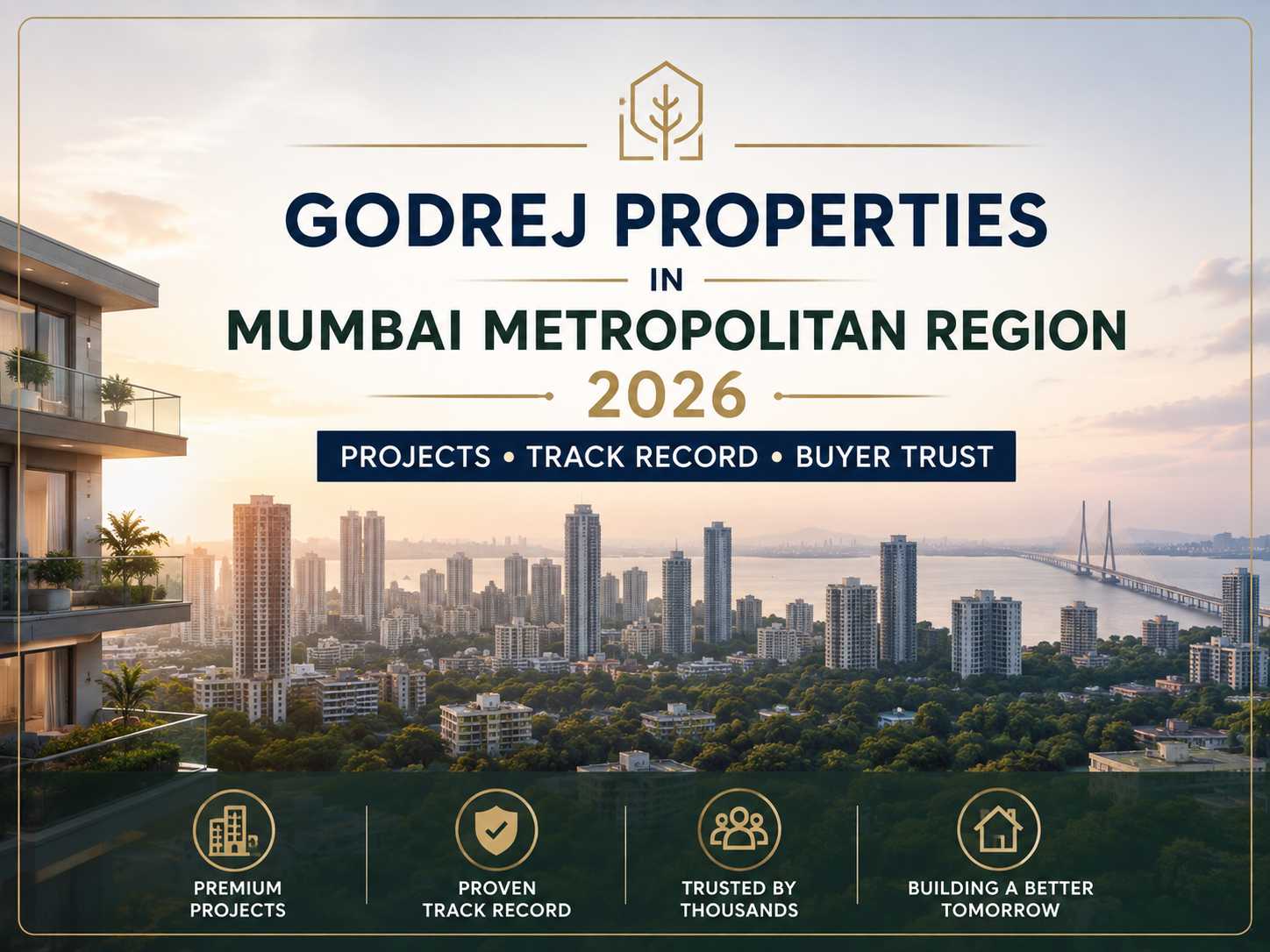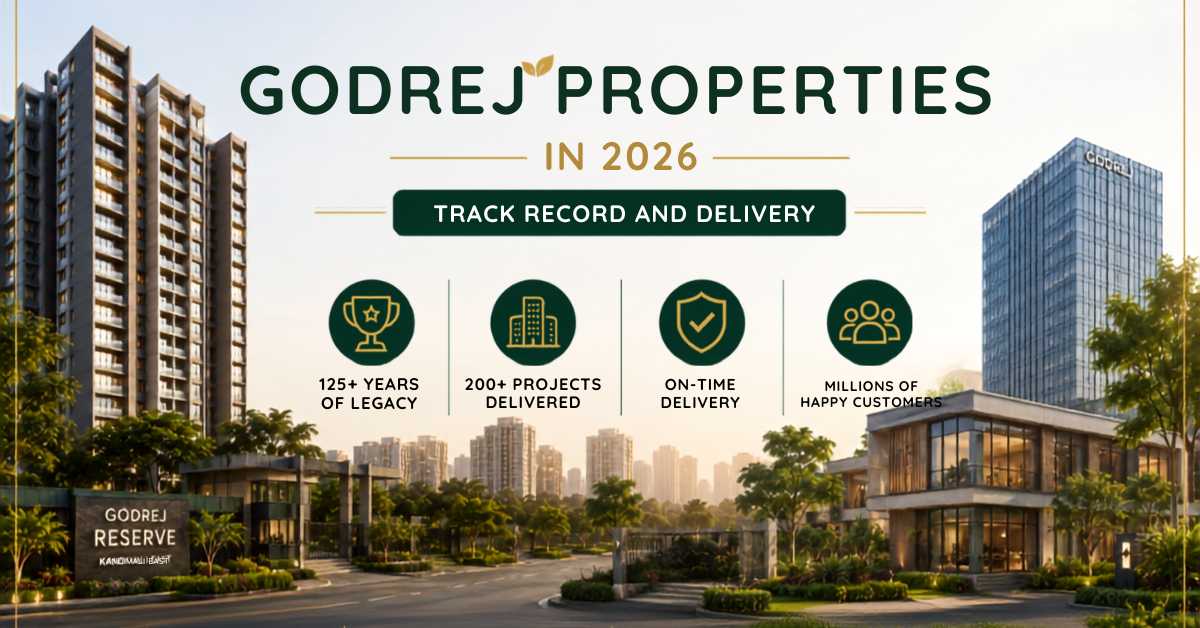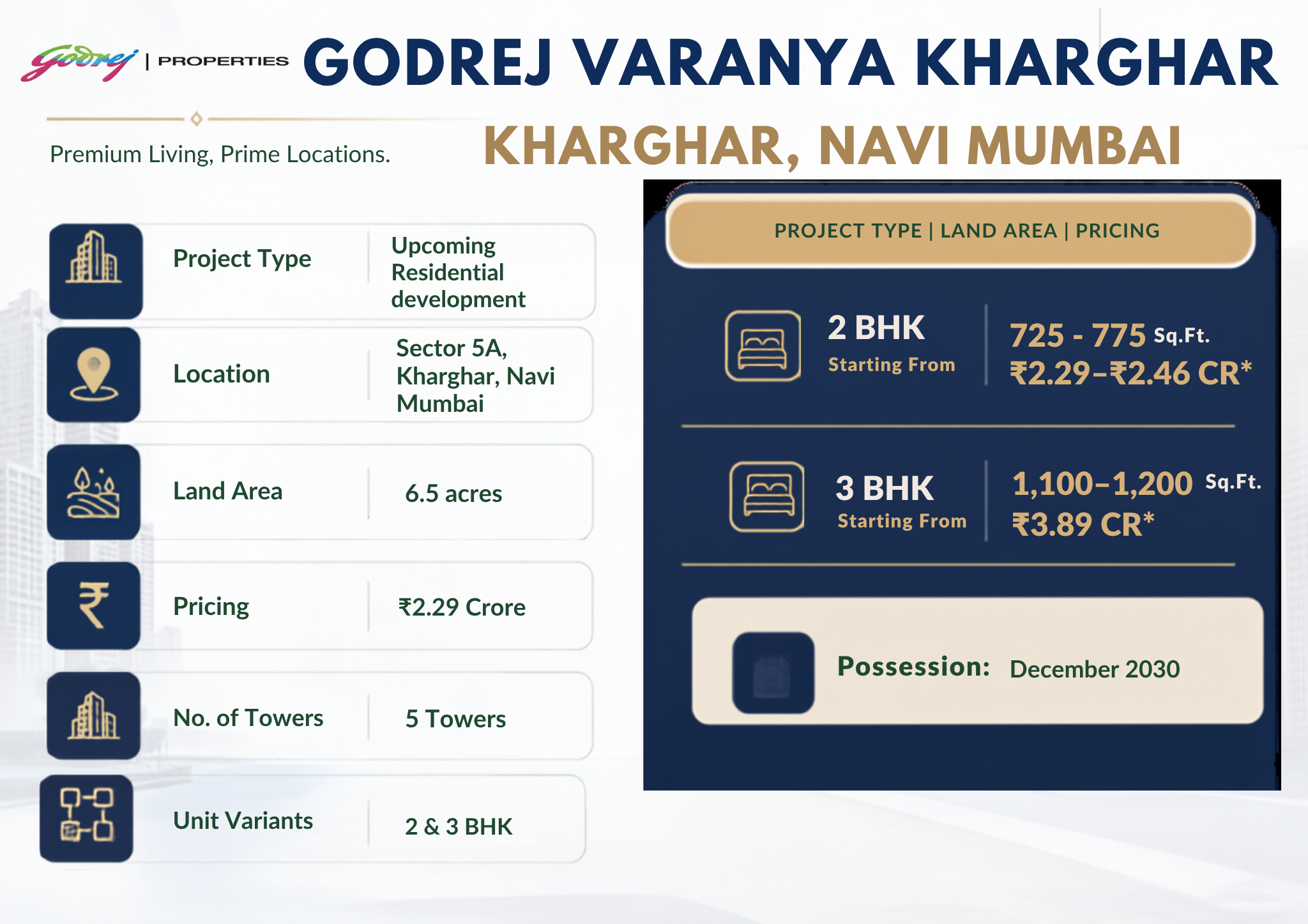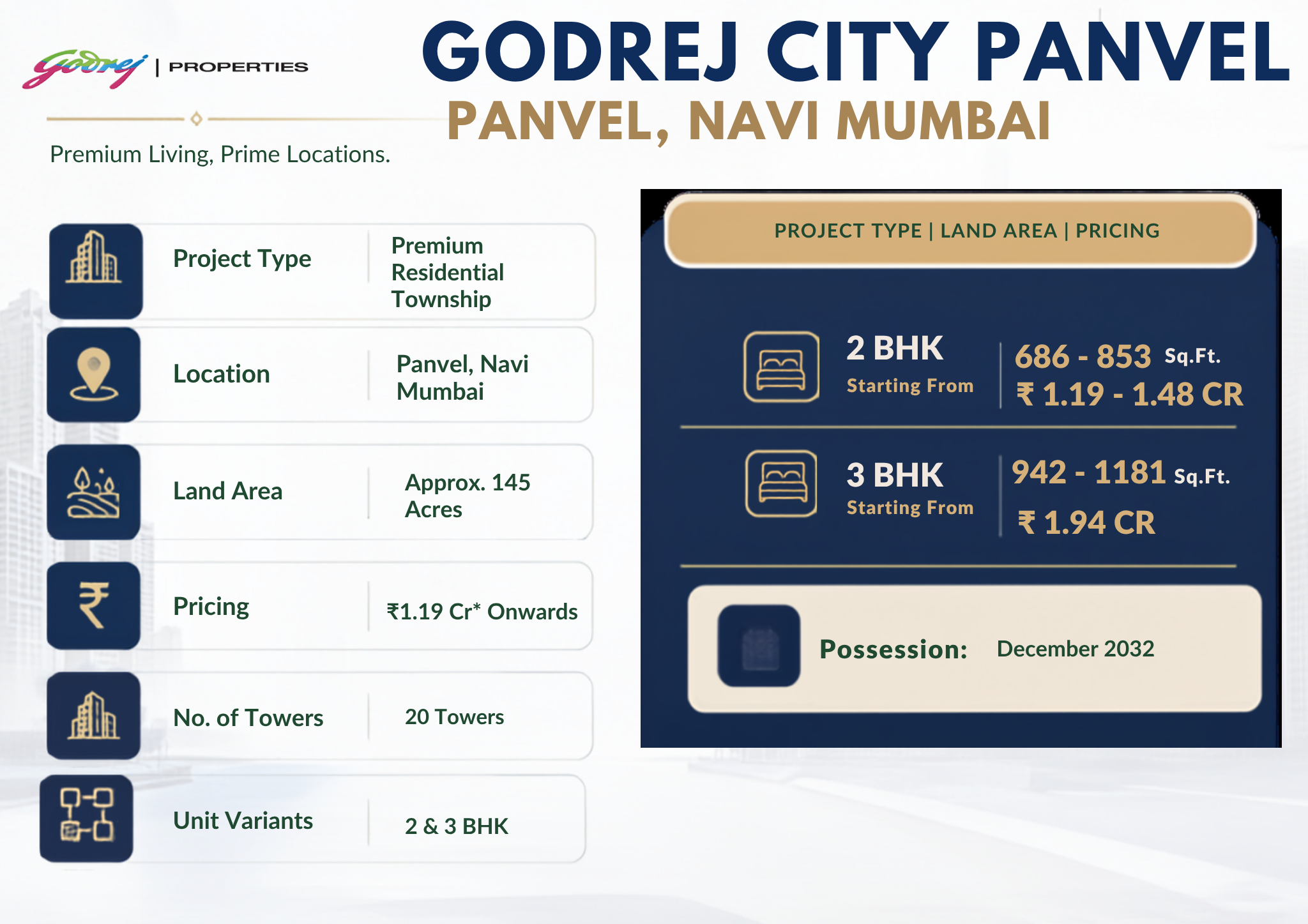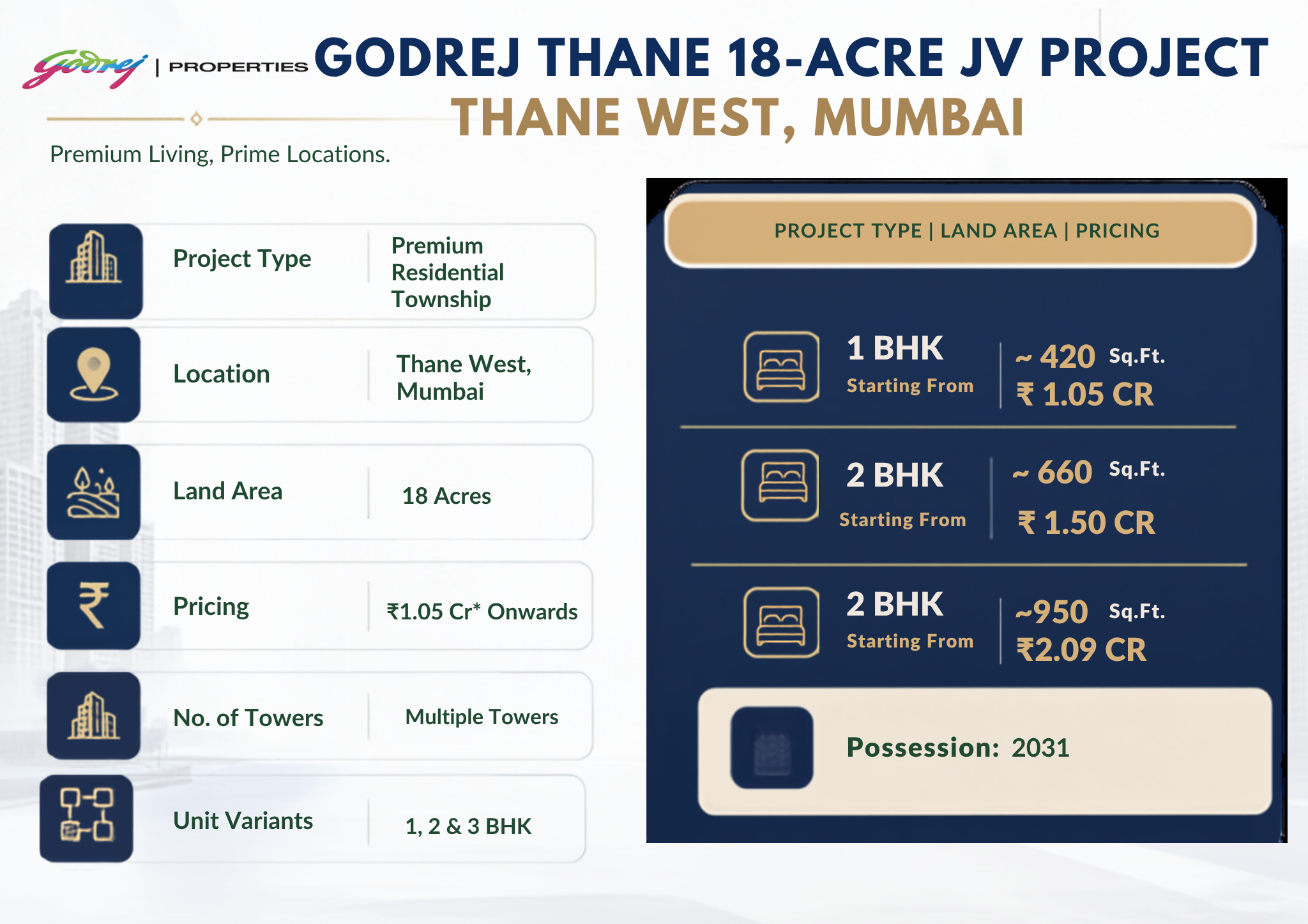

Why buyers trust Godrej Properties Limited: a 35-year delivery record, 300+ projects, and Pune proof points like the ready-to-move Godrej Infinity in Mundhwa.
RERA: P52100003129 | Ready to Move | Builder: Godrej Properties Limited | Our Rating: 4.4/5
Our Verdict: Three decades of completed handovers and an IGBC-aligned green portfolio make this one of the lowest execution-risk developer names in Indian real estate. The trade-off is that brand-led pricing rarely leaves room for deep bargains, so buyers pay a premium for reliability.
Why the builder behind your flat matters more than the brochure
When buyers ask us which name to trust, the answer almost always comes back to one phrase: the godrej properties builder track record. Godrej Properties Limited is the real estate arm of the 125-year-old Godrej group, and over 35 years it has built a delivery reputation that very few Indian developers can match. In Pune, the clearest proof of that reputation is Godrej Infinity in Keshav Nagar, Mundhwa, East Pune (411036) — a delivered, occupancy-certified riverfront township where 2 BHK homes start from ₹80 lakh at rates of ₹12,000–₹14,000/sqft under RERA registration P52100003129.
We present this builder profile because the developer is the single biggest variable a buyer cannot inspect on a site visit. You can measure a carpet area, count amenities, and walk a clubhouse, but you cannot see whether a company will finish on time, honour its specification, and stand behind the asset a decade later. With 300+ projects delivered across 250M+ sq ft and 12+ cities, Godrej Properties Limited gives buyers a longer evidence trail than almost any competitor.
Our team has tracked this developer’s Pune portfolio closely, from delivered stock like Godrej Infinity to live launches across the eastern and western corridors. In this post we break down the company history, the delivery numbers that actually matter, the sustainability credentials, and the reason a completed project removes the two risks buyers fear most — construction delay and possession default. Every figure here is drawn from the developer’s public record and our own market tracking.
The short version: a builder is a 20-year relationship, not a one-time transaction. A home loan runs two decades, a resale may sit five to ten years out, and warranty and maintenance support stretch across the entire holding period. That is why we weigh the godrej properties builder credentials as heavily as price per square foot when we advise a buyer.
The history behind Godrej Properties Limited
Godrej Properties Limited was founded in 1990 as the real estate development company of the wider Godrej group, whose industrial lineage stretches back more than 125 years to 1897. That parentage matters: the developer did not arrive as a speculative builder chasing a property cycle, but as the real estate division of an established manufacturing and consumer house through Godrej Industries. You can read the full corporate record on the developer’s own site at godrejproperties.com, where the legal entity Godrej Properties Limited is listed under its NSE symbol GODREJPROP.
The company listed publicly on the National Stock Exchange in 2010, which placed it under continuous regulatory and shareholder scrutiny. A listed developer must publish audited financials, disclose project pipelines, and answer to institutional investors every quarter — a level of transparency that private builders simply do not face. For a homebuyer, that listing is an indirect safeguard, because financial distress at a public company surfaces in disclosures long before it reaches a buyer’s possession date.
Since then the developer has scaled to 300+ projects and 250M+ sq ft of developed area across 12+ cities, spanning Mumbai, Pune, the NCR, Bengaluru, and beyond. That national footprint is not just a vanity statistic; it means the company has navigated multiple state RERA regimes, dozens of municipal approval bodies, and several economic cycles without abandoning a corridor. Breadth at this scale is itself a form of resilience.
The Godrej name also carries something harder to quantify — a reputation built over a century in households across India. When a buyer signs for a flat, they are partly buying the assurance that the brand has more to lose from a botched handover than they do. That asymmetry, where the developer’s century-old reputation is on the line for an ₹80 lakh transaction, is the quiet reason buyers extend trust before they have even seen a completed unit.
The numbers that define the developer
Trust should be measured, not assumed, so we put the core credentials in one place. The table below is the snapshot we hand buyers when they ask why this developer commands a brand premium. Every figure is a matter of public record, and together they describe a company with reach, longevity, and regulatory exposure rather than a regional player riding a single market.
| Credential | Detail | Why it matters to a buyer |
|---|---|---|
| Founded | 1990 (real estate arm of Godrej group) | 35 years of completed cycles, not a new entrant |
| Parent group age | 125+ years (Godrej Industries, since 1897) | Century-long reputation backs every handover |
| NSE listing | 2010 (GODREJPROP) | Audited, transparent, shareholder-scrutinised |
| Projects delivered | 300+ | Deep evidence trail of finished work |
| Area developed | 250M+ sq ft | Execution capacity at national scale |
| Cities | 12+ | Proven across multiple RERA regimes |
| Sustainability | IGBC-certified projects | Lower running costs, future-proofed asset |
The figure we weigh most heavily is 300+ delivered projects, because delivery is the one credential a buyer can verify by walking into a completed society. A pipeline of launches tells you a company can sell; a record of handovers tells you it can finish. Across 250M+ sq ft, the developer has demonstrated the second far more often than most peers can claim.
Listing on the NSE in 2010 adds a layer that brochures cannot fake. Because Godrej Properties Limited reports audited results every quarter, its financial health is a public document rather than a private gamble, and that scrutiny is exactly what protects a buyer’s deposit during a slow market.
Why delivery record beats marketing
The single biggest risk in Indian real estate is not price — it is non-delivery. Buyers across the country have lost years and savings to stalled towers, and the entire RERA framework exists because under-construction default became a national problem. Against that backdrop, a developer’s completion history is worth more than any amenity list, and it is where Godrej Properties Limited separates itself from corridor-specific builders.
The table below frames the difference in plain terms. An under-construction purchase from an unproven builder carries delay risk, specification risk, and the chance of a developer running out of capital mid-project. A delivered project from an established name carries none of those, which is why we treat a completion certificate as the most valuable document in any deal.
| Risk factor | Unproven / under-construction | Delivered Godrej project (e.g. Infinity) |
|---|---|---|
| Construction delay | High — 1 to 3 year slips common | Zero — already built and occupied |
| Specification gap | Possible — finishes downgraded late | None — inspect the actual unit |
| Amenity readiness | Promised, often delayed | 45+ amenities operational today |
| GST on purchase | Payable on under-construction | Saved on ready-to-move resale |
| Occupancy certificate | Pending | Received (possession from ~2019–2020) |
At Godrej Infinity, the developer has already converted promise into a delivered ~43-acre township on the Mula-Mutha river, with 18 towers of 24 floors and 1,204 homes in the registered phase. The 45+ amenities — clubhouse, swimming pool, gymnasium, jogging and cycling tracks, amphitheatre, and more — are operational, not rendered, because the project handed over possession around 2019 to 2020. That is the difference a buyer can stand inside and feel.
For a deeper, balanced read on how that delivery translates into day-to-day living, our team’s independent assessment is set out in our Godrej Infinity review for 2026. It covers the pros, the cons, and where the brand premium is and is not justified.
Sustainability and the IGBC commitment
Beyond delivery, the developer’s IGBC-certified approach is a credential that compounds over a holding period. Indian Green Building Council certification is not decoration — it governs water efficiency, energy use, ventilation, and material choices, and it directly lowers a household’s running costs. Over a 20-year ownership horizon, those savings on electricity and water are a meaningful return that buyers rarely price in upfront.
Godrej Properties Limited has positioned green building as a portfolio standard rather than a one-off marketing exercise, aligning with its parent group’s broader sustainability commitments. For a buyer, this means a flat purchased today is less likely to feel dated against future environmental norms, protecting resale value as green expectations tighten. A non-certified building bought now may need expensive retrofits later to stay competitive.
At the township level, the riverfront setting of Godrej Infinity along the Mula-Mutha demonstrates how green planning shows up in practice — water bodies, landscaped gardens, and an acupressure pathway sit alongside the harder infrastructure. These are not luxuries layered on top; they are part of a design philosophy that treats the environment as an asset rather than an afterthought. That philosophy is consistent across the developer’s national portfolio.
We treat sustainability as a financial argument as much as an environmental one. A home that costs less to run, holds value better, and resists regulatory obsolescence is simply a stronger asset, and that is the practical payoff of the IGBC standard the developer applies. It is one more reason the brand premium is defensible rather than purely aspirational.
The investment case for a trusted builder
Trust is not only about safety — it shows up in returns. A flat from a credible developer enjoys deeper resale liquidity, a wider buyer pool, and a rental tenant base that recognises the brand. At Godrej Infinity, that liquidity is visible in 33+ resale listings active on portals, and in portal averages that moved from ₹11,800 to ₹14,050/sqft over the past year, a rise of roughly 19%.
The table below sets out the East Pune numbers that frame the investment case. Keshav Nagar sits at a sensible entry point relative to the pricier Kharadi and Magarpatta belt, while still drawing the same salaried IT tenant pool that drives rental demand. A trusted builder in a jobs-belt micro-market is a combination that supports steady, rather than speculative, appreciation.
| Metric (East Pune) | Figure | Read |
|---|---|---|
| Keshav Nagar rate | ₹11,000–14,000/sqft | Entry point below Kharadi/Magarpatta |
| Kharadi/Magarpatta rate | ₹13,000–16,000/sqft | Premium jobs belt, higher base |
| Infinity portal move (1 yr) | ₹11,800 → ₹14,050/sqft | ~19% appreciation |
| Gross rental yield | ~3–3.5% | Deep salaried tenant pool |
| 2 BHK rent | ₹22,000–32,000/month | Steady IT-driven demand |
| Resale liquidity | 33+ active listings | Easy exit when needed |
For buyers weighing the full return picture, our detailed numbers — ROI, EMI, and yield — are laid out in our Godrej Infinity investment guide for 2026. A representative ₹80 lakh ticket with 20% down at 8.5% over 20 years works out to roughly ₹55,000 a month, against rent in the ₹22,000–32,000 band. The brand premium, in our view, is the cost of buying into that liquidity and stability rather than a tax on the buyer.
How we advise buyers to use the builder record
A strong developer name is a starting filter, not a final verdict, so we tell buyers to use it as the first of several checks. Confirm the RERA registration — here, P52100003129 — verify the completion and occupancy certificates for any delivered project, and inspect the actual unit rather than a sample flat. With Godrej Infinity already occupied since around 2019 to 2020, all three checks can be completed in a single site visit.
We also advise matching the developer’s portfolio to your timeline and risk appetite. A ready-to-move asset like Godrej Infinity suits a buyer who wants zero construction risk and immediate possession, while the same developer’s under-construction projects suit buyers chasing a lower entry price with patience for the build. The trust in the brand carries across both, but the risk profile does not.
Our practical checklist: verify RERA P52100003129, confirm OC/completion certificates, inspect the real unit, check resale and rental comps in Keshav Nagar, and compare the brand premium against delivered competitor stock at ₹11,000–13,500/sqft before you negotiate.
Finally, we remind buyers that even the best builder name does not exempt a deal from due diligence on title, society dues, and parking allotment. The developer’s record lowers execution risk dramatically, but the buyer still owns the responsibility for the legal and financial fine print. A trusted builder makes the homework lighter — it does not make it disappear.
Our verdict on trusting Godrej Properties in 2026
After tracking this developer’s Pune delivery, our position is straightforward: Godrej Properties Limited has earned its place among the most trusted names in Indian real estate through 35 years of completed work, a 125-year-old parent group, 300+ projects, and an IGBC-aligned green standard. The trust is not a marketing construct — it is a measured record that a buyer can verify at a delivered site like Godrej Infinity.
The honest counterweight is price. A brand this credible rarely sells at a discount, so buyers should expect to pay a premium of a few hundred rupees per square foot over comparable but less proven stock. For most buyers, especially those funding through a 20-year loan, that premium buys peace of mind, liquidity, and a green-certified asset — a trade we consider worth making.
If you want to see the proof point in person, the delivered, occupancy-certified township is on our Godrej Infinity main listing, with 2 and 3 BHK homes from ₹80 lakh at ₹12,000–₹14,000/sqft. Walk the operational clubhouse, see the 45+ amenities working, and judge the builder record against the asset it produced. That, in the end, is how trust should be tested.
Frequently Asked Questions
Q. When was Godrej Properties Limited founded and listed?
Godrej Properties Limited was founded in 1990 as the real estate arm of the 125-year-old Godrej group, and it listed on the National Stock Exchange in 2010 under the symbol GODREJPROP. That listing brings audited quarterly disclosure, which adds a layer of financial transparency for buyers.
Q. How many projects has the developer delivered?
The developer has 300+ projects and 250M+ sq ft developed across 12+ cities. In Pune, the delivered, occupancy-certified Godrej Infinity township in Keshav Nagar, Mundhwa is a clear local proof point, with possession handed over around 2019 to 2020.
Q. Does the brand premium make Godrej flats overpriced?
Godrej stock typically carries a modest premium over less proven builders, but at Godrej Infinity rates of ₹12,000–₹14,000/sqft sit within the Keshav Nagar band of ₹11,000–14,000/sqft. The premium buys delivery certainty, deep resale liquidity, and a green-certified asset rather than inflated cost.
Q. What does IGBC certification mean for my running costs?
IGBC certification governs water efficiency, energy use, and materials, which lowers monthly electricity and water bills over a 20-year holding period. It also protects resale value as green building norms tighten, making the asset less likely to need expensive retrofits later.
Q. How do I verify the developer’s claims before buying?
Confirm the RERA registration — for Godrej Infinity it is P52100003129 — check the completion and occupancy certificates, and inspect the actual delivered unit rather than a sample. Because the township is already occupied, all three checks can be done in one site visit at the main listing.