Quick Answer
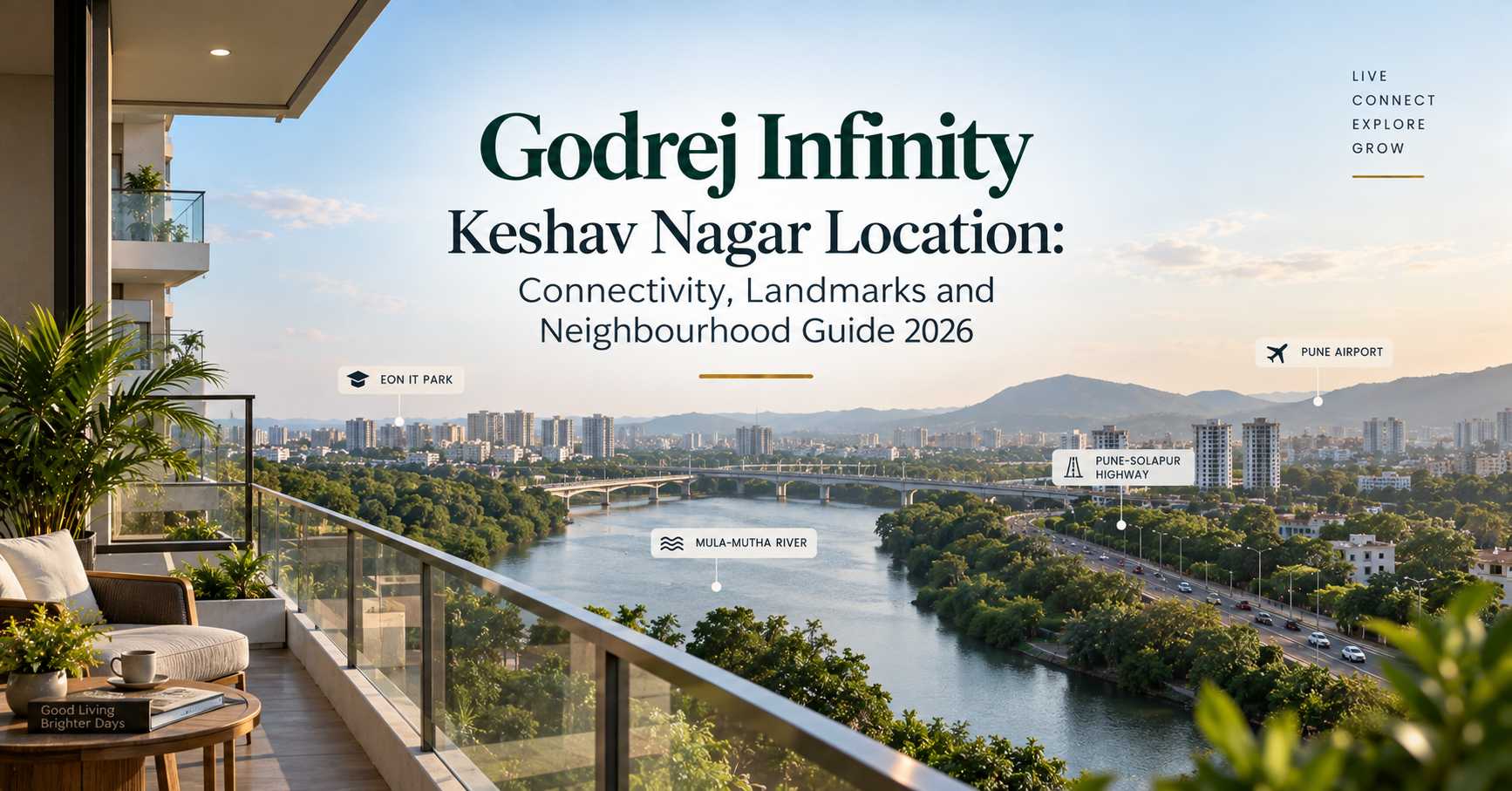
Godrej Infinity sits at Keshav Nagar, Mundhwa, on the Mula-Mutha riverfront in East Pune. Kharadi and the EON IT Park are 6–8 km away, Magarpatta and Hadapsar 4–6 km, Pune Junction 8–9 km and the airport 10–12 km. The Kharadi–Keshavnagar bridge opened in August 2026 and changed the commute materially.
For most of the last decade, the honest problem with Keshav Nagar was geography. Kharadi’s office towers sat a few hundred metres away across the Mula-Mutha, and getting there meant a long detour through congested junctions. People who worked at EON IT Park looked at Keshav Nagar, did the drive once at 9 am, and bought somewhere else.
That changed in August 2026. The Kharadi–Keshavnagar bridge opened to traffic, and the single biggest structural objection to the locality went away. Any assessment of the Godrej Infinity Keshav Nagar location written before then is describing a different place. Our team mapped the current distances, the road works still in progress, and the daily-life infrastructure a household actually uses.
Godrej Infinity Keshav Nagar Location: Distances That Matter
The project address is Keshav Nagar, Mundhwa, Pune 411036, on 42.95 riverfront acres registered under MahaRERA P52100003129. It sits inside the eastern employment belt rather than beside it, which is the whole commercial logic of the location.
| Destination | Distance | Why It Matters |
|---|---|---|
| Magarpatta City / Hadapsar belt | 4–6 km | Nearest large office and retail cluster |
| Kharadi EON IT Park | 6–8 km | Main IT employment node, now bridge-linked |
| Pune Junction railway station | 8–9 km | Intercity rail access |
| Pune International Airport | 10–12 km | Roughly 30 minutes off-peak |
| Mundhwa centre | 2–3 km | Daily retail, markets, local services |
Two numbers in that table do the heavy lifting. A 4 to 6 km run to Magarpatta and Hadapsar puts a large share of Pune’s services and IT employment inside a twenty-minute drive, and 6 to 8 km to Kharadi covers most of the rest. A household with two salaries anchored in the eastern belt can live here and neither person commutes across the city.
The Bridge That Rewrote the Commute
The Kharadi–Keshavnagar bridge over the Mula-Mutha is a 245-metre span built by the Pune Municipal Corporation on a public-private partnership model at a cost of Rs 23.20 crore. It opened to the public around 15 August 2026 after roughly three years of construction, and it connects into a 7.5 km Kharadi stretch.
The bridge was built to ease traffic between Kharadi, Mundhwa, Keshavnagar, Magarpatta, Hadapsar, Wagholi and Vadgaon Sheri — the exact set of destinations a Keshav Nagar household drives to every week.
Two further pieces of road work are in the pipeline and worth tracking, because they determine how much of the bridge’s benefit actually reaches the ground. The PMC has committed to a link road from the Keshavnagar bridge to Mundhwa, intended to resolve the chronic congestion at Mahatma Phule Chowk in Mundhwa and Shivaji Chowk in Keshavnagar. A further 3.5 km road near Hadapsar railway station is proposed.
Until the Mundhwa link road is complete, peak-hour queuing at those two chowks remains the realistic daily friction of living here. It is a smaller problem than the one the bridge solved, but it has not disappeared, and anyone buying should drive the route at 9 am on a weekday rather than on a Sunday afternoon.
What Is Coming: Metro and the Longer View
The Union Cabinet approved Pune Metro Rail Phase 2 with an outlay of Rs 9,858 crore, covering Line 4 from Kharadi to Khadakwasla and Line 4A from Nal Stop to Warje and Manik Baug. The Kharadi–Khadakwasla corridor is the one that matters here: it puts a rail spine across the eastern belt that Keshav Nagar depends on, connecting into the operational Aqua Line which runs Ramwadi to Vanaz.
Treat this honestly in your buying maths. The line is sanctioned rather than running, and metro corridors in India typically take years from approval to operation. It is a genuine 2030s value driver for Keshav Nagar, not a reason to pay more in 2026. The bridge is the infrastructure you can actually use today.
Riverfront, read properly: The Mula-Mutha frontage is the project’s defining feature and cannot be built out, which protects views and supports resale. It also means you should ask directly about the flood line, historical waterlogging on the approach roads, and drainage on the lower levels before committing to a ground or first-floor unit.
Daily Life: Schools, Hospitals and Retail
Keshav Nagar has matured from a fringe address into a functioning residential node over the past decade, and the supporting infrastructure has followed the population rather than led it. The practical position today:
- Schools — the Magarpatta, Hadapsar and Kharadi catchments carry the established options, all within a 4 to 8 km run
- Hospitals — multi-speciality care is concentrated in Hadapsar and Kharadi; Keshav Nagar itself has clinics and pharmacies rather than large hospitals
- Retail and malls — Magarpatta’s retail spine and the Kharadi cluster serve the area; local markets at Mundhwa cover daily needs
- Offices — EON IT Park, Magarpatta City and the Hadapsar industrial belt form the employment triangle around the location
- Open space — the riverfront is the defining amenity, and the project’s own 42.95 acres add to it at roughly 28 homes per acre
The fair summary is that Keshav Nagar is a place you live and drive out of for specialist services, rather than a self-contained node like Magarpatta. For most buyers in the eastern belt that is an acceptable trade, and it is reflected in the locality’s pricing — flats here trade around Rs 8,150 to Rs 9,900 per sq ft against considerably more in Kharadi and Magarpatta proper.
What the Location Has Done to Prices
Location arguments are only worth as much as the price record behind them. Keshav Nagar flat rates rose 4.5% over the past year, 27.3% over three years, 28.3% over five years and 44.2% over ten. That is a steady node rather than a speculative one.
Godrej Infinity itself moved far faster in the short run, repricing from Rs 11,800 to Rs 14,050 per sq ft during Q1 2026 — a 19.07% quarter that coincided with the bridge nearing completion and the metro sanction. Rental yield in the locality sits around 4%, with monthly rents typically between Rs 18,600 and Rs 38,700. The full return picture is set out in our Godrej Infinity review, and project specifications are on the Godrej Infinity Keshav Nagar listing.
Why This Address Fits Godrej’s Pune Strategy
Godrej Properties Limited, as a third-party developer, has concentrated its Pune activity in two corridors: the Hinjewadi and Mahalunge belt in the west, and the Mundhwa, Manjari and Handewadi belt in the east. The eastern corridor is where the affordability sits, and Keshav Nagar is its riverfront address.
The closest comparison in the portfolio is Godrej Sky Greens at Manjari Khurd, roughly 8 km further east and entering near Rs 56.50 Lakh — cheaper, but further from the Kharadi and Magarpatta employment triangle. Buyers weighing the whole eastern belt should read our East Pune locality guide. Corporate project information is published by Godrej Properties Limited.
Frequently Asked Questions
Q: How far is Godrej Infinity from Kharadi EON IT Park?
Between 6 and 8 km. The drive improved materially when the 245-metre Kharadi–Keshavnagar bridge over the Mula-Mutha opened around 15 August 2026, built by the PMC at a cost of Rs 23.20 crore on a public-private partnership model.
Q: Is the Kharadi–Keshavnagar bridge open?
Yes. It opened to traffic around 15 August 2026 after roughly three years of construction. It connects into a 7.5 km Kharadi stretch and links Kharadi, Mundhwa, Keshavnagar, Magarpatta, Hadapsar, Wagholi and Vadgaon Sheri.
Q: Will Pune Metro reach Keshav Nagar?
Pune Metro Phase 2 is approved with a Rs 9,858 crore outlay, including Line 4 from Kharadi to Khadakwasla. That corridor serves the eastern belt around Keshav Nagar. It is sanctioned rather than operational, so treat it as a long-term value driver rather than a 2026 benefit.
Q: How far is Godrej Infinity from Pune airport?
Between 10 and 12 km, typically around 30 minutes outside peak hours. Pune Junction railway station is 8 to 9 km away, and Magarpatta City with the wider Hadapsar belt sits 4 to 6 km from the project.
Q: What are the drawbacks of the Keshav Nagar location?
Peak-hour congestion at Mahatma Phule Chowk in Mundhwa and Shivaji Chowk in Keshavnagar remains until the PMC’s link road from the bridge to Mundhwa is complete. Specialist hospitals and larger retail are in Hadapsar and Kharadi rather than in Keshav Nagar itself.
Q: Is riverfront property in Keshav Nagar a monsoon risk?
Riverfront land requires specific due diligence. Ask for the flood line, the history of waterlogging on the approach roads, and the drainage design for lower levels. Upper-floor units carry considerably less exposure to this question than ground and first-floor stock.
Q: Has the Keshav Nagar location delivered price growth?
Flat rates in Keshav Nagar rose 4.5% over one year, 27.3% over three years, 28.3% over five and 44.2% over ten. Godrej Infinity itself repriced from Rs 11,800 to Rs 14,050 per sq ft in Q1 2026, a 19.07% quarter.
Our Verdict on the Location
Keshav Nagar in 2026 is a materially better address than it was in 2025, and the reason is a single 245-metre bridge. With Kharadi 6 to 8 km away and Magarpatta 4 to 6 km, a household working in East Pune can live on a riverfront parcel at Rs 8,150 to Rs 9,900 per sq ft locality pricing rather than Kharadi rates.
The remaining friction is the last mile — the chowks at Mundhwa and Keshavnagar until the PMC link road lands. Drive it yourself on a weekday morning before you decide, and check the flood line if you are looking at lower floors. Our team can arrange a site visit timed to peak traffic so you see the commute as it really is, and share tower-wise availability including river-facing options.