Quick Answer
Mumbai property prices in 2026 are rising fastest in Ulwe (up 22-25%), Panvel (9-12%) and premium South Mumbai (10-14%). The MMR average is a far more modest 4-7%. Dombivli fell 4.95%, Bhiwandi 1.54% and Kalyan was flat — proving the region no longer moves as one market.
There is no single answer to the question of Mumbai property prices 2026. There are about forty answers, and the spread between the best and worst of them is close to 30 percentage points in a single year. Ulwe appreciated 22-25%. Dombivli, roughly 45 kilometres away and inside the same metropolitan region, fell 4.95%. Both of those are true simultaneously, and averaging them into a regional number produces a figure that describes nothing anybody actually bought.
The regional average, for the record, is 4-7% annualised — Knight Frank put MMR capital value growth at close to 5% through 2025 and most micro-markets are tracking in that band into the second half of 2026. Against 6% stamp duty and roughly 4-5% consumer inflation, the average MMR property is a wealth-preservation instrument, not a wealth-creation one.
What separates the outliers is not luck. Our team has tracked these numbers monthly, and the pattern is consistent enough to state plainly: price growth in 2026 followed operational infrastructure, and nothing else came close.
Mumbai Property Prices 2026: Full Micro-Market Rate Card
These are the working rates we quote clients in September 2026, sourced from listing portals and cross-checked against registered transaction data. Rates are for new-build or near-new stock; older resale typically trades 10-20% below these.
| Micro-Market | Rate (Rs/sq ft) | 12-Month Change | Primary Driver |
|---|---|---|---|
| Ulwe | 10,000 – 16,000 | +22 to +25% | NMIA operational Dec 2025 |
| Worli / Prabhadevi | 65,000 – 1,20,000 | +10 to +14% | Coastal Road, land scarcity |
| Bandra Reclamation | 85,000 – 1,40,000 | +10 to +14% | Sea Link, BKC, zero new supply |
| Panvel | 13,350 – 15,000 | +9 to +12% | Atal Setu, airport gateway |
| Kharghar | 11,000 – 18,000 | +8 to +10% | CIDCO planning, airport proximity |
| Vikhroli East | ~24,550 | +7 to +9% | Eastern Freeway, BKC access |
| Badlapur | 6,500 – 8,000 | +7.59% | Affordability floor, rail corridor |
| Kandivali East | ~28,700 | +6 to +8% | Metro 7, end-user depth |
| Thane (avg) | ~15,350 | +5 to +7% | Metro 5, employment base |
| Kalyan | ~9,750 | -0.36% | Supply overhang |
| Bhiwandi | 7,000 – 9,000 | -1.54% | Logistics-led, thin housing demand |
| Dombivli East | 8,500 – 10,500 | -4.95% | Oversupply, delayed infrastructure |
Read that table bottom-up and the lesson is sharper than reading it top-down. The three localities that lost value in 2026 all share one characteristic: heavy launch activity between 2019 and 2023 aimed at price-sensitive buyers, delivered into a corridor where the promised connectivity has not yet opened. Supply arrived before demand did.
Why Ulwe and Panvel Ran Away From the Pack
The Navi Mumbai International Airport began commercial operations on 25 December 2025. That single event is responsible for most of the top of the table.
Ulwe is the closest substantial residential node to the terminal, 10-15 minutes by road, and it went from Rs 8,000-odd per sq ft territory to Rs 10,000-16,000 in roughly eighteen months. Over an eight-year view, Ulwe values are up 200-300%. Panvel did similar work over a longer window — apartment capital values rose about 74% between FY21 and FY25, reaching Rs 13,350-15,000 per sq ft.
The Atal Setu amplified both. The 22-kilometre Sewri-to-Nhava Sheva sea bridge cut a 60-plus-minute drive to 20-25 minutes, which functionally moved Navi Mumbai’s southern nodes inside Mumbai’s commuting radius for the first time.
Key takeaway
A 22-25% annual gain is a repricing event, not a growth rate. Ulwe’s jump reflects the market closing the gap between “airport announced” and “airport flying”. That gap can only close once. Anyone modelling 20%+ into year three is extrapolating a one-time adjustment.
The Premium Paradox: Highest Prices, Strongest Growth
Conventional logic says expensive assets appreciate slower. Mumbai in 2026 says otherwise. Premium South Mumbai grew 10-14%, comfortably ahead of the 4-7% regional average, despite already trading at Rs 65,000 to Rs 1.4 lakh per sq ft.
Two things explain it. First, absolute supply scarcity — Worli, Prabhadevi and Bandra Reclamation have almost no developable land left, and what exists comes through complex redevelopment. Second, the buyer pool is not credit-constrained. A repo rate at 5.25% matters enormously to a Rs 1.2 crore buyer in Thane and barely at all to a Rs 20 crore buyer in Bandra.
Our team analysed this at the segment level, and the divergence is structural rather than cyclical. Unsold inventory in the Rs 2-5 crore band rose 43% to 65,671 units in H1 2026. Above Rs 20 crore, genuine sea-facing stock is measured in dozens of units, not thousands.
That scarcity is why the two most-watched new launches in the city sit at this end. Godrej Trilogy in Worli is quoted from around Rs 13.88 crore for sea-facing 3 and 4 BHK residences, while Godrej Bandra Reclamation opens from about Rs 19.5 crore. Neither is an income asset — yields there run 2-2.5% — but both sit in the fastest-appreciating band in the city.
The Suburbs: Slower, Steadier, Far More Liquid
Between the airport belt and South Mumbai sits the part of the city where most people actually buy. Kandivali East averages roughly Rs 28,700 per sq ft, Vikhroli East around Rs 24,550, and Chandivali and Powai sit in a similar band. Growth of 6-9% is unremarkable — and that is rather the point.
What the western and central corridors give you instead is depth. Metro Lines 2A, 7 and 9 support high rental demand across Andheri, Malad, Goregaon and Kandivali, and well-located stock in that zone has averaged 8-12% annual appreciation. More importantly, there are always buyers. A Kandivali 2 BHK finds a purchaser in weeks; a comparable unit in a peripheral node can sit for a year.
For area-level detail, our Kandivali East price analysis and Chandivali-Powai market trends go building by building.
What Actually Drives Mumbai Property Prices
Strip away the marketing and price movement in MMR comes down to five variables. We weight them roughly in this order.
- Operational transit, not announced transit. Values typically move 15-25% within three years of a metro line beginning operations. They move far less on announcement. Metro Line 5’s Thane-Bhiwandi leg, due December 2026, is the next one to watch.
- Segment-level supply. The Rs 2-5 crore band added 43% more unsold units in six months. That single fact caps pricing power across most mid-premium suburbs regardless of location quality.
- Interest rates. The RBI cut 125 basis points through 2025 and has held at 5.25% since April 2026, with Mumbai home loans at roughly 7.10-8.6%. Stable rates support volume more than they support price.
- Ready reckoner revisions. Annual RR increases raise the floor on stamp duty and, indirectly, on quoted rates. They also cause a March transaction rush ahead of the new schedule.
- Employment proximity. BKC, Powai, Airoli and Thane’s IT belt anchor rental demand. Localities without an employment node within 45 minutes have underperformed consistently.
How to Read a Quoted Price Before You Believe It
Headline per-square-foot rates are among the least reliable numbers in Indian real estate. Run this sequence on any quote you receive.
- Ask which area the rate applies to. Carpet, built-up and saleable can differ by 30%. Under RERA, the agreement must state carpet area — insist the comparison is carpet-to-carpet.
- Separate base rate from all-inclusive. Floor rise, preferred location charges, parking, club membership and infrastructure charges can add 8-15% to the base.
- Check the registered transaction data, not the asking price. IGR Maharashtra records show what actually changed hands in the building.
- Pull three resale comparables in the same project or the one next door. A large gap between new-sale and resale pricing tells you the launch price was aspirational.
- Add 7-8% for transaction costs — stamp duty at 6% in Mumbai (5% for women buyers), registration capped at Rs 30,000, GST on under-construction units, and legal verification.
- Compare against the ready reckoner rate for the locality. A quote far above RR is not automatically wrong, but it should be explainable by something specific.
Where Godrej Pricing Sits Across the MMR Curve
Godrej Properties Limited is a third-party developer, and its MMR price ladder is a useful reference precisely because it spans nearly the full range discussed above with broadly comparable specification standards.
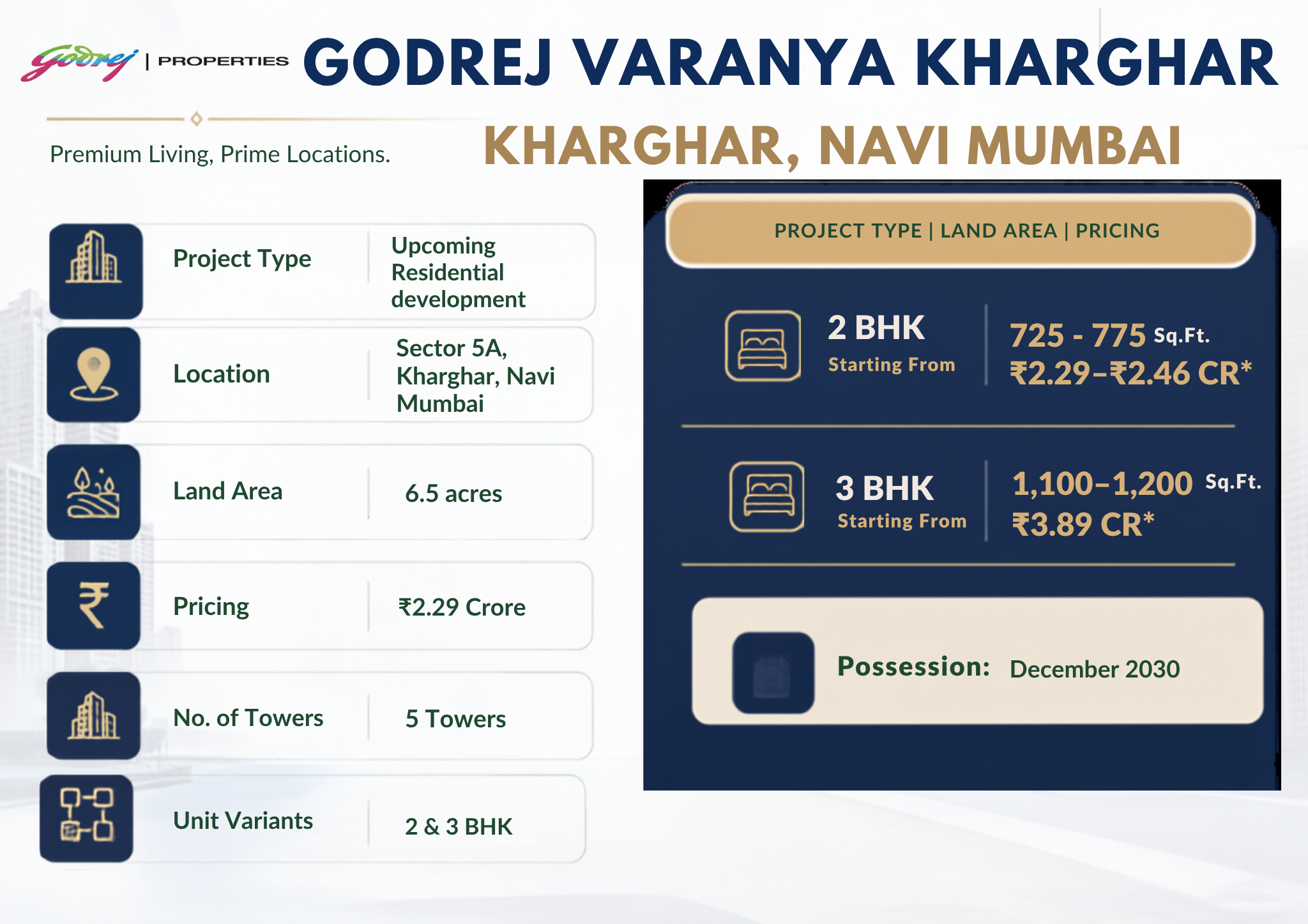
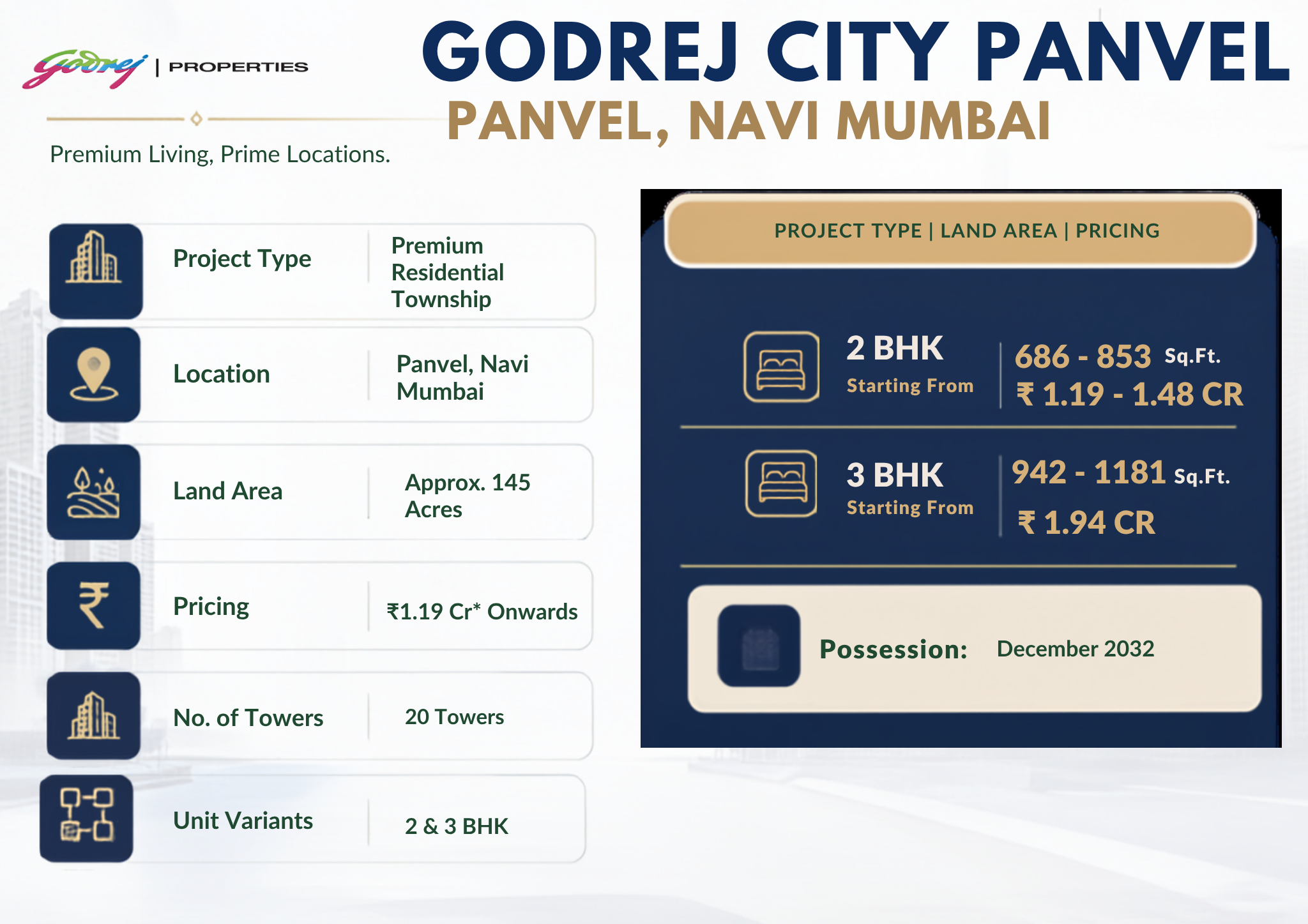
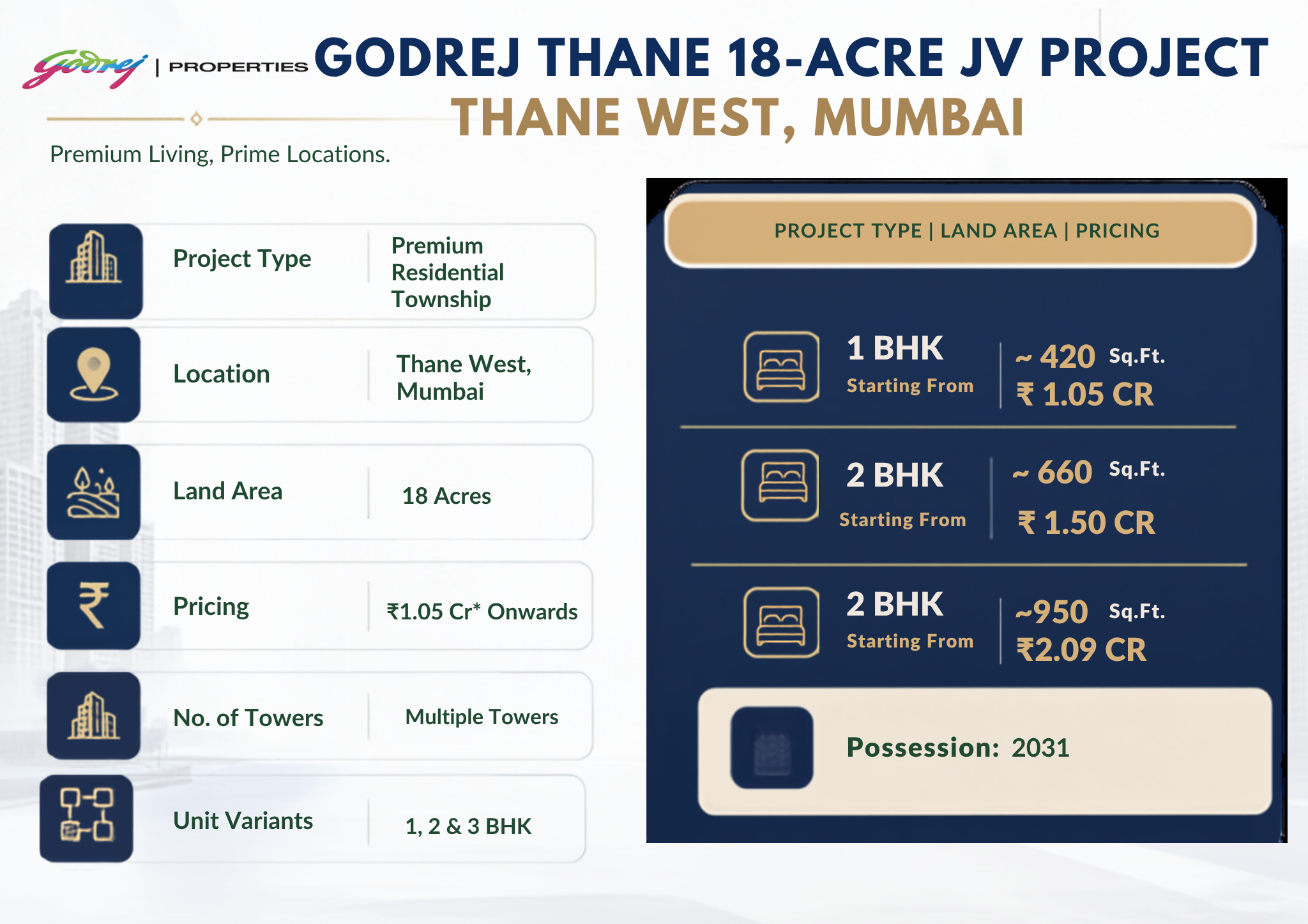
At the entry end, Godrej Bliss in Kandivali East starts near Rs 98 lakh and Godrej City Panvel near Rs 79 lakh. In the mid-premium suburbs, Godrej Urban Park at Chandivali opens around Rs 1.38 crore and Godrej Nest Kandivali around Rs 1.21 crore. Godrej Horizon at Wadala sits at about Rs 3.37 crore, and the Worli and Bandra Reclamation projects occupy the top of the curve. The developer’s own disclosures are at Godrej Properties Limited.
Frequently Asked Questions
Q: Which area has the fastest rising Mumbai property prices in 2026?
Ulwe, at 22-25% year-on-year, driven by the Navi Mumbai International Airport becoming operational in December 2025. Among established markets, premium South Mumbai leads at 10-14%. Panvel follows at 9-12%.
Q: Are Mumbai property prices falling anywhere in 2026?
Yes. Dombivli depreciated 4.95%, Bhiwandi 1.54% and Kalyan was roughly flat at minus 0.36% over the past year. All three saw heavy launch activity into corridors where promised connectivity has not yet opened, producing a supply overhang.
Q: What is the average property rate in Mumbai in 2026?
There is no useful single figure. Working ranges are Rs 9,750 per sq ft in Kalyan, Rs 15,350 in Thane, Rs 24,550 in Vikhroli, Rs 28,700 in Kandivali and Rs 65,000 to Rs 1.4 lakh in premium South Mumbai. The MMR-wide growth rate is 4-7% annualised.
Q: Will Mumbai property prices rise in 2027?
The consensus view is continued moderate growth of 4-7%, with transit-linked corridors outperforming. Metro Line 5’s Thane-Bhiwandi section, expected by December 2026, is the clearest near-term catalyst. The Rs 2-5 crore segment, carrying 65,671 unsold units, is likely to lag.
Q: How do ready reckoner rates affect what I pay?
Ready reckoner rates set the minimum valuation on which stamp duty is calculated, so an annual revision raises your transaction cost even if the negotiated price does not change. They also drive a March registration rush as buyers close ahead of the new schedule.
Q: Is Mumbai property overpriced in 2026?
By affordability metrics, parts of it are — price-to-income ratios in the western suburbs remain among the highest in India. By supply metrics, premium South Mumbai is not, given how little sea-facing stock exists. The genuinely stretched segment is Rs 2-5 crore mid-premium, where inventory grew 43% in six months.
Q: Do metro lines really raise property prices?
Operational ones do. Corridors elsewhere in India have gained 15-25% within three years of services starting. Announced-but-unbuilt lines produce a short speculative bump that often fades. That distinction explains most of the Ulwe-versus-Dombivli gap this year.
Our Verdict on Mumbai Prices in 2026
Mumbai property prices in 2026 reward specificity and punish generalisation. The region grew 4-7%, but almost nobody experienced that number — buyers either bought into an operational infrastructure corridor and made 9-25%, or bought into a promised one and lost money. The variable that mattered was not the developer, the amenity list or the launch discount. It was whether the road, bridge or line in the brochure was actually carrying traffic.
If you are pricing a purchase this quarter, get the carpet-area comparison right, check registered transactions rather than asking rates, and make sure the catalyst you are paying for is already open. Our team can share current pricing and inventory across the Godrej MMR portfolio or arrange a site visit in the micro-markets that match your budget.