Quick Answer
Living in Vikhroli East means an address 0.3 km from the Eastern Express Highway, ten minutes from the Powai employment cluster and 10–12 km from the airport, at roughly Rs 23,600–28,700 per sq ft — well below Powai or Chembur. Metro Line 6 will terminate here, adding a direct east-west link to Andheri and SEEPZ that does not exist today.
Vikhroli is one of the few Mumbai suburbs that most buyers pass through daily without ever considering as a place to live. It sits on the Central Line between Ghatkopar and Bhandup, hard against the Eastern Express Highway, and for decades it read as an industrial address rather than a residential one. That reading is now out of date.
The numbers make the case better than the reputation does. Vikhroli East averages roughly Rs 23,600 to Rs 28,700 per sq ft depending on the data source — materially below Powai and Chembur while sitting minutes from both. The locality carries a rental yield near 5%, among the healthier in Mumbai, which tells you demand is real rather than speculative. And Metro Line 6 will terminate here, converting a single-line Central Railway suburb into an east-west interchange node.
This guide covers what living in Vikhroli East actually involves in 2026 — connectivity, the commute maths, what your money buys, the infrastructure timeline, and the honest drawbacks that anyone considering the move should weigh.
Connectivity — The Core of the Vikhroli Case
Vikhroli’s advantage is not proximity to one place. It is near-equidistance from several, which is a more durable position in a city where employment nodes shift.
| Destination | Distance / Time | Route | Daily Relevance |
|---|---|---|---|
| Eastern Express Highway | 0.3 km | Direct | North-south spine |
| LBS Marg | 1.2 km | Direct | Alternate arterial |
| Vikhroli station | ~5 minutes | Road | Central Line to CSMT/Thane |
| Powai employment cluster | ~10 minutes | LBS / internal roads | Primary job catchment |
| Mumbai International Airport | 10–12 km | EEH / JVLR | 30–40 minute drive |
| Bandra-Kurla Complex | 30–40 minutes | EEH / JVLR | Financial district |
The 0.3 km figure to the Eastern Express Highway is the one worth pausing on. Most Mumbai listings describe highway access loosely; here it is three hundred metres. In practice that means a resident heading north to Thane or south to Sion is on the arterial within two minutes of leaving the gate — which, in a city where the first two kilometres of any journey are often the slowest, is a genuine daily saving.
Ten minutes to the Powai job cluster, five minutes to Vikhroli station, thirty minutes to BKC and 10–12 km to the airport. Few Mumbai suburbs put all four inside those ranges at Vikhroli’s price point.
Metro Line 6 — What Changes and When
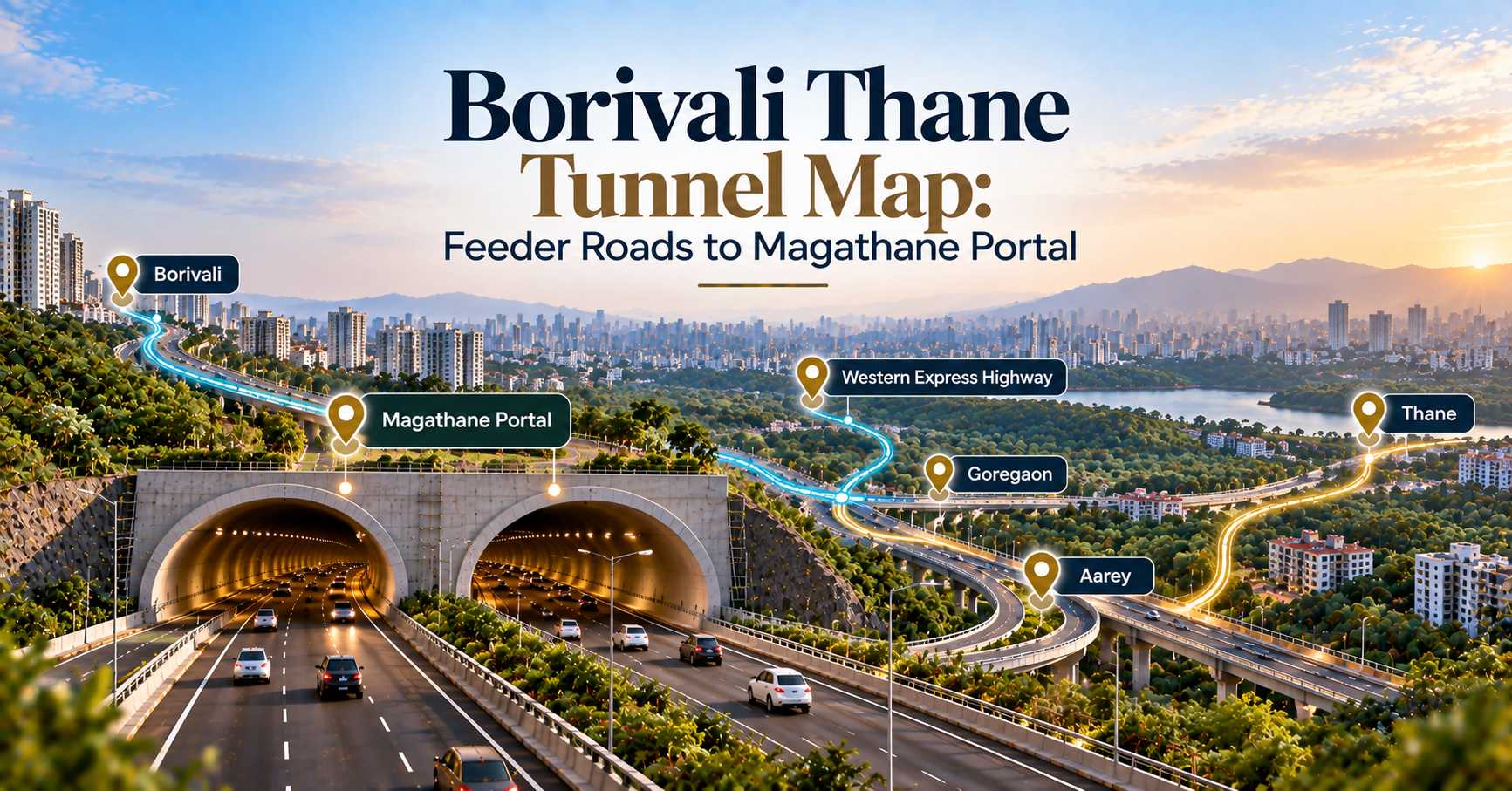
The Pink Line is the largest single change coming to this locality. It runs 15.31 km from Swami Samarth Nagar in Andheri West to Vikhroli via the Jogeshwari–Vikhroli Link Road, with 13 stations across a fully elevated corridor connecting the Western and Eastern Express Highways.
- Interchanges: Line 2 at Adarsh Nagar, Line 3 at SEEPZ, Line 4 at Kanjurmarg West and Line 7 at JVLR — four connections from a single corridor
- Time saved: Travel along the JVLR route is expected to fall by 30–45 minutes
- Road relief: Roughly 30% of current road users on the corridor are projected to shift to metro
- Timeline: MMRDA has cleared the way for an opening in the second half of 2026 without the Kanjurmarg car depot, though some projections place full commissioning later
- Position: Vikhroli is the eastern terminus, which typically draws a wider catchment than an intermediate station
The practical effect for a resident is that Andheri West, SEEPZ and the western suburbs stop being a road journey. Today, crossing the city east to west at peak hour is the single worst commute in Mumbai. The Pink Line is designed specifically to fix that, and Vikhroli sits at one end of it.
A note of realism: metro timelines in Mumbai slip. Anyone buying here should treat Line 6 as upside rather than as a commitment they are relying on from a specific date. The locality’s existing road and rail connectivity stands on its own without it.
What Your Money Buys in Vikhroli East
Pricing is the reason Vikhroli deserves a look. The locality sits meaningfully below its immediate neighbours while offering comparable access to the same employment clusters.
| Segment | Rate per Sq Ft | Typical 2 BHK | Rental Yield | Notes |
|---|---|---|---|---|
| Vikhroli East average | Rs 23,600–28,700 | Rs 1.6–2.2 Cr | ~5% | Mixed older and newer stock |
| Premium developments | Rs 41,000–43,500 | Rs 3.15 Cr+ | 3.4–4.2% | Low-density, branded, ready |
| Chandivali / Powai fringe | Rs 25,700–32,000 | Rs 1.75 Cr+ | 3–3.8% | Nearer the job cluster |
The roughly 5% locality rental yield is the standout figure. Mumbai as a whole struggles to clear 3%, and a suburb delivering 5% is telling you that rents are strong relative to capital values — which usually means end-user demand rather than investor speculation is setting the price. For a buyer, that is a healthier foundation than a locality where prices have run ahead of rents.
At the premium end, Godrej The Trees Vikhroli East offers 864 ready-to-move homes across roughly 34 acres from Rs 1.85 crore — a low-density format that is scarce anywhere in Mumbai. It trades at a substantial premium to the locality average, which we assess in detail in our Godrej The Trees review.
Daily Life — The Honest Picture
Vikhroli is a functional suburb rather than a lifestyle destination, and prospective residents should understand what that means before moving.
What Vikhroli Borrows From Powai
Much of the retail, dining, healthcare and schooling that Vikhroli residents use sits in Powai, roughly ten minutes away, or along LBS Marg. This works well for a household with a car and less well for one without. Assess the drive at peak hour, not on a Sunday.
On the plus side, the eastern corridor has a substantial institutional and corporate presence — the Powai cluster hosts major employers and IIT Bombay, and the Godrej Group’s own long-established Vikhroli campus anchors significant employment on this side of the highway. That base is what supports the locality’s rental demand and keeps vacancy low.
On the honest side: Vikhroli is a Central Line suburb, and peak-hour local trains from here are crowded in the way all Central Line stations are. The Eastern Express Highway that gives the locality its access also generates traffic and noise along the corridor, and units facing it directly are a genuinely different living experience from those set back. Walk the specific building at 8 am on a weekday before committing.
Seven Things to Check Before Moving to Vikhroli East
- Do your actual commute at peak hour, in both directions, before you shortlist — Vikhroli’s advantage is time saved, so verify the time
- Check the building’s orientation relative to the Eastern Express Highway; noise falls off sharply with setback and floor height
- Confirm which schools and hospitals your household will realistically use, and drive to them at the hour you would actually go
- Compare rate per sq ft on a carpet basis across shortlisted projects — locality averages are often quoted on built-up area and are not directly comparable
- Verify MahaRERA registration and occupancy certificate status for any project you consider, completed or otherwise
- Ask where the nearest Metro Line 6 station will sit relative to the building, and how you would reach it on foot
- Check water supply and power reliability with existing residents rather than with the seller
Point four catches out more buyers in Vikhroli than anywhere else in the eastern suburbs, because the gap between the two commonly quoted locality figures — Rs 23,600 and Rs 28,700 per sq ft — is largely an area-basis difference. Comparing a carpet-area price against a built-up-area average will make almost any project look overpriced.
Vikhroli Against Its Neighbours
The relevant comparison for most buyers is Chandivali and Powai, which sit on the other side of the same employment cluster. Godrej Urban Park Chandivali, priced from Rs 1.38 crore with December 2026 possession, sits closer to Powai and SEEPZ but at higher density on 2.71 acres. Vikhroli offers more land per home and better highway access; Chandivali offers a shorter commute to the Powai and Andheri East offices.
Godrej Properties Limited holds a significant position across the eastern suburbs, and reported FY26 sales bookings of Rs 34,171 crore across 17,515 homes, with Rs 10,313 crore from the Mumbai Metropolitan Region — its largest regional contribution. Corporate information is published at Godrej Properties Limited.
Frequently Asked Questions
Q: Is Vikhroli East a good place to live in 2026?
Yes, for households that value connectivity over lifestyle amenities. It sits 0.3 km from the Eastern Express Highway, ten minutes from Powai and 10–12 km from the airport, at Rs 23,600–28,700 per sq ft — well below Powai or Chembur for comparable access.
Q: What are property prices in Vikhroli East?
The locality averages roughly Rs 23,600 to Rs 28,700 per sq ft depending on the source and area basis used. Premium low-density developments trade higher, in the Rs 41,000–43,500 per sq ft range. Always confirm whether a quoted rate is on carpet or built-up area.
Q: How far is Vikhroli from BKC and the airport?
BKC is roughly 30–40 minutes by road via the Eastern Express Highway and JVLR, depending on the hour. Mumbai International Airport is 10–12 km away, typically a 30–40 minute drive. Powai is about ten minutes and Vikhroli station around five.
Q: When will Metro Line 6 open at Vikhroli?
MMRDA has cleared the way for an opening in the second half of 2026 without the Kanjurmarg car depot, though some projections place full commissioning later. The 15.31 km Pink Line terminates at Vikhroli with 13 stations and interchanges to Lines 2, 3, 4 and 7.
Q: What rental yield does Vikhroli East offer?
Around 5% at the locality level, which is well above the Mumbai average of 2.5–3%. Premium branded developments yield less, in the 3.4–4.2% range, because capital values are higher relative to achievable rent.
Q: What are the drawbacks of living in Vikhroli East?
Retail, dining, healthcare and schooling largely sit in Powai or along LBS Marg rather than within Vikhroli itself, so a car helps considerably. Central Line trains are crowded at peak hour, and units facing the Eastern Express Highway directly experience noticeable traffic noise.
Q: Is Vikhroli better than Powai or Chandivali?
It is cheaper per square foot with better highway access and more available land, while Powai and Chandivali sit closer to the job cluster and offer deeper retail and dining. If your commute is to Powai itself, Chandivali wins on time; if it is north-south or to BKC, Vikhroli wins.
Our Take
Living in Vikhroli East is a rational choice rather than an aspirational one, and that is precisely its appeal. You are buying connectivity — 0.3 km to the Eastern Express Highway, ten minutes to Powai, five to the station — at a price point that neighbouring suburbs with the same access no longer offer. The roughly 5% locality rental yield confirms that real households, not speculators, are setting the price.
The Metro Line 6 terminus is the upside, and it is a substantial one if it commissions on the cleared second-half 2026 timeline. Buy on the connectivity that exists today, treat the metro as a bonus, and drive your actual commute before you sign anything. Our team can arrange site visits across Vikhroli and the neighbouring Powai-Chandivali belt so you can compare the commute properly.