How to Buy a Flat in Kharghar — Step by Step 2026
Covering: Budget planning | RERA verification | Home loan process | Legal checks | Registration | Hidden costs
Bottom line: Buying a flat in Kharghar in 2026 requires a budget of ₹80 Lakh to ₹4+ Crore depending on configuration and developer. Follow the 8-step process in this guide to avoid overpaying, ensure legal compliance and structure your purchase for maximum financial efficiency.
1. Introduction — Buying in Kharghar in 2026
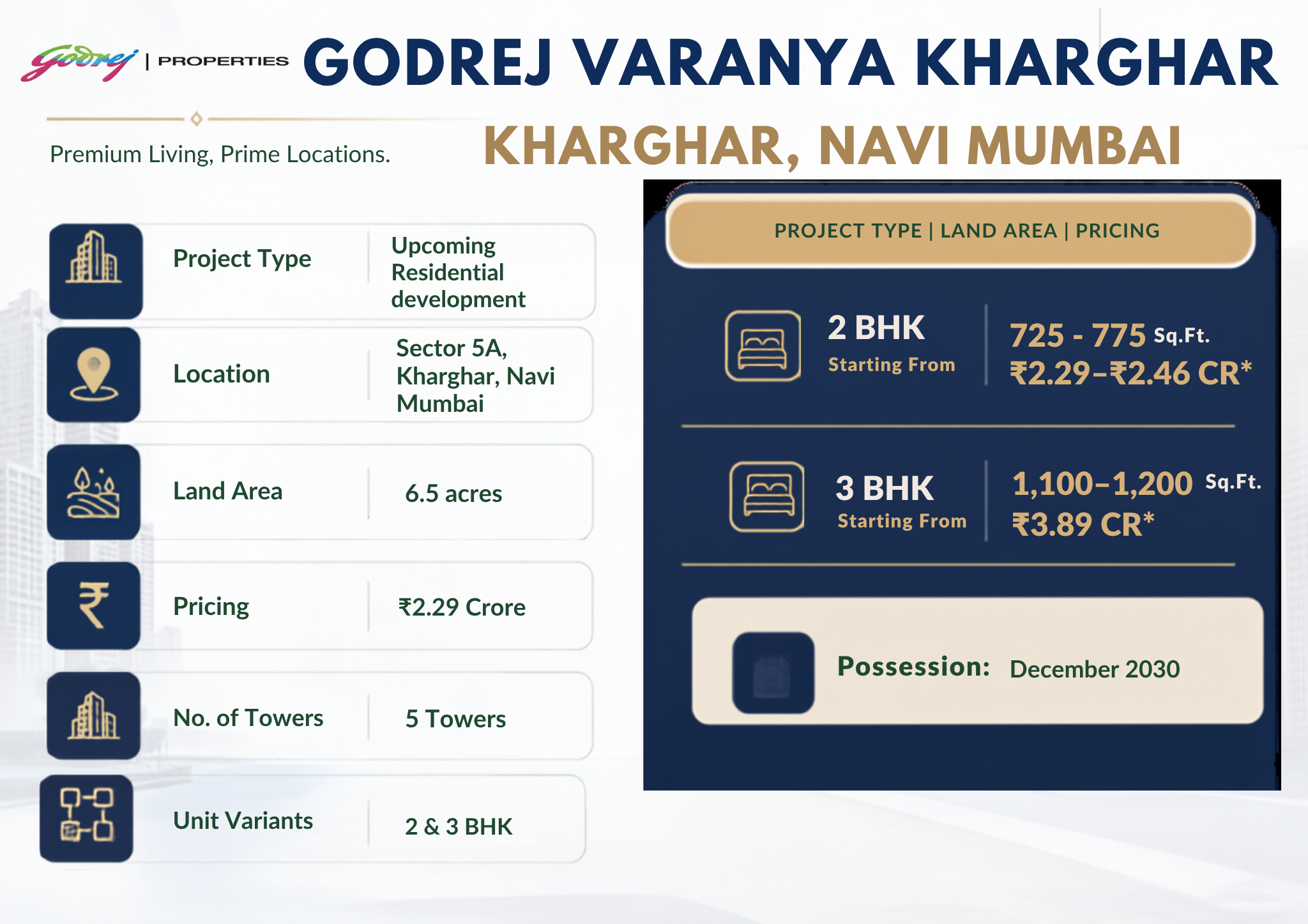
Kharghar is one of Navi Mumbai’s most actively transacted residential markets, and the buying process in 2026 involves more steps and higher stakes than most first-time buyers anticipate. With premium projects like Godrej Varanya by Godrej Properties Limited (NSE: GODREJPROP) — RERA registrations P51271012502176 and P51271012502343 — starting at ₹2.29 Crore for a 2 BHK, the financial commitment is substantial and the margin for error is small. A misstep in RERA verification, loan structuring or cost estimation can cost you several lakh rupees or lock you into a transaction that does not suit your profile.
This guide walks you through the complete buying process from budget planning to registration, covering every step that applies specifically to the Kharghar market. We have structured it as a sequential checklist because the order matters — doing things in the wrong sequence creates problems that are expensive to fix later. Whether you are buying your first apartment or adding to a portfolio, the steps below ensure you cover every base before signing.
The Kharghar market in 2026 offers inventory across a wide spectrum — from ₹80 Lakh resale 1 BHKs in Sector 19–20 to ₹4-plus Crore 3 BHKs from branded developers in Sector 5A. The buying process is fundamentally the same regardless of ticket size, but the financial planning, loan eligibility and tax implications differ significantly at different price points. We flag these differences throughout the guide so you can adapt each step to your specific purchase.
2. Understanding the Kharghar Market — Before You Start
Before starting the buying process, you need a working understanding of how the Kharghar market is structured. The node is divided into numbered sectors, each with a different maturity level, price range and infrastructure profile. Sectors 3–7 are fully established with schools, hospitals, retail and direct railway access — prices here range from ₹18,000 to ₹27,000 per sqft. Sectors 5A and 8–10 are the premium belt with new branded launches at ₹26,000–35,000 per sqft. Sectors 12–20 and 33–36 offer mid-range to affordable options at ₹16,000–25,000 per sqft. Knowing this map prevents you from overpaying in a sector that does not warrant a premium. Review the full Kharghar market structure at Godrej Properties.
The second market fact to internalise is the difference between branded and unbranded inventory. Branded developers like Godrej, Tata and Hiranandani price their stock 15–25% above the sector average, reflecting the brand premium, construction-quality assurance and resale liquidity advantage. Unbranded stock from local developers is priced lower but carries higher execution risk — delayed possession, quality variations and weaker resale premiums. Your choice between these categories should be driven by your risk tolerance and your holding horizon rather than just the headline price.
The third context point is the payment-plan difference between ready-to-move and under-construction purchases. Ready-to-move flats require the full payment at transaction (funded by home loan plus down payment), while under-construction projects use construction-linked payment plans where the loan is disbursed in tranches as construction milestones are met. The construction-linked plan is financially advantageous — you pay interest only on the disbursed amount during the build period — but it requires patience and the ability to service pre-EMI interest for 3–4 years without occupying the apartment.
3. Step-by-Step Buying Checklist
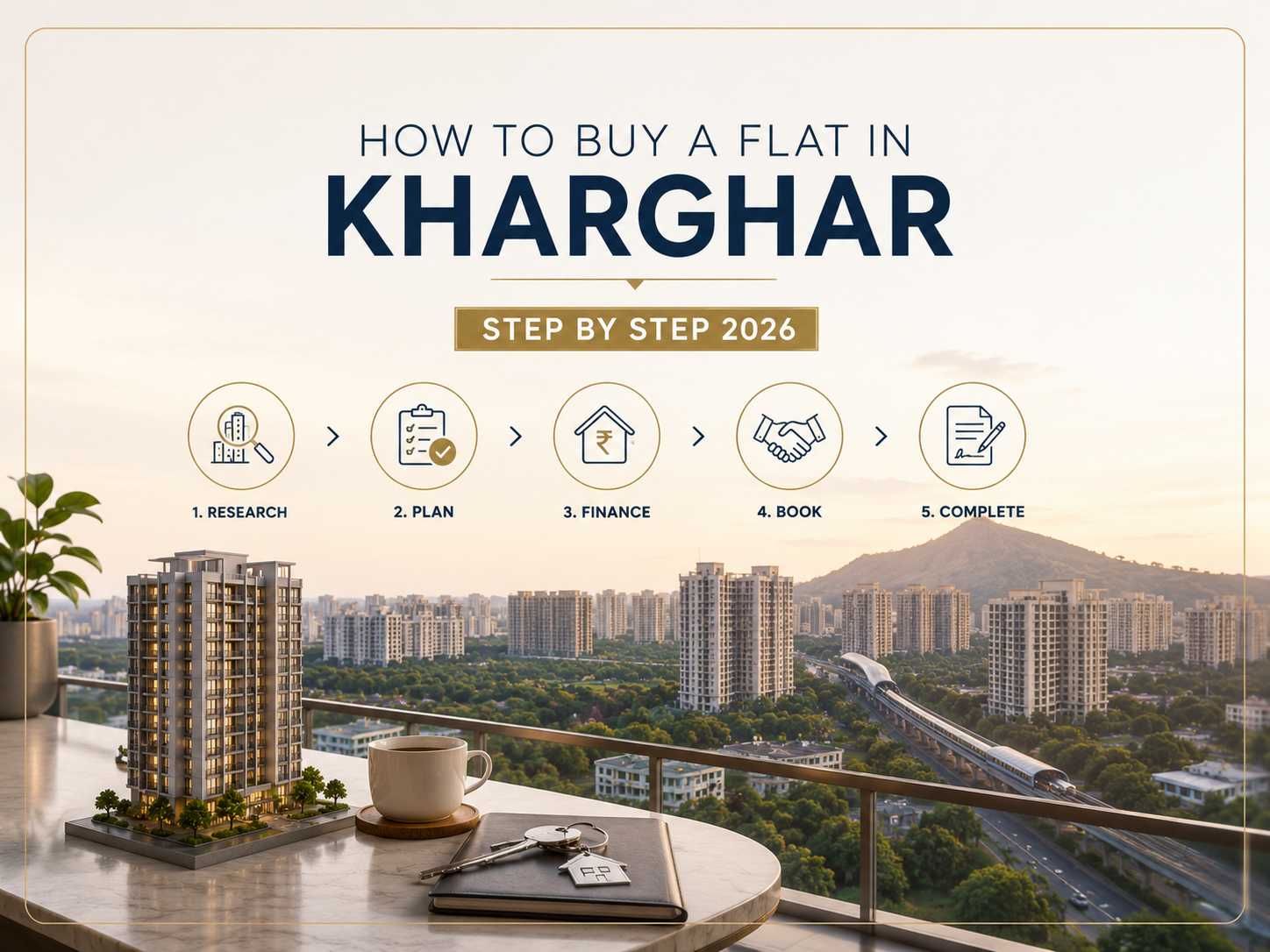
The table below presents the 8-step buying process in sequence. Each step builds on the previous one, and skipping or reordering steps creates problems downstream. We recommend printing this checklist and tracking your progress as you move through the purchase.
| Step | Action | Timeline | Key Output |
|---|---|---|---|
| 1 | Set budget (including all costs, not just ticket price) | Week 1 | Total affordable outlay with 20% buffer |
| 2 | Get home-loan pre-approval from 2–3 banks | Week 1–2 | Sanctioned amount, interest rate, tenure |
| 3 | Shortlist 3–5 projects (sector, developer, configuration) | Week 2–3 | Shortlist with pricing comparison |
| 4 | Verify RERA registration on MahaRERA portal | Week 3 | Confirmed RERA number, possession date, carpet area |
| 5 | Site visit + floor-plan evaluation | Week 3–4 | Preferred unit (floor, facing, view) |
| 6 | Legal verification (title, encumbrances, approvals) | Week 4–5 | Lawyer’s clearance report |
| 7 | Negotiate, finalise unit, sign agreement for sale | Week 5–6 | Executed agreement with payment schedule |
| 8 | Complete stamp duty, registration and loan disbursement | Week 6–8 | Registered agreement, loan activated |
The most common mistake first-time buyers make is starting at Step 5 (site visits) without completing Steps 1–2 (budget and loan pre-approval). Visiting projects before knowing your actual loan eligibility wastes time, creates emotional attachment to properties you cannot afford and weakens your negotiating position because you cannot move decisively when a good unit becomes available. Start with the finances. The site visits come after.
The second common mistake is skipping Step 4 (RERA verification). Every legitimate project in Maharashtra must be registered on the MahaRERA portal (maharera.maharashtra.gov.in), and the registration details — including carpet area, possession date, approved plans and complaint history — are publicly accessible. Verifying these details takes 10 minutes and protects you from misrepresented specifications, undisclosed delays and projects that are not legally authorised to sell. For Godrej Varanya, the RERA numbers P51271012502176 and P51271012502343 can be verified directly on the portal.
4. Financial Planning & Home Loan Guide
The financial structure of a Kharghar flat purchase involves more cost components than most buyers initially account for. The table below breaks down the full cost stack for a ₹2.29 Crore 2 BHK purchase (representative of the premium segment), showing the costs beyond the headline ticket price that affect your real outlay.
| Cost Component | Amount (Approx.) | When Payable |
|---|---|---|
| Base Price (Agreement Value) | ₹2.29 Crore | As per payment schedule |
| GST (5% on under-construction) | ₹11.45 Lakh | With each instalment |
| Stamp Duty (6% in Navi Mumbai) | ₹13.74 Lakh | At registration |
| Registration Fee (1%) | ₹2.29 Lakh | At registration |
| Legal & Documentation | ₹50,000–1 Lakh | During due diligence |
| Home Loan Processing Fee | ₹20,000–50,000 | At loan sanction |
| Pre-EMI Interest (4-year build) | ₹20–30 Lakh (cumulative) | Monthly during construction |
| Total Estimated Outlay | ₹2.77–2.88 Crore | Over 4–5 years |
The total outlay of ₹2.77–2.88 Crore on a ₹2.29 Crore ticket price illustrates why budget planning must account for 20–25% above the headline price. The stamp duty, GST, registration and pre-EMI interest add ₹48–59 Lakh to the cost — a figure that catches many buyers off-guard if they have not budgeted for it. The pre-EMI interest component is particularly significant for under-construction purchases: ₹20–30 Lakh paid over the 4-year build period is money that generates no return and no tax deduction until possession.
For home-loan structuring, we recommend approaching at least three lenders: your existing bank (where you have a salary account and relationship advantage), SBI or HDFC (for competitive rates on large tickets) and a housing finance company like LIC HFL or Bajaj Housing Finance (for flexibility on documentation). The rate differential between lenders can be 25–50 basis points, which on a ₹1.83 Crore loan (80% LTV on ₹2.29 Crore) translates to ₹3–6 Lakh in interest savings over the loan tenure. That 30-minute investment in comparing offers pays for itself many times over.
5. Legal Verification — The Non-Negotiable Step
Legal verification is the step that most directly protects your investment, and it is the step that buyers most frequently rush through or skip entirely. For Kharghar properties, the legal check covers five specific areas: RERA registration validity (confirm on MahaRERA portal), title chain (verify the developer’s ownership or development-rights agreement with CIDCO), approved building plans (cross-check with CIDCO/NMMC), encumbrance certificate (confirm no outstanding liens or disputes) and commencement certificate (verify the project is legally authorised to begin construction and sale).
For branded developers like Godrej Properties, the legal risk is significantly lower than for regional builders because the institutional due-diligence process is more rigorous and the developer’s legal team maintains documentation to bankable standards. However, “lower risk” does not mean “no risk” — and the cost of a legal review (₹50,000–1 Lakh for a property lawyer’s opinion) is trivial compared to the cost of discovering a title defect after you have paid ₹2 Crore. Engage an independent property lawyer — not one recommended by the developer — and insist on a written opinion covering all five areas listed above.
The RERA portal (maharera.maharashtra.gov.in) is your first and most accessible verification tool. For any Kharghar project, enter the RERA registration number and verify: the developer entity name matches the company you are transacting with, the carpet areas match what is being offered to you, the possession date matches what is being promised and there are no registered complaints or compliance orders against the project. This 10-minute check catches the most common misrepresentations — exaggerated carpet areas, undisclosed project delays and developers selling under a different entity than the RERA registrant.
6. Hidden Costs — What Nobody Tells You
Beyond the standard cost stack covered in Section 4, there are additional costs that surface during and after the purchase process. The table below lists the most common hidden costs in Kharghar flat purchases, along with the typical amount and when they arise.
| Hidden Cost | Typical Amount | When It Hits |
|---|---|---|
| Floor-Rise Premium | ₹100–300/sqft per floor (above base) | At booking (built into price) |
| Preferential Location Charges (PLC) | ₹2–5 Lakh for corner/garden-facing | At booking (added to base price) |
| Car Parking (if not included) | ₹3–6 Lakh per slot | At agreement stage |
| IFMS / Maintenance Deposit | ₹2–4 Lakh (2-year advance) | At or before possession |
| Electricity & Water Deposits | ₹50,000–1 Lakh | At possession |
| Interior Fit-Out | ₹8–15 Lakh (basic to mid-range) | Post-possession (before moving in) |
| Society Formation Costs | ₹25,000–50,000 per unit | Post-possession (first year) |
The cumulative impact of hidden costs can add ₹15–30 Lakh to your total outlay, depending on the unit you choose and your interior requirements. The most frequently underestimated item is the interior fit-out — most developers hand over apartments in a semi-finished state (bare walls, basic flooring, no kitchen fittings), and the cost to make the apartment liveable ranges from ₹8 Lakh for a basic fit-out to ₹20-plus Lakh for a premium interior. Budget for this separately and source interior quotes before finalising your overall financing plan.
The floor-rise premium deserves specific attention because it compounds across 37 floors. At ₹200/sqft per floor on a 725-sqft apartment, the difference between Floor 5 and Floor 30 is approximately ₹3.6 Lakh — a meaningful amount but one that is typically recovered at resale, where higher floors with better views command stronger pricing. Our recommendation is to stretch for a higher floor if the premium is within ₹3–5 Lakh, because the resale advantage typically exceeds 2x the floor-rise premium paid at booking. For a deeper investment perspective on this calculation, read our Godrej Varanya investment analysis.
7. Common Mistakes to Avoid
Our team has observed the same mistakes repeated across hundreds of Kharghar transactions. The first is buying based on brochure renders rather than floor plans. Renders make every apartment look spacious and sunlit — floor plans tell you the actual dimensions, the placement of columns, the usability of the balcony and the ventilation pattern. Always evaluate the floor plan at actual scale, and if possible, visit a sample apartment or a completed project by the same developer to see how the plan translates into built space.
The second mistake is not comparing loan offers. The difference between 8.5% and 8.75% on a ₹1.83 Crore loan over 20 years is approximately ₹5.5 Lakh in total interest. Many buyers accept the first offer they receive — usually from the developer’s preferred lending partner — without checking whether their existing bank or a competing lender offers a better rate. Spending one day collecting 3 loan quotes can save you more than a month’s salary.
The third mistake is ignoring the resale exit when buying under-construction. Your apartment is not just a home — it is a financial asset that you may need to sell in 5, 10 or 15 years due to job relocation, family-size changes or financial needs. Projects with lower density, better connectivity and stronger developer brands sell faster and at higher prices in the secondary market. Buying the cheapest available unit maximises your entry savings but may cost you significantly more at exit if the project has poor resale liquidity. For project-specific comparisons in this context, read our Godrej Varanya review.
The fourth mistake is delaying the purchase while waiting for prices to fall. In Kharghar’s premium segment, prices have appreciated 25–35% over five years with no year-on-year decline since 2020. Every year of waiting has meant buying at a higher price. If your financial readiness and project research are both complete, acting sooner captures a lower entry price and, in the case of launch-period projects, benefits like the up to ₹20 Lakh currently available at Godrej Varanya on select units. For the full market context, read our Kharghar price trends guide.
8. Conclusion & FAQs
Buying a flat in Kharghar in 2026 is a significant financial decision that rewards preparation and penalises shortcuts. The 8-step process outlined in this guide — from budget planning through registration — ensures you cover every legal, financial and practical base before committing your capital. The Kharghar market offers genuine value for buyers who do their homework: established infrastructure, improving connectivity and a credible appreciation trajectory backed by airport and metro catalysts. Follow the steps, verify every claim on the RERA portal, compare at least 3 loan offers and budget 20–25% above the ticket price for the full cost stack. The process takes 6–8 weeks if executed systematically — and the discipline of following it saves you from the mistakes that cost other buyers lakhs of rupees.
What is the minimum budget to buy a flat in Kharghar?
The minimum budget for a liveable flat in Kharghar is approximately ₹80 Lakh–1 Crore for a resale 1 BHK in Sectors 19–20. For a new 2 BHK from a reputable developer, budget ₹1.50–2.30 Crore depending on the sector and developer. Add 20–25% to the ticket price for stamp duty, GST, registration and interior costs.
How do I verify a Kharghar project’s RERA registration?
Visit maharera.maharashtra.gov.in and enter the project’s RERA registration number. The portal displays the developer entity, approved carpet areas, possession date, approved plans and any registered complaints. For Godrej Varanya, verify RERA numbers P51271012502176 and P51271012502343. This 10-minute check is non-negotiable before booking.
What are the stamp duty charges for buying in Kharghar?
Stamp duty in Navi Mumbai (including Kharghar) is 6% of the agreement value for male buyers and 5% for female buyers. Registration fee is an additional 1% (capped at ₹30,000). For a ₹2.29 Crore property, the total stamp duty and registration cost is approximately ₹14–16 Lakh. Consider registering in a female family member’s name where eligible to save 1% on stamp duty.
Should I buy ready-to-move or under-construction in Kharghar?
Ready-to-move eliminates construction risk and allows immediate occupancy or rental income. Under-construction (construction-linked plan) is financially advantageous — you pay interest only on the disbursed amount during the build period, and launch-phase pricing is typically 10–15% below post-construction rates. Choose based on your urgency for occupancy and your ability to service pre-EMI interest for 3–4 years.
What home loan interest rate can I expect for a Kharghar flat in 2026?
Home loan rates for salaried borrowers in 2026 range from 8.25% to 9.0% depending on the lender, your credit score and the loan amount. For loans above ₹75 Lakh, SBI, HDFC Bank and Bank of Baroda typically offer the most competitive rates. Always negotiate — the published rate is the starting point, not the final offer, especially if your CIBIL score is above 750.