Property Prices in Kharghar — 2026 Complete Guide
Covering: Per-sqft rates across sectors | 5-year appreciation trends | Forecast and catalysts | Node-wise comparison
Bottom line: Kharghar’s premium residential segment trades at ₹24,000–35,000 per sqft in 2026, reflecting 25–35% appreciation over five years. The airport catalyst, metro expansion and Atal Setu connectivity position the node for a further 15–25% appreciation by 2030, with premium-branded projects capturing the upper band.
1. Introduction — Kharghar’s Place in the Navi Mumbai Price Map
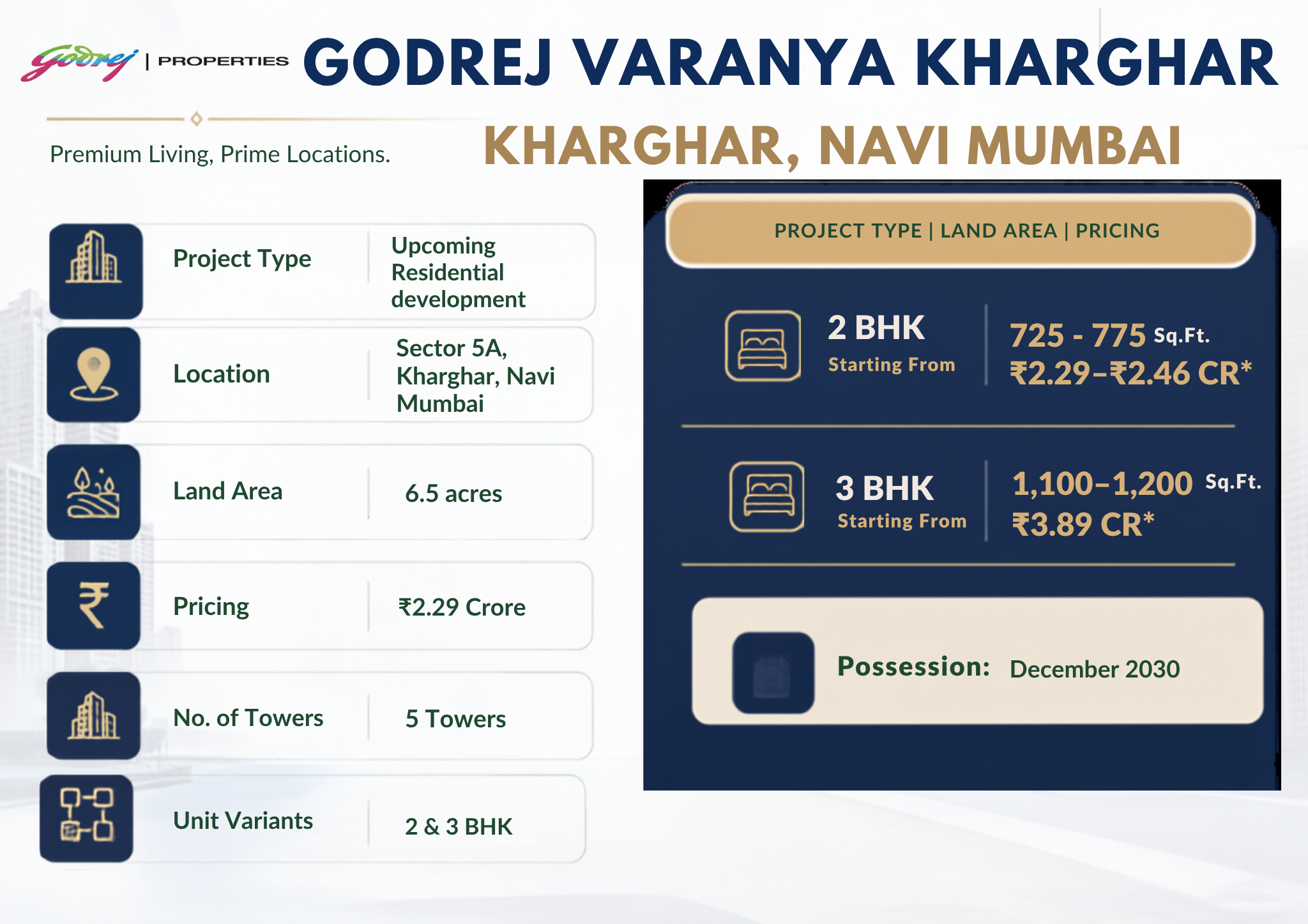
Kharghar has evolved from a CIDCO-planned residential node into one of Navi Mumbai’s most sought-after premium addresses, and property prices in 2026 reflect that transformation. Developed under CIDCO’s systematic planning framework with dedicated sectors for residential, commercial and institutional use, Kharghar today commands per-sqft rates that are second only to Vashi in the Navi Mumbai hierarchy. For buyers evaluating projects like Godrej Varanya (RERA: P51271012502176 / P51271012502343) developed by Godrej Properties Limited (NSE: GODREJPROP), understanding where current prices sit in the historical trajectory — and where they are headed — is essential for making a well-timed purchase decision.
This guide compiles pricing data across Kharghar’s sectors, tracks the five-year appreciation trend, identifies the infrastructure catalysts that are driving the next leg of growth and compares Kharghar’s value proposition against neighbouring Navi Mumbai nodes. We present the data in tables and supplement it with our editorial analysis of what the numbers mean for buyers entering the market in 2026. The objective is straightforward: arm you with enough pricing intelligence to negotiate effectively and buy at the right level.
Kharghar’s price story is not uniform across the node. Older sectors with established social infrastructure command different rates than newer sectors where the neighbourhood ecosystem is still forming. Branded developer projects trade at significant premiums over local-builder stock, and the connectivity profile — specifically, proximity to the railway station and metro — creates sharp price differentials within the same pincode. Our sector-by-sector breakdown in Section 3 maps these variations so you know exactly what you should be paying.
2. How Kharghar Evolved — From CIDCO Plots to Premium Address
Kharghar’s development began in the late 1990s when CIDCO allocated residential plots across numbered sectors. The initial phase of growth was modest — affordable housing in Sectors 3–7, supported by the Kharghar railway station on the Harbour Line and the Central Park that gave the node its green identity. Through the 2000s, prices remained below ₹5,000 per sqft, making Kharghar one of the most affordable planned nodes in the broader Mumbai region. The full developer portfolio driving Navi Mumbai’s transformation can be explored at Godrej Properties.
The inflection point came around 2012–2015, when three forces converged: the CIDCO convention centre and golf course elevated the node’s profile, the announcement of the Navi Mumbai International Airport created a long-term appreciation catalyst and national-brand developers like Godrej, Tata and Hiranandani entered the market with premium offerings. Prices crossed ₹10,000 per sqft by 2014 and ₹18,000 by 2019 in the premium segment. The pandemic-era reset of 2020–2021 created a brief buying window before prices resumed their upward march, crossing ₹25,000 by 2023 and reaching the current ₹28,000–35,000 band in 2026.
Understanding this trajectory matters because it reveals that Kharghar’s appreciation has been infrastructure-driven rather than speculative. Each major price step corresponded to a tangible improvement in connectivity, social infrastructure or institutional presence — not to a speculative run-up fuelled by investor flipping. That infrastructure-driven appreciation pattern is more sustainable than speculative cycles and provides a more reliable basis for forecasting the next 3–5 years of price movement.
3. Current Prices by Sector — 2026 Snapshot
The table below maps current per-sqft pricing across Kharghar’s active residential sectors. Prices reflect the range from local-builder inventory (lower end) to branded-developer premium stock (upper end) based on active listings and recent transactions.
| Sector | Price Range (Rs/sqft) | Primary Configuration | Infrastructure Maturity |
|---|---|---|---|
| Sector 3–4 | ₹18,000–24,000 | 1 & 2 BHK (older stock) | Fully mature — schools, hospitals, retail |
| Sector 5–5A | ₹26,000–35,000 | 2 & 3 BHK (new launches) | Mature with premium new supply |
| Sector 6–7 | ₹20,000–27,000 | 2 & 3 BHK (mixed vintage) | Well-established residential zone |
| Sector 8–10 | ₹22,000–30,000 | 2 & 3 BHK | Developing — retail coming up |
| Sector 12–15 | ₹19,000–25,000 | 2 & 3 BHK | Partially developed — improving |
| Sector 19–20 | ₹16,000–22,000 | 1 & 2 BHK (affordable) | Developing with good connectivity |
| Sector 33–36 | ₹22,000–30,000 | 2, 3 & 4 BHK (townships) | Township-driven development |
The pricing spread of ₹16,000–35,000 per sqft across Kharghar reflects the diversity of the node. Budget-conscious buyers can find well-located 2 BHK apartments in Sectors 19–20 from ₹80 Lakh, while premium buyers in Sectors 5–5A pay ₹2.29 Crore and above for branded inventory with walk-to-station connectivity. The sector you choose should be driven by your budget, your commute pattern and your timeline — ready-to-move stock in established sectors commands a premium over under-construction inventory in developing areas, but the appreciation potential is often higher in the latter.
Sector 5A, where Godrej Varanya is located, sits at the top of the pricing range due to three specific advantages: direct adjacency to the Kharghar railway station and Belpada metro station, frontage visibility from the main Kharghar arterial road and the presence of Godrej’s branded premium inventory. The ₹30,500–33,000 per-sqft rate at Varanya is the ceiling for the sector, but it is also anchored by the connectivity premium that this specific micro-location commands.
4. Price Trends — Five-Year Appreciation Data
The table below tracks Kharghar’s premium-segment pricing across the five-year period from 2021 to 2026. The data reflects branded developer inventory in established sectors, which is the segment most relevant for buyers evaluating projects like Godrej Varanya.
| Year | Premium Segment (Rs/sqft) | YoY Change | Key Catalyst |
|---|---|---|---|
| 2021 | ₹18,000–22,000 | — | Post-pandemic recovery; stamp-duty cut |
| 2022 | ₹20,000–25,000 | +10–14% | Demand surge; stamp-duty normalisation |
| 2023 | ₹22,000–28,000 | +8–12% | Metro progress; Atal Setu anticipation |
| 2024 | ₹24,000–30,000 | +7–10% | Atal Setu opening; branded developer entries |
| 2025 | ₹26,000–32,000 | +6–8% | Airport progress; metro commissioning |
| 2026 | ₹28,000–35,000 | +7–9% | New premium launches; infrastructure maturity |
The compound appreciation of 25–35% over five years translates to a CAGR of approximately 5–6% in the premium segment. That growth rate is moderate by Indian real-estate standards but reflects Kharghar’s positioning as a maturing market rather than a speculative frontier. The important nuance is that branded inventory at the upper end of the range has appreciated faster than the segment average — a 2021 purchase of Godrej or Tata-branded stock would have gained closer to 35–40% versus the 25% at the lower end. This branded-premium differential is a pattern that we expect to continue through 2030.
The year-on-year deceleration from 10–14% in 2022 to 7–9% in 2026 is healthy rather than concerning. Hyper-appreciation is unsustainable and creates bubble risk; a steady 7–9% annual appreciation at the premium level reflects genuine demand absorption rather than speculative cycling. The upcoming airport commissioning is the catalyst most likely to trigger a step-change in this trajectory — historical precedents from other Indian airport corridors suggest a 15–25% acceleration in the 2–3 years surrounding an airport’s opening.
5. What Is Driving Prices — The Catalyst Stack
Kharghar’s pricing trajectory is supported by four infrastructure catalysts that are either operational or approaching completion. The first and most significant is the Navi Mumbai International Airport, approximately 20 minutes from central Kharghar. Airport-adjacent residential markets in Indian metros have consistently shown outsized appreciation: Devanahalli near Bangalore’s airport and Shamshabad near Hyderabad’s Rajiv Gandhi International both saw 40–60% jumps in the five-year window surrounding their respective airport launches. Kharghar’s established liveability profile means it captures this airport premium without the raw-land risk that characterises true airport-adjacent locations like Ulwe.
The second catalyst is the Navi Mumbai Metro, with the Belpada station directly serving Sector 5A (and by extension, projects like Godrej Varanya). The metro adds a second rapid-transit layer on top of the existing Harbour Line railway, creating a dual-rail connectivity advantage that very few Navi Mumbai locations can claim. For property prices, the established pattern across Indian cities is that metro-adjacent residential stock appreciates 8–15% faster than comparable non-metro stock over a 5-year period following metro commissioning.
The third catalyst is the Atal Setu (Mumbai Trans Harbour Link), which has dramatically improved South Mumbai access from Navi Mumbai. Before the sea link, commuting from Kharghar to Nariman Point or Lower Parel involved a 90-minute-plus journey through congested routes. The Atal Setu has compressed this to under 45 minutes, expanding the employment catchment for Kharghar residents and making the node viable for South Mumbai professionals who previously would not have considered Navi Mumbai. This expanded buyer base is a structural demand driver for premium inventory.
The fourth driver is the ongoing commercial development in CBD Belapur and the Airoli–Ghansoli IT corridor, both within 10–15 minutes of Kharghar. Employment growth in these zones generates rental and purchase demand from working professionals, supporting both rental yields and resale velocity. The commercial pipeline includes office-space expansions by major IT and financial-services companies, ensuring sustained employment-driven demand through 2030 and beyond.
6. Kharghar vs Neighbouring Nodes — Price Comparison
To evaluate whether Kharghar offers fair value at current price levels, the table below compares its premium-segment pricing with five neighbouring Navi Mumbai nodes. The comparison covers current rates, five-year appreciation, risk profile and the infrastructure that supports or limits future growth.
| Node | Premium Rs/sqft (2026) | 5-Year Growth | Risk Level | Best Suited For |
|---|---|---|---|---|
| Kharghar | ₹28,000–35,000 | 25–35% | Low–Medium | Premium end-users, patient investors |
| Vashi | ₹30,000–40,000 | 15–22% | Low | End-users preferring full maturity |
| Panvel | ₹14,000–18,000 | 30–40% | Medium | Budget buyers, growth investors |
| Ulwe | ₹12,000–16,000 | 35–50% | High | Aggressive investors (airport bet) |
| Belapur | ₹25,000–32,000 | 18–25% | Low | CBD workers, mature-market buyers |
| Taloja | ₹8,000–13,000 | 20–30% | Medium–High | First-time budget buyers |
The comparison positions Kharghar as the balanced option in the Navi Mumbai market. It offers higher appreciation potential than the fully mature nodes (Vashi, Belapur) without the infrastructure-delivery risk that makes Ulwe, Taloja and even parts of Panvel volatile. For buyers with budgets in the ₹2–4 Crore range, Kharghar is the only Navi Mumbai node that delivers established liveability combined with meaningful remaining upside — Vashi is already at its ceiling, and the lower-priced nodes do not offer the same quality of daily living.
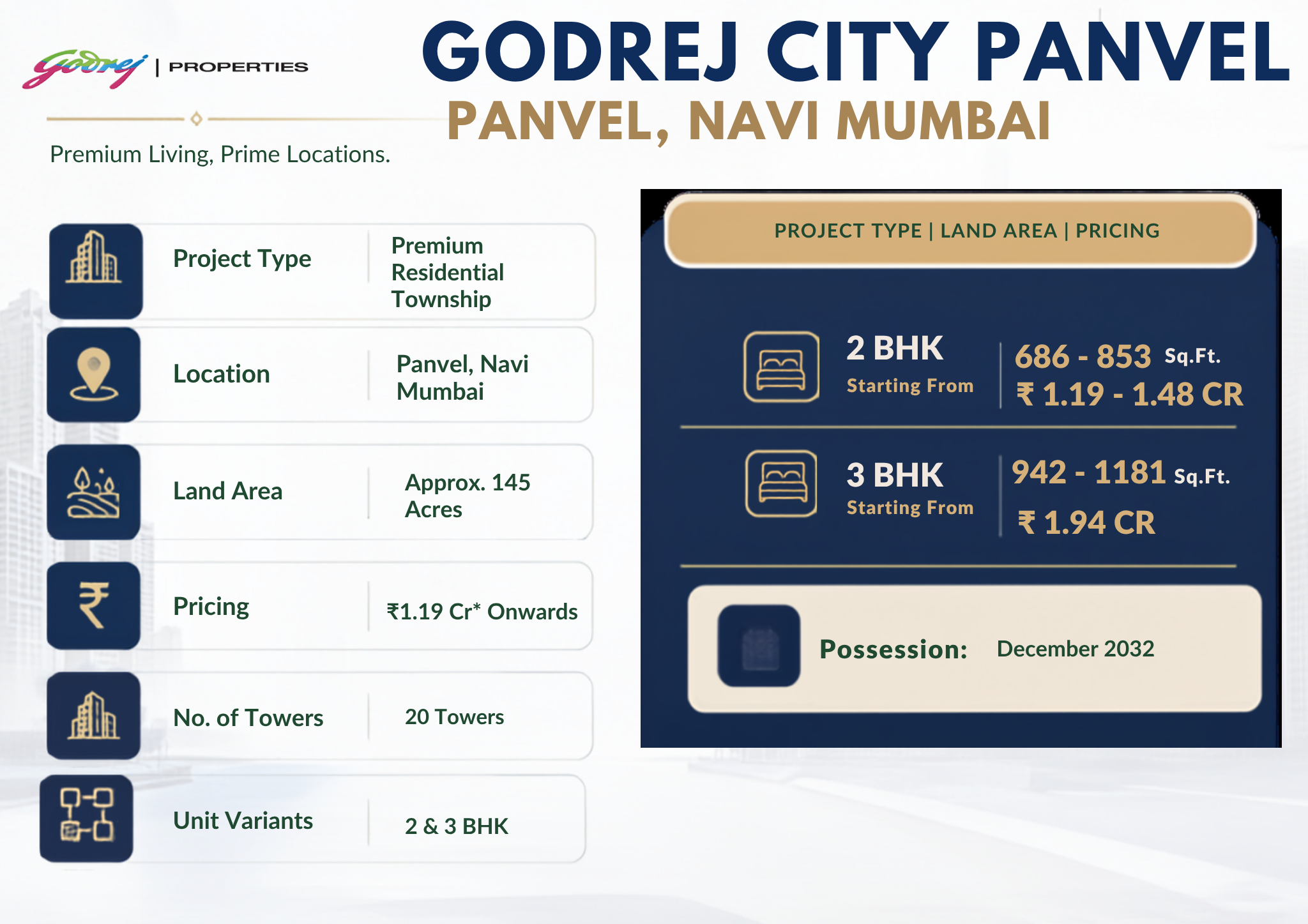
For buyers considering Panvel as an alternative, our Godrej Golf Side Estate listing offers a different format — villa plots starting at ₹59.90 Lakh — that caters to buyers seeking land ownership in the Panvel growth corridor. For a deeper understanding of Kharghar’s neighbourhood ecosystem, read our complete guide to living in Kharghar.
7. Buyer Guidance — Timing and Strategy for 2026
If you are entering the Kharghar market in 2026, the most important strategic decision is whether to buy ready-to-move or under-construction. Ready-to-move inventory in established sectors (3–7) offers immediate occupancy and no construction risk, but prices reflect the full maturity premium — ₹24,000–28,000 per sqft with limited remaining upside. Under-construction inventory from branded developers in sectors 5A, 8–10 and 33–36 is priced at ₹26,000–35,000 but carries 3–4 years of construction timeline and the associated pre-EMI interest cost.
Our recommendation for most buyers is a two-part approach. First, establish your non-negotiable requirements: commute pattern, school proximity, hospital access and daily convenience. Use these to shortlist 2–3 sectors that meet your lifestyle needs. Second, within those sectors, compare branded versus unbranded inventory at the specific floor level and view orientation you want. The branded premium of 15–25% is justified for buyers who value developer trust, on-time delivery and post-possession maintenance. It is less justified for pure investors who plan to exit at possession and do not benefit from the long-term living-quality advantages.
For buyers who have completed their evaluation, there is a timing argument for acting in 2026 rather than waiting. With the airport approaching its operational timeline, the next 2–3 years are likely to see accelerating appreciation in the Kharghar premium segment. Waiting for prices to drop is a strategy that has not worked in Kharghar for over a decade — every year of waiting has meant buying at a higher price. The launch-period benefits currently available at projects like Godrej Varanya (up to ₹20 Lakh on select units) further favour early action. For a detailed walkthrough of the buying process, read our step-by-step buyer guide.
8. Conclusion & FAQs
Kharghar’s property market in 2026 is at an interesting inflection point. Five years of steady 25–35% appreciation have pushed premium prices to ₹28,000–35,000 per sqft — a level that requires larger budgets but also reflects genuine infrastructure maturity and connectivity advantages. The upcoming catalysts — the airport, metro expansion and continued commercial development in the CBD Belapur corridor — provide a credible basis for expecting a further 15–25% appreciation by 2030. For buyers entering now, the question is not whether Kharghar will appreciate further, but which specific micro-location, developer and configuration will capture the strongest appreciation within the node. Our sector-by-sector data and node-comparison analysis above provide the framework for making that decision with confidence.
What is the average property price in Kharghar in 2026?
The average price across all segments in Kharghar is approximately ₹20,000–25,000 per sqft. The premium branded segment (Godrej, Tata, Hiranandani) trades at ₹28,000–35,000 per sqft, while older resale stock in established sectors ranges from ₹16,000–22,000 per sqft. The range reflects the diversity of inventory across the node.
Which sector in Kharghar has the best appreciation potential?
Sectors 5–5A and 8–10 currently offer the strongest appreciation potential. Sector 5A benefits from direct railway and metro station adjacency, while Sectors 8–10 are undergoing active development with new branded launches that will elevate the micro-market. Older sectors (3–7) are mature with limited remaining upside.
Is Kharghar more expensive than Panvel?
Yes — Kharghar’s premium segment (₹28,000–35,000/sqft) is roughly double Panvel’s premium segment (₹14,000–18,000/sqft). The premium reflects Kharghar’s established infrastructure, social ecosystem and connectivity. Panvel offers higher percentage appreciation potential but with correspondingly higher infrastructure-delivery risk.
Will Kharghar property prices drop in 2026?
A price correction in Kharghar is unlikely in 2026 given the active infrastructure catalysts (airport, metro, Atal Setu), sustained demand from the CBD Belapur employment corridor and limited premium supply. Kharghar has not seen a year-on-year price decline in the premium segment since 2020, and the current catalyst pipeline supports continued appreciation.
What is the best budget to buy in Kharghar?
A budget of ₹1.50–2.50 Crore gives you access to well-located 2 BHK apartments from branded developers in established sectors. Below ₹1 Crore, options are limited to compact 1 BHK in less connected areas. Above ₹3 Crore, you enter the 3 BHK premium segment with projects like Godrej Varanya offering walk-to-station connectivity and low-density living.