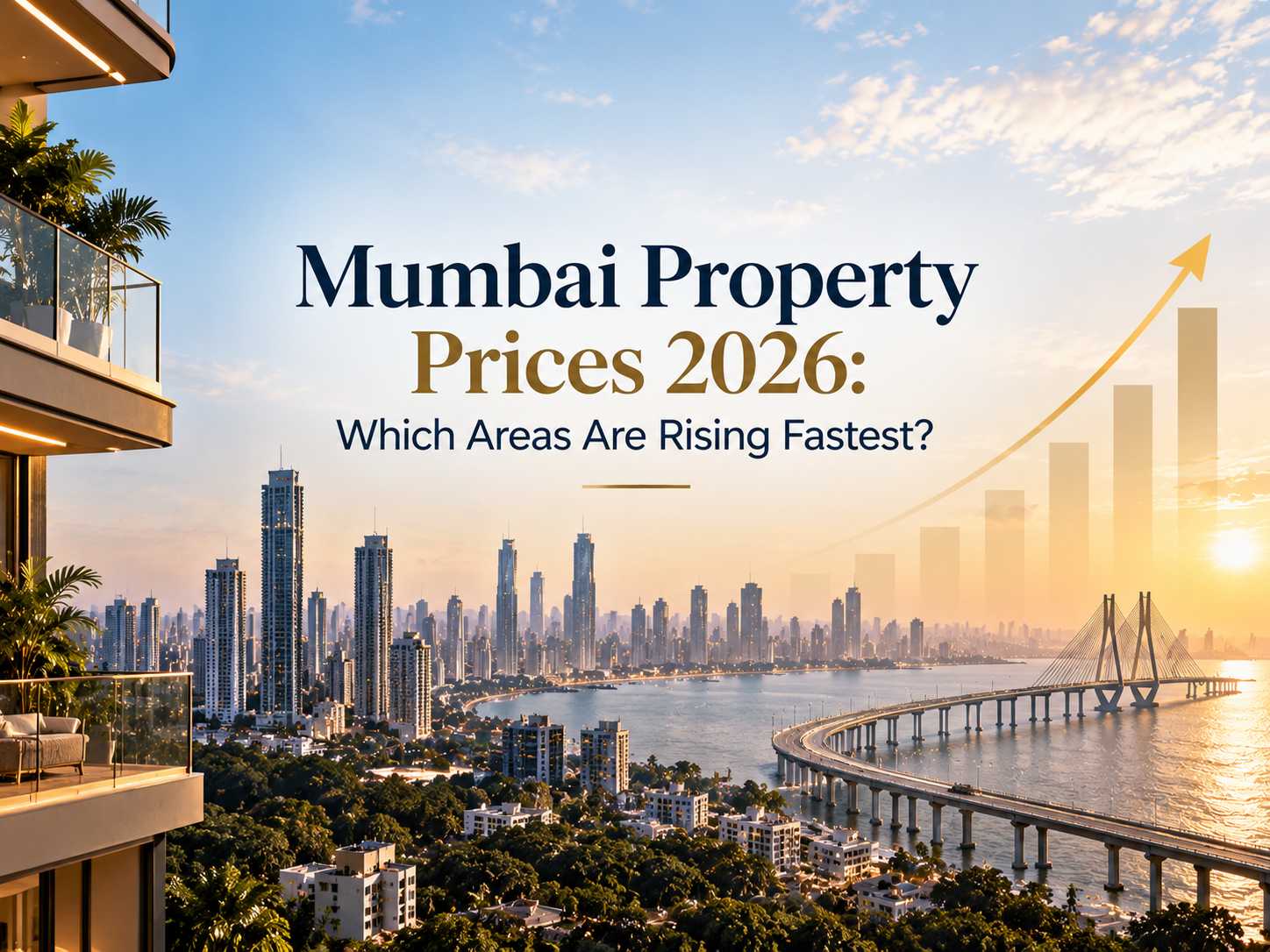
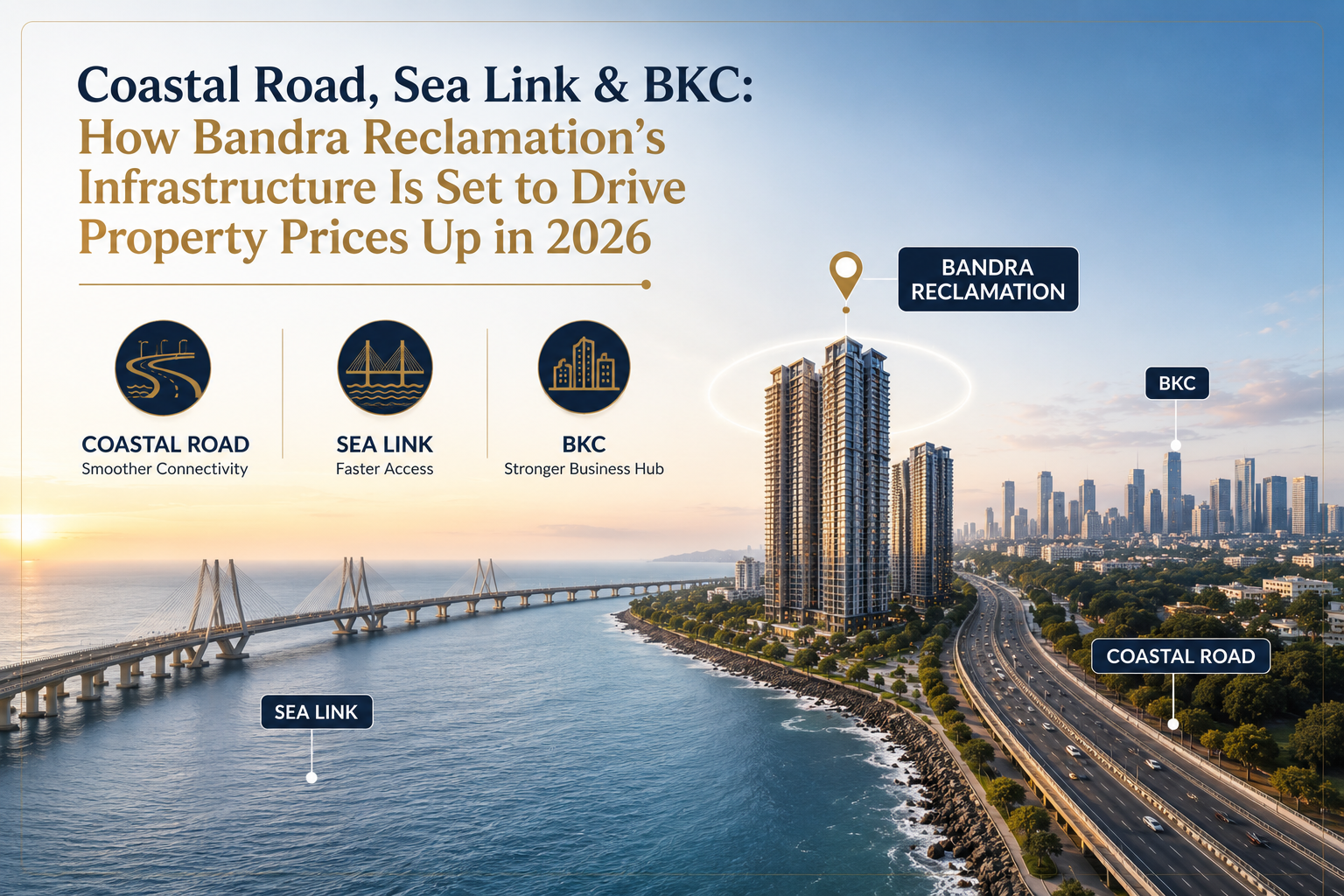
Mumbai’s three most consequential infrastructure projects — the Coastal Road, the Bandra-Worli Sea Link, and BKC — converge at a single address in 2026, and Bandra Reclamation sits at their exact intersection.
Developer: Godrej Properties Limited | Status: Pre-launch 2026 | Starting Price: ₹19.5 Cr | Location: Bandra Reclamation, Bandra West, Mumbai
1. Why Infrastructure Is the Single Biggest Driver of Sea-Facing Property Prices
In most asset classes, price discovery is driven by supply and demand in isolation. In Mumbai’s luxury residential market, a third variable — infrastructure proximity — acts as a multiplier that overrides nearly every other factor. Sea-facing land is finite by definition; the western coastline from Bandra to Nariman Point cannot grow. But what infrastructure does is transform time: it compresses the minutes between a sea-facing home and the city’s employment, retail, and social infrastructure.
Worli’s dramatic price appreciation over the past decade is the most instructive case study available to any buyer evaluating Bandra Reclamation today. Before the Bandra-Worli Sea Link opened in 2009, Worli was a mid-range industrial and residential neighbourhood with ocean frontage. The Sea Link did not change the neighbourhood’s physical geography — it changed its time distance to BKC and South Mumbai. That single connectivity shift drove capital values from roughly ₹15,000-18,000 per sq ft in 2009 to north of ₹80,000-1,10,000 per sq ft by 2024 in the premium Worli Sea Face segment.
Bandra Reclamation in 2026 is at a comparable inflection point, except that it benefits from not one but three simultaneous infrastructure upgrades — the Mumbai Coastal Road (now operational), Metro Line 3, and the BKC expansion — none of which existed in their current form when the last significant sea-facing project launched in this micro-market. For buyers evaluating Godrej Bandra Reclamation, the infrastructure story is not aspirational — much of it is already built and operational.
2. The Mumbai Coastal Road — What It Changes for Bandra Reclamation
The Mumbai Coastal Road (MCR) is the single largest road infrastructure project in the city’s history, stretching approximately 10.58 km from Marine Lines (Princess Street Flyover) northward to Worli, with Phase 2 extending further to Bandra. Phase 1, connecting Marine Lines to Worli, became operational in 2024. Phase 2, which directly links Bandra Reclamation into this corridor, is the critical leg for residents of the micro-market.
The operational Phase 1 stretch alone has already transformed journey times from South Mumbai’s business and cultural districts to Worli. When the Bandra leg is fully integrated, residents of Bandra Reclamation — already positioned adjacent to the Sea Link interchange — will be able to reach Marine Lines in under 15 minutes during off-peak hours on an uninterrupted, signal-free coastal corridor. Compare this to the earlier reality: the same journey via the S.V. Road or Linking Road congestion could take 45 minutes to over an hour at peak times.
The Coastal Road also changes the quality of the drive. The route is a sea-hugging, landscaped corridor — not a flyover threading through dense urban fabric. For residents of sea-facing homes at Bandra Reclamation, this means the view from the living room and the commute to the office share the same geography. That alignment between lifestyle and logistics is precisely what Mumbai’s ₹15 Cr-plus buyer segment pays a premium for.
| Coastal Road Milestone | Status (2026) | Benefit for Bandra Reclamation Residents |
|---|---|---|
| Phase 1: Marine Lines to Worli (~10.58 km) | Operational | Connects via Worli interchange; Sea Link already provides Bandra access in 3-4 min |
| Phase 2: Worli to Bandra (direct integration) | Under advanced construction; targeted completion 2026-27 | Direct coastal corridor access; eliminates Mahim Causeway dependency |
| U-turn access points at Worli / Bandra interchange | Operational | Provides current Sea Link-to-Coastal Road transition for residents |
| Marine Drive promenade connectivity | Operational | South Mumbai social and business circuit reachable in under 20 min |
3. Bandra-Worli Sea Link — Already Priced In? What It Still Means for Residents
The Bandra-Worli Sea Link (BWSL) is often described by buyers as “already priced in” — implying that its capital impact has been fully absorbed by the market. This is a partial truth that misses an important nuance. The Sea Link has been priced in to Worli, where properties directly adjacent to the southern terminus appreciated dramatically over the 2009-2020 period. At Bandra Reclamation — the northern terminus — the full repricing cycle has not yet completed, in large part because very little new luxury supply has entered the market in this precise location.
Practically, the Sea Link delivers three things that money cannot replicate once you have bought elsewhere. First, the 5.6-km crossing eliminates the eastern congestion dependency: residents are not reliant on the Mahim Causeway or the S.V. Road to reach Worli, Lower Parel, or South Mumbai. Second, the current toll of ₹85 per single trip (for cars) means the infrastructure pays for itself on a per-trip basis multiple times over in time savings — for a household making 20 crossings monthly, that represents roughly ₹2,000 per month in toll versus hours of commute time recovered. Third, the Sea Link provides direct airport-side connectivity: the Western Express Highway is accessible from the Bandra-end interchange within 12-15 minutes, making international travel genuinely convenient for the NRI and business-travel-heavy buyer demographic that dominates the ₹19.5 Cr-plus segment.
The Sea Link is not a future promise for Bandra Reclamation buyers — it is existing, operational infrastructure whose daily utility residents of Godrej Bandra Reclamation will draw on from day one of possession.
4. BKC — The Employment Hub That Explains the ₹19.5 Cr Starting Price
Bandra Kurla Complex is Mumbai’s premier planned business district and the primary reason that Bandra West commands a sustained premium over geographically comparable sea-facing neighbourhoods further north or south. BKC hosts the headquarters or major India offices of over 200 domestic and multinational corporations, including the National Stock Exchange, SEBI, the Reserve Bank of India’s regional office, HDFC, ICICI, Citibank, JPMorgan, Goldman Sachs, and a dense concentration of management consulting, law, and media firms. Daily commuter volumes into BKC are estimated at over 5 lakh (500,000) persons per working day — a number that has grown substantially with the post-pandemic return-to-office trend in financial services.
From Bandra Reclamation, BKC is a 10-12 minute drive via the connector roads through Bandra West. This is a materially different proposition from reaching BKC via the Eastern suburbs (where road distances are longer and the Western Express Highway access is shared with airport traffic) or from South Mumbai (where the journey can exceed 30-40 minutes in traffic without Sea Link). The BKC proximity means that residents of an apartment at Bandra Reclamation are, for practical commute purposes, among the closest residential communities to one of Asia’s most productive square kilometres of office space.
For the buyer demographic — senior executives, promoters, financial professionals, NRIs seeking a base near India’s business capital — this 10-minute commute to BKC is a non-negotiable filter. It explains why this micro-market sustains prices that might appear disconnected from broader Mumbai averages. It also explains why Godrej Properties Limited, with its disciplined approach to land acquisition, chose this specific 4.2-acre parcel for a luxury launch rather than a more abundant but less strategically located site.
5. Metro Lines Coming to Bandra — Metro 2A and Metro 3 Status and Connectivity
Mumbai’s Metro network expansion is adding a rail-based connectivity layer that will, over the next several years, make the western suburbs genuinely multi-modal. Two metro lines are directly relevant to Bandra Reclamation residents, and their current operational status deserves precise examination rather than generic optimism.
Metro Line 2A (D.N. Nagar to Dahisar) is operational as of 2023, running through the western suburbs along the S.V. Road corridor. The Andheri station on Line 2A provides interchange access northward, and connectivity to the airport-adjacent stations improves multi-modal options for the significant number of residents who travel frequently. Metro Line 3 (Colaba-Bandra-SEEPZ) is the more transformative project for this neighbourhood. Line 3, Mumbai’s first underground metro, connects Colaba in South Mumbai through BKC (Bandra Kurla Complex station) and then continues to SEEPZ via the Bandra (W) station. The BKC station on Line 3 provides a direct underground rail connection between the city’s financial district and the western suburbs, with Bandra West station serving as a primary interchange point.
For residents of Bandra Reclamation, the practical implication is a rail alternative to the car-dominant commute pattern that currently defines the neighbourhood. A resident choosing not to drive to BKC will be able to use Line 3’s Bandra station — approximately 8 minutes from the project site by car or auto-rickshaw — for a direct underground journey to the BKC business district. As Phase 2 of Line 3 achieves full operational density with increased train frequency, this option will become more attractive. The broader metro network also facilitates domestic staff, service personnel, and support infrastructure access — a quality-of-life factor that matters for large-format luxury apartments in the 3 and 4 BHK category.
6. Infrastructure Investment Comparison: Bandra Reclamation vs Worli vs Prabhadevi
Buyers evaluating sea-facing luxury homes in the ₹15 Cr-plus segment in Mumbai typically shortlist three micro-markets: Bandra Reclamation (Bandra West), Worli Sea Face, and Prabhadevi. The infrastructure profiles of these three locations differ meaningfully, and a direct comparison helps explain both current price differences and forward appreciation potential. Bandra Reclamation currently prices at a modest discount to Worli Sea Face, a differential that the convergence of Coastal Road Phase 2, Metro Line 3, and BKC proximity is expected to close over the 2026-2030 window.
| Infrastructure Factor | Bandra Reclamation | Worli Sea Face | Prabhadevi |
|---|---|---|---|
| Mumbai Coastal Road Access | Direct — adjacent to Phase 2 alignment; Phase 1 via Sea Link (3 min) | Operational Phase 1 — at southern terminus | Partial — via Worli connector; not direct seafront |
| Bandra-Worli Sea Link | 2-3 min drive — northern terminus | 3-5 min drive — southern terminus | 10-12 min via Worli |
| BKC Proximity (drive time) | 10-12 min | 18-22 min | 20-25 min |
| Metro Connectivity | Metro Line 3 Bandra station (8 min); Line 2A interchange | No direct metro station (Worli is not on Line 3 alignment) | No direct metro station currently |
| Airport Access | 25-30 min via WEH | 30-40 min via WEH or Mahim | 35-45 min |
| Current Luxury Price Range (approx) | ₹65,000-90,000 per sq ft (sea-facing, new) | ₹90,000-1,20,000 per sq ft (sea-facing) | ₹55,000-75,000 per sq ft |
| New Supply Pipeline (luxury) | Very limited — Godrej Bandra Reclamation among very few launches | Active — multiple developers | Limited |
| Neighbourhood Maturity | Fully established — St Andrews, Hill Road, Linking Road, top schools | Primarily commercial/high-rise residential | Established residential, older building stock |
The table above highlights what may be the most important insight for a buyer choosing between these three markets in 2026: Bandra Reclamation offers Worli-equivalent connectivity with BKC superiority (shorter drive, metro access), at current prices that have not yet reached Worli Sea Face levels. This gap exists partly because of lower historical transaction volumes in the micro-market — a function of limited supply rather than lower desirability.
7. What This Means for Property Prices — A 5-Year Forecast and Why Buyers Are Moving Now
Capital appreciation forecasting in Mumbai’s luxury segment is not speculative in the way it might be in a less supply-constrained market. The Bandra Reclamation micro-market has a structural constraint on supply: the total developable land in this pocket of Bandra West is finite, and virtually all of it is occupied by existing structures, government reservations, or the reclaimed land parcels that are subject to complex regulatory approvals. The 4.2-acre footprint that underpins Godrej Bandra Reclamation is among the last large, contiguous parcels in this geography available for premium residential development. That scarcity is the foundational appreciation driver — infrastructure merely accelerates the timeline.
Based on the trajectory of comparable Sea Link corridor projects — and Worli Sea Face is the most directly comparable, given its proximity to the same infrastructure anchor — the 5-year appreciation outlook for Bandra Reclamation sea-facing homes purchased at pre-launch in 2026 is estimated at 12-18% CAGR. At the lower end of this range (12% CAGR), a home purchased at ₹19.5 Cr in 2026 would be valued at approximately ₹34.4 Cr by 2031. At 18% CAGR — consistent with the appreciation seen in Worli Sea Face during its infrastructure absorption phase — the same home reaches approximately ₹44.6 Cr. These are not guarantees; they are data-anchored projections based on comparable supply-demand dynamics.
NRI interest in this segment has doubled post-2020, driven by a combination of rupee depreciation making Indian real estate more dollar-affordable, and a renewed emphasis on family-oriented luxury in well-established Mumbai neighbourhoods rather than newer, less proven locations. Bandra West — with its international schools, Lilavati Hospital (5 min from the project), the American Consulate (10 min), and a restaurant and retail ecosystem that requires no car for daily necessities — satisfies the NRI buyer’s requirement for a truly liveable address, not just an investment parcel.
Rental yield for sea-facing Bandra West apartments in the premium segment currently runs at 2.5-3% gross — below the headline yields available in commercial property, but with the capital appreciation differential more than compensating on a total return basis. Ultra-luxury (above ₹15 Cr) transaction volumes in Mumbai grew by 40%+ in 2024-25, reflecting a structural shift in how India’s wealthiest buyers are allocating capital: away from financial assets as a sole store of value and toward trophy residential as a combined lifestyle and capital preservation asset.
For buyers who are shortlisting pre-launch opportunities for 2026, the Godrej Bandra Reclamation timing is significant. Pre-launch pricing typically represents the first-mover advantage window before post-RERA launch, when prices typically step up and floor-plate selection is limited. With RERA registration, exact carpet areas, and amenity specifications to be announced at launch, early engagement with the project allows buyers to position themselves for the best configurations — particularly the higher floors, which carry the most premium for unobstructed Arabian Sea views. The combination of the Coastal Road becoming fully integrated, Metro Line 3 reaching full operational frequency, and Mumbai’s ultra-luxury market continuing to absorb limited supply makes 2026 a structurally important entry point rather than an arbitrary one.
Infrastructure at this level — three major projects converging at a single address — does not happen twice in the same generation for a given neighbourhood. Bandra Reclamation in 2026 is that neighbourhood.