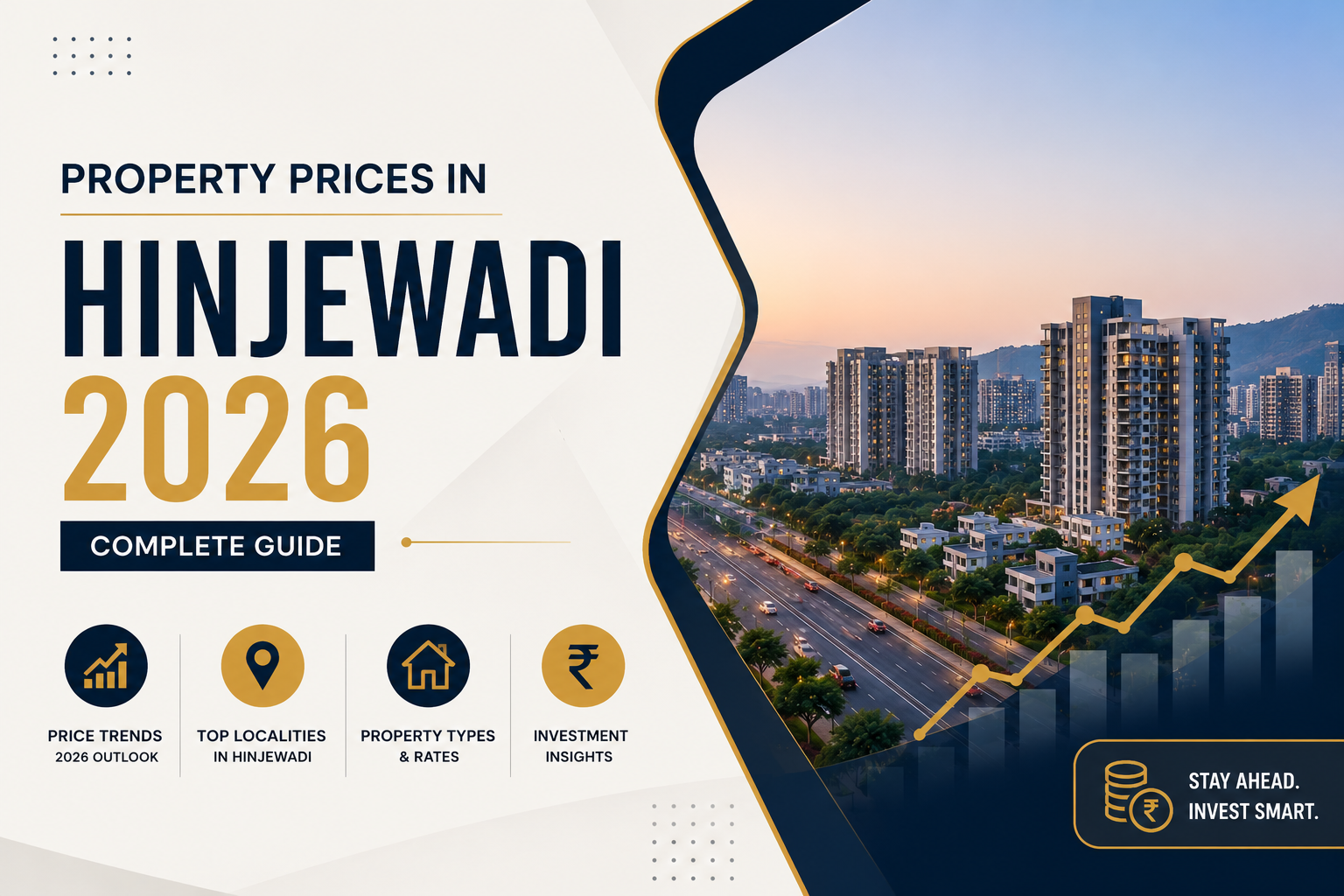
Hinjewadi Property Prices 2026: ₹9,000-11,500/sqft for standard stock, ₹14,000-14,500/sqft for branded high-rise
Average carpet rates sit in the ₹9,000-11,500/sqft band, gross rental yields run 3.5-4.5%, and the trend is steady appreciation of roughly 5-7% a year.
Hinjewadi remains one of Pune’s most rented micro-markets thanks to the IT belt, but a heavy supply pipeline keeps growth consistent rather than explosive. Buyers should price branded towers at a clear premium to resale stock.
1. Introduction: The Hinjewadi Price Snapshot for 2026
Hinjewadi has matured into the anchor of West Pune’s IT corridor, and its 2026 pricing reflects that status. Standard residential stock across the area trades between ₹9,000 and ₹11,500 per square foot on carpet, while branded high-rise inventory commands a separate band closer to ₹14,000-14,500 per square foot. That roughly 25-40% gap between resale and new branded supply is the single most important number a buyer needs to internalise before negotiating. The spread exists because newer towers offer larger floor plates, deeper amenity decks, and the resale liquidity that comes with a recognised developer name.
The reference point our team uses for the branded end of this market is The Gale at Godrej Park World (RERA P52100054971), a 1/2/3 BHK project in Hinjewadi Phase 1 with carpet areas from 562 to 1,041 square feet. Pricing there starts at ₹79.9 Lakh and runs to ₹1.48 Cr, which places it firmly in the premium tier described above. Its location roughly 5 minutes from the Rajiv Gandhi Infotech Park is exactly the kind of address that sustains both end-user demand and tenant interest. You can review the full configuration and pricing detail on the main project listing for The Gale at Godrej Park World.
For context, the entry-level EMI on the ₹79.9 Lakh unit works out to roughly ₹55,000 per month, assuming 20% down, an 8.5% rate, and a 20-year tenure. That figure matters because it sits within reach of dual-income IT households earning in the ₹25-35 Lakh annual range, which is the demographic driving absorption in this corridor. Throughout this guide we will keep returning to real rate bands and yields rather than vague promises, so you can benchmark any quote you receive against the wider market.
2. What Drives Hinjewadi Prices
The first driver is employment density. The Rajiv Gandhi Infotech Park concentrates hundreds of thousands of IT and ITeS jobs within a few kilometres, and that demand floor is what keeps Hinjewadi rates from softening even when the broader Pune market cools. When a single employment node generates this much daily footfall, housing within a 5-minute radius behaves more like a captive market than a speculative one. This is also why the ₹9,000-11,500/sqft floor has held firm rather than drifting downward.
The second driver is spillover. Baner and Wakad, the older premium pockets, have largely saturated at ₹12,000-14,000 and ₹9,500-11,500 per square foot respectively, pushing both end-users and developers toward Hinjewadi and adjacent Mahalunge for fresh land. Godrej Properties Limited has positioned several of its West Pune launches precisely to capture this redirected demand, and you can see the developer’s national portfolio context at godrejproperties.com. The presence of a large institutional developer in a micro-market typically lifts the price ceiling for the entire pocket, because branded launches reset the reference rate for everything around them.
The third driver is infrastructure, led by the Hinjewadi-Shivajinagar metro line. The first stretch of roughly 11 km is slated to be operational in 2026, with the full 23 km corridor following, and wider Development Plan roads are being widened in parallel. Connectivity upgrades of this scale historically add a measurable premium to addresses within walking distance of stations. Together these three forces (jobs, spillover, and transit) explain why Hinjewadi prices appreciate steadily rather than swinging on sentiment.
3. Current Price Bands by Configuration
The table below breaks down what buyers are actually paying across the two main supply tiers in 2026. Standard stock covers the bulk of resale and mid-segment new launches, while branded high-rise reflects projects like The Gale at the premium end. Use these bands as a sanity check: a quote materially above the branded range or below the standard floor deserves scrutiny.
| Configuration / Tier | Carpet Area (sqft) | Rate Band (₹/sqft) | Indicative All-in Price |
|---|---|---|---|
| 1 BHK (branded, e.g. The Gale) | 562 | ₹14,000-14,500 | From ₹79.9 Lakh |
| 2 BHK (standard stock) | 650-800 | ₹9,000-11,500 | ₹70 Lakh-₹92 Lakh |
| 2 BHK (branded high-rise) | 750-900 | ₹14,000-14,500 | ₹1.05 Cr-₹1.30 Cr |
| 3 BHK (branded, e.g. The Gale) | up to 1,041 | ₹14,000-14,500 | Up to ₹1.48 Cr |
| 3 BHK (standard stock) | 900-1,100 | ₹9,000-11,500 | ₹95 Lakh-₹1.25 Cr |
Two patterns stand out. First, the branded premium is config-agnostic: a 2 BHK in a Godrej tower can cost as much as a standard 3 BHK, because the buyer is paying for the brand, the amenity scale, and resale liquidity rather than raw square footage. Second, the 562 sqft 1 BHK at ₹79.9 Lakh is the most accessible branded entry point in the corridor, which is why it draws first-time IT buyers and investors alike. If you are weighing villa-plot formats instead, the Godrej Eden Estate plotted listing from ₹2.50 Cr sits in a different price category entirely.
4. Micro-market Comparison: Hinjewadi vs Its Neighbours
Hinjewadi does not price in isolation; it sits inside a cluster of four competing West Pune micro-markets, each with its own rate logic. The comparison below shows why Hinjewadi remains the value play of the corridor: its standard band of ₹9,000-11,500 undercuts Baner and Balewadi by several thousand rupees per square foot while offering comparable IT-job access. Mahalunge, the emerging neighbour, averages around ₹11,669 and is worth watching as the next appreciation story.
| Micro-market | Rate Band (₹/sqft) | Average (₹/sqft) | Position |
|---|---|---|---|
| Hinjewadi (standard) | ₹9,000-11,500 | ~₹10,250 | Value / IT core |
| Wakad | ₹9,500-11,500 | ~₹10,500 | Established mid-tier |
| Mahalunge | ₹11,000-13,400 | ~₹11,669 | Emerging growth |
| Balewadi | ₹11,500-14,000 | ~₹12,750 | Premium lifestyle |
| Baner | ₹12,000-14,000 | ~₹13,000 | Saturated premium |
The takeaway is a clear price ladder: Hinjewadi and Wakad form the affordable base around ₹10,250-10,500, Mahalunge bridges the middle near ₹11,669, and Baner and Balewadi top the chart at ₹12,750-13,000. Aundh sits higher still and falls outside the typical IT-buyer budget. For a buyer prioritising appreciation headroom over established prestige, the Hinjewadi-Mahalunge axis offers the better entry economics. The Godrej Hillside 3 listing in Mahalunge, with 2/3 BHK homes from ₹70 Lakh, is a useful reference point for that adjacent market.
5. Price-Trend Deep Dive
The clearest evidence of the corridor’s trajectory comes from Mahalunge, Hinjewadi’s immediate neighbour, where rates climbed roughly 90% over five years, from ₹7,020/sqft in 2019 to about ₹13,400 in 2024. That near-doubling captures what sustained IT-driven demand can do to a West Pune micro-market over a full cycle. Hinjewadi has tracked a similar upward path, though its larger existing base and deeper supply pipeline have kept percentage gains slightly more contained. The lesson for 2026 buyers is that the corridor’s growth is structural, not speculative.
Looking forward, our team expects annual appreciation in the range of 5-7% rather than a repeat of the 90% five-year surge. The reason is straightforward: Hinjewadi now carries a heavy new-supply pipeline, and abundant fresh inventory caps how fast prices can climb. This is a healthy dynamic for end-users, because it means rates rise predictably rather than pricing out the IT workforce that underpins the area. Investors should model returns on that conservative 5-7% assumption and treat any sharper jump as upside, not baseline.
The metro is the wildcard that could lift specific addresses above the 5-7% trend. With the first ~11 km of the Hinjewadi-Shivajinagar line operational in 2026 and the full 23 km to follow, units within a short walk of a station should outperform the corridor average. Combined with the ongoing widening of Development Plan roads, the connectivity story gives well-located 2026 purchases a credible path to above-trend gains over the next five years. For a deeper read on whether a specific branded tower captures this upside, see our analysis of whether The Gale at Godrej Park World is a good investment in 2026.
6. Rental Yields and Investment Math
Hinjewadi’s rental story is what separates it from purely appreciation-driven markets. Gross yields run 3.5-4.5%, among the healthiest in Pune, supported by a deep IT tenant pool that turns over predictably with hiring cycles. A 1 or 2 BHK in the area rents for ₹18,000-30,000 a month, which means a well-bought unit can cover a meaningful slice of its EMI from day one. The table below frames the core investment numbers a buyer should run before committing.
| Metric | Figure | Notes |
|---|---|---|
| Gross rental yield | 3.5-4.5% | Among Pune’s healthiest |
| Monthly rent (1/2 BHK) | ₹18,000-30,000 | Deep IT tenant pool |
| The Gale 1 BHK price | ₹79.9 Lakh | 562 sqft carpet, branded |
| Indicative EMI | ~₹55,000/month | 20% down, 8.5%, 20 yr |
| Possession (The Gale) | March 2029 | Under construction |
Run the math on the entry unit and the picture sharpens. At ₹79.9 Lakh with an EMI near ₹55,000 and achievable rent of ₹18,000-30,000, the rental income offsets roughly a third to half of the monthly outflow, with appreciation and tax benefits layered on top. Because The Gale completes in March 2029, an investor buying now is funding construction in exchange for the lower under-construction price, then capturing rent once tenants move in. That deferred-income trade-off is the central calculation for any pre-possession purchase in this corridor.
7. Buyer Guidance: Timing, Negotiation, and Checks
On timing, the heavy 2026 supply pipeline works in the buyer’s favour. With multiple projects competing for the same IT demand, developers and resellers are more flexible on price and payment terms than they were two years ago. Our team’s view is that buyers have a genuine negotiating window through 2026, particularly on standard stock in the ₹9,000-11,500 band where inventory is deepest. Branded launches hold their pricing more firmly, so the leverage there is on payment schedules and inclusions rather than headline rate.
On negotiation, anchor every conversation to the bands in this guide. If a standard 2 BHK is quoted above ₹11,500/sqft, ask what justifies the premium; if a branded tower is offered below ₹14,000, verify the carpet definition and floor rise. Always confirm the RERA number before paying anything, and check possession dates against the registered timeline. For The Gale, that reference is RERA P52100054971 with a March 2029 possession date, which gives you a documented benchmark to hold the sales team to.
On due diligence, prioritise three checks beyond price: the carpet-versus-built-up basis of the quote, the metro and Development Plan road status near the specific address, and the developer’s delivery track record. A unit within a short walk of a 2026 metro station carries more durable value than one a kilometre away at the same rate. For a fuller neighbourhood-level checklist covering schools, commute, and daily life, our complete guide to living in Hinjewadi for 2026 walks through what to inspect on the ground.
8. Conclusion: The 2026 Outlook
Hinjewadi enters 2026 as a structurally sound market rather than a speculative one. The ₹9,000-11,500/sqft floor for standard stock and the ₹14,000-14,500 branded tier are both well supported by IT employment, spillover demand, and the incoming metro. With appreciation expected at a steady 5-7% a year and gross yields of 3.5-4.5%, the corridor rewards patient end-users and disciplined investors over short-term flippers. The heavy supply pipeline is a feature, not a flaw: it keeps the area affordable to the workforce that sustains it.
For buyers, the practical conclusion is to use 2026’s negotiating window, anchor to the published bands, and weight addresses by metro proximity. The branded premium is real and worth paying where resale liquidity and delivery certainty matter, with The Gale at Godrej Park World (RERA P52100054971) serving as the clearest reference at the ₹79.9 Lakh-₹1.48 Cr premium tier. Match your configuration to your yield target, verify every number against the data above, and Hinjewadi’s 2026 market offers one of the more dependable risk-reward profiles in West Pune.
Frequently Asked Questions
Q. What is the average property price in Hinjewadi in 2026?
Standard residential stock in Hinjewadi trades between ₹9,000 and ₹11,500 per square foot on carpet in 2026, averaging around ₹10,250. Branded high-rise inventory such as The Gale sits separately at roughly ₹14,000-14,500 per square foot, reflecting a 25-40% brand premium over resale.
Q. How much does a flat in The Gale at Godrej Park World cost?
The Gale at Godrej Park World (RERA P52100054971) offers 1/2/3 BHK homes from 562 to 1,041 sqft, priced from ₹79.9 Lakh up to ₹1.48 Cr. The entry 1 BHK carries an indicative EMI near ₹55,000 a month at 20% down, 8.5%, over 20 years, with possession in March 2029.
Q. What rental yield can I expect in Hinjewadi?
Gross rental yields in Hinjewadi run 3.5-4.5%, among the healthiest in Pune, supported by a deep IT tenant pool. A typical 1 or 2 BHK rents for ₹18,000-30,000 per month, allowing the rent to offset a meaningful share of the EMI on a well-bought unit.
Q. How does Hinjewadi compare to Baner and Balewadi on price?
Hinjewadi is the value option at around ₹10,250/sqft, undercutting Baner (~₹13,000) and Balewadi (~₹12,750) by several thousand rupees per square foot. Wakad sits close to Hinjewadi near ₹10,500, while emerging Mahalunge averages about ₹11,669, bridging the gap between the value and premium tiers.
Q. Will Hinjewadi prices keep rising in 2026 and beyond?
Our team expects steady appreciation of roughly 5-7% a year rather than the 90% five-year surge Mahalunge saw from 2019 to 2024. A heavy new-supply pipeline caps explosive growth, while the Hinjewadi-Shivajinagar metro (first 11 km operational in 2026) supports above-trend gains for well-located addresses.