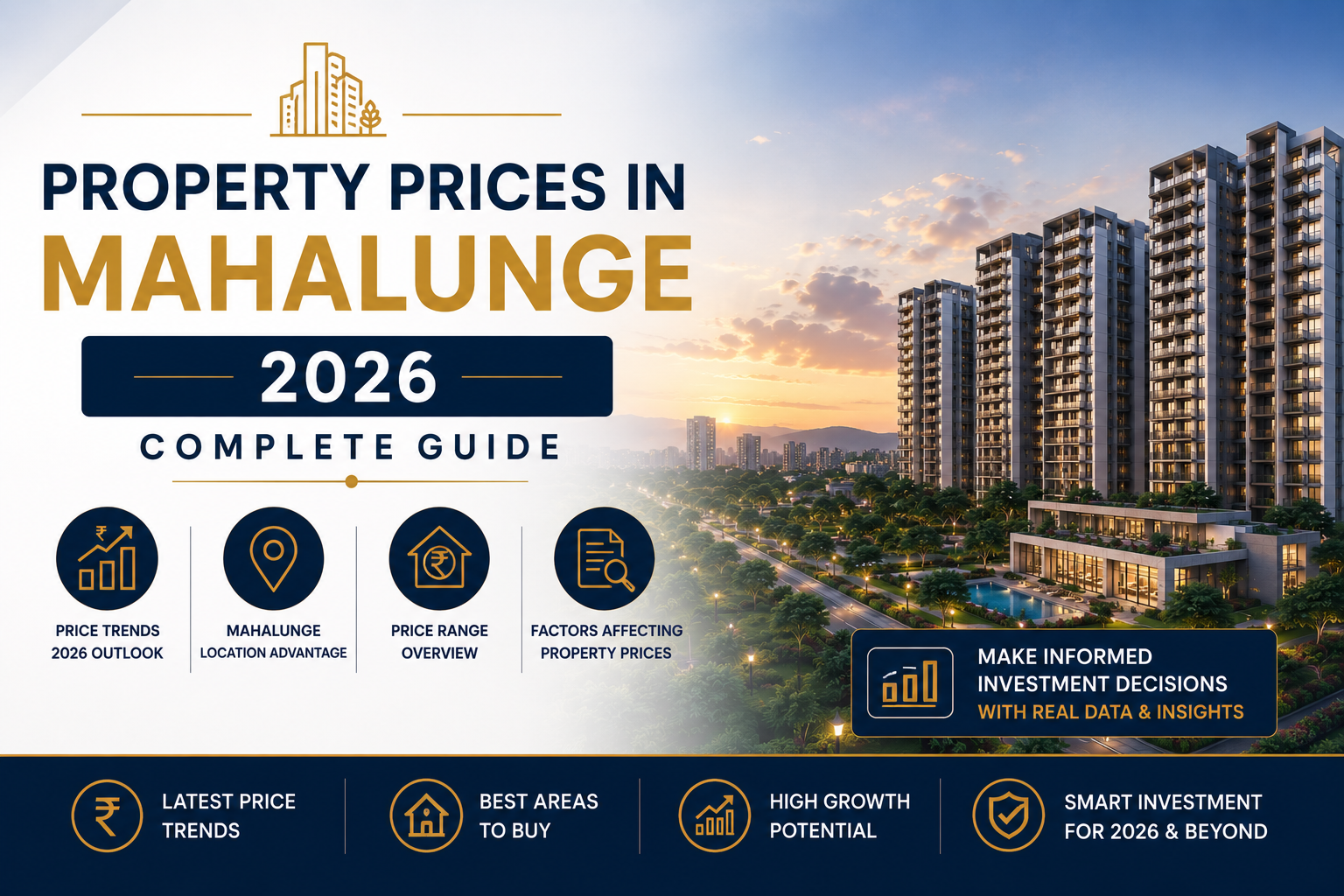
What do property prices in Mahalunge, Pune look like in 2026?
Mahalunge rate band: ₹8,500–10,000/sqft | Worked example: Godrej Hillside 1 & 2 (RERA P52100022099 / P52100022153) | Ready to Move, Phase 1 handover Oct 2024 | Builder: Godrej Properties Limited
Our take: Mahalunge trades at a 10–20% discount to neighbouring Baner and Balewadi while drawing on the same Hinjewadi jobs belt, which makes it one of west Pune’s clearest value-entry pockets. The Mahalunge–Maan town-planning scheme and the westward metro give it a multi-year appreciation runway, so buy for a 4–5 year hold, not a quick flip.
Property prices in Mahalunge — where the market stands in 2026
Mahalunge property prices now sit in the ₹8,500–10,000/sqft band, and this guide breaks down exactly what that buys you across the area in 2026. We use Godrej Hillside 1 & 2 by Godrej Properties Limited — the delivered, ready-to-move twin-tower project off Baner–Mahalunge Road, where 2 BHK homes start from ₹51 lakh — as the worked example throughout, because a handed-over project gives the cleanest read on real transacted rates rather than launch-day promises. The story of mahalunge property prices in 2026 is one of measured catch-up growth against a far pricier Baner next door.
The micro-market splits visibly even within a single address: Hillside I averages around ₹8,700/sqft while the newer Hillside II carries roughly ₹9,400/sqft, a spread of about 8% driven purely by tower vintage and inventory mix. That single comparison matters because it shows how much floor, phase and configuration move the per-sqft number inside one project, let alone across the locality. For buyers, it sets the benchmark against which every quote in Mahalunge should be judged.
Mahalunge’s appeal is structural rather than speculative. It sits 6–9 km from the Hinjewadi Phase 1 IT park (a 15–25 minute drive), 4–5 km from Balewadi High Street, and directly on the Baner–Mahalunge Road feeding the Mumbai–Bengaluru Expressway. Those fundamentals are what convert a price band into a durable appreciation trend, and the sections below quantify each driver and place the numbers side by side with the neighbouring micro-markets buyers actually shortlist.
If you want the lifestyle-and-locality view before the pricing detail, read our companion living in Mahalunge complete guide for buyers. For the full specification, configurations and current ask on our worked example, see the Godrej Hillside 1 & 2 Mahalunge listing.
Background — how Mahalunge became a west Pune price story
Godrej Properties Limited (NSE: GODREJPROP), founded in 1990 and listed in 2010, brings a delivery record you can review at godrejproperties.com, and its Mahalunge project anchors local pricing precisely because it is finished. Godrej Hillside 1 & 2 spans 2.71 acres with twin G+31 towers, roughly 493 apartments and about 70% open space, and Phase 1 handover began in October 2024. A delivered scheme of that scale sets a visible floor and ceiling for the whole micro-market because its resale rates transact transparently.
A few years ago, Mahalunge was treated as an affordable overflow of Baner, valued mainly for being cheaper than the established suburb next door. The arrival of branded, fully-amenitised towers changed the buyer profile from budget-first to quality-first, and possession-ready inventory from late 2024 onward gave the area a base of finished homes that re-rate over time. That shift is the single biggest reason average Mahalunge rates have climbed toward the ₹9,000–10,000/sqft mark rather than stalling under ₹8,000.
The second force is the jobs belt. With Hinjewadi Phase 1 at 6–9 km and the Balewadi sports-and-commercial cluster at 4–5 km, Mahalunge functions as a residential catchment for tens of thousands of IT and services employees. That employment density underwrites both end-user demand and a gross rental yield of about 3–4% across the Hinjewadi–Mahalunge belt, the two things that keep a price band from softening.
The third force is planned infrastructure. The Mahalunge–Maan town-planning scheme is laying out organised road grids and serviced land parcels, while the Pune Metro is expanding toward the western suburbs and Hinjewadi. Each piece reduces the friction of living and commuting here, and reduced friction is what sustains the ₹8,500–10,000/sqft band and gives it room to run rather than letting it plateau.
Key data — Mahalunge pricing at a glance
The table below sets out the core pricing figures for Mahalunge in 2026, using Godrej Hillside 1 & 2 as the delivered benchmark. These are the numbers to anchor on before comparing neighbouring localities or configurations.
| Metric | Figure (2026) |
|---|---|
| Mahalunge rate band | ₹8,500 – ₹10,000/sqft |
| Godrej Hillside avg rate | ₹8,700 – ₹9,400/sqft (HS I ~₹8,700, HS II ~₹9,400) |
| 2 BHK ticket range | ₹51 – 78 lakh |
| 3 BHK ticket range | ₹66 – 91 lakh |
| 1 BHK ticket (indicative) | ~₹38 – 48 lakh (limited inventory) |
| Carpet area range | 396 – 955 sqft (1–3 BHK) |
| Gross rental yield | ~3 – 4% |
| 5-year appreciation | Double-digit cumulative |
Read these together rather than in isolation. The ₹51 lakh 2 BHK entry and the ₹8,700–9,400/sqft delivered average tell you the floor and the realistic benchmark, while the 3–4% yield and double-digit five-year appreciation tell you what to expect once you hold the asset. The 396–955 sqft carpet spread also explains the wide ticket range, since configuration and phase drive a meaningful part of the per-sqft figure.
Price analysis — Mahalunge versus the west Pune belt
The only way to judge whether ₹8,500–10,000/sqft is fair is to set it against the localities buyers actually shortlist alongside it. West Pune’s western corridor splits cleanly into tiers, and Mahalunge sits in the value seat just below Baner and Balewadi. The table below maps the landscape.
| Micro-market | Rate band (₹/sqft) | Position |
|---|---|---|
| Baner | ₹10,000 – 12,000 | Premium / established |
| Balewadi | ₹9,500 – 11,000 | Upper-mid / sports belt |
| Mahalunge | ₹8,500 – 10,000 | Value middle |
| Hinjewadi | Similar / slightly lower | Jobs-led / high supply |
| Godrej Hillside (delivered) | ₹8,700 – 9,400 | Top of Mahalunge band |
The premium tier — Baner — runs ₹10,000–12,000/sqft, reflecting its mature commercial core, schools and decades of established demand. Mahalunge offers much of that western-corridor access at a discount: a buyer paying ₹9,400/sqft here is typically 10–20% cheaper than a comparable Baner address while sitting on the same Baner–Mahalunge Road and within the same 6–9 km reach of Hinjewadi. That gap is the core of the value argument.
Balewadi, at ₹9,500–11,000/sqft, sits between the two, lifted by Shree Shiv Chhatrapati Sports Complex and Balewadi High Street, both within 4–5 km of Mahalunge. Hinjewadi itself trades at similar or slightly lower rates than Mahalunge despite hosting the IT park, because it carries a heavier under-construction pipeline and denser supply that caps per-sqft growth. Mahalunge’s lower density and hillside open space are precisely what justify a small premium over the jobs hub it serves.
Within Mahalunge, Godrej Hillside sits at the top of the local band at ₹8,700–9,400/sqft because it is delivered, amenitised and brand-backed, with a vehicle-free podium and 40-plus amenities. Comparable delivered stock across Mahalunge runs broadly in line, so the project’s pricing is a modest brand premium rather than an outlier — the kind of premium that tends to hold its value on exit. For buyers who want to compare a different west-Pune format, the Godrej Eden Estate Hinjewadi villa plots sit in the same belt at a very different ticket.
Deep dive — what is actually driving Mahalunge prices
Four forces explain the trend, and understanding them tells you whether the ₹8,500–10,000/sqft band is sustainable. The first is the Hinjewadi jobs engine. The Phase 1 IT park alone employs a very large salaried base within a 15–25 minute, 6–9 km drive, and that proximity converts directly into both end-user purchase demand and a reliable 3–4% rental yield. Employment density is the single most durable price driver in any residential micro-market.
The second is the Mahalunge–Maan town-planning scheme. By laying out organised road grids, serviced parcels and planned civic infrastructure, the scheme is doing for Mahalunge what unplanned growth never could — it raises the floor on land values and de-risks future development. Areas that move from ad-hoc growth to TP-scheme planning have historically delivered the double-digit cumulative appreciation that premium west-Pune stock has logged over the past five years.
The third is connectivity. Mahalunge sits on the Baner–Mahalunge Road feeding the Mumbai–Bengaluru Expressway, with Pune Metro expanding toward the western suburbs and Hinjewadi, Pune Railway Station 16–18 km out and Pune Airport 22–25 km away. Each new link compresses commute times, and shorter commutes are what pull a value micro-market closer to the rates of its established neighbours rather than letting the gap widen.
The fourth force works the other way: supply. The wider Hinjewadi–Mahalunge belt carries a meaningful new-launch pipeline, and that incoming inventory disciplines how fast prices can run. This is why appreciation here has been steady double-digit over five years rather than the explosive spikes seen in supply-starved pockets. For a buyer, that balance is arguably healthier — the jobs belt and TP scheme push rates up, the pipeline keeps them honest, and the net result is a durable, demand-backed trend.
Investment — price by configuration and what owners earn
Translating the price band into a per-configuration view is what most buyers actually care about, since the ticket you pay swings hard on whether you buy a 1, 2 or 3 BHK. The table below frames the economics for each configuration at Godrej Hillside, our Mahalunge benchmark.
| Configuration | Carpet (sqft) | Ticket range | Position |
|---|---|---|---|
| 1 BHK (indicative) | 396 – 462 | ~₹38 – 48 lakh | Limited inventory |
| 2 BHK | 680 – 767 | ₹51 – 78 lakh | Core demand / best liquidity |
| 3 BHK | 845 – 955 | ₹66 – 91 lakh | End-user / upgrade buyer |
| Gross rental yield | — | ~3 – 4% | Across belt |
| 5-year appreciation | — | Double-digit cumulative | Premium west-Pune stock |
The cash-flow reality is plain: a 3–4% gross yield means a Mahalunge home costs money to carry in the early years, and no honest reading of those numbers suggests otherwise. The return case rests on appreciation plus a deep, low-vacancy tenant pool from the Hinjewadi belt, not on rent covering the loan. The 2 BHK at ₹51–78 lakh is the liquidity sweet spot, since it matches the largest salaried-buyer cohort and resells fastest.
Where Mahalunge earns its keep is the appreciation column. A double-digit cumulative five-year gain on a ₹51 lakh base is meaningful capital growth over a multi-year hold, and the ready-to-move status removes construction risk while delivering a single home-loan disbursement instead of construction-linked tranches. For a deeper return model — EMI, exit and risk on this exact project — read our full Godrej Hillside investment analysis for 2026.
Buyer guidance — how to read these prices before you offer
First, separate the headline rate from what you actually pay. A quoted ₹9,400/sqft can swing on floor, view, phase and whether the unit is fresh-sale or resale — the 8% gap between Hillside I and Hillside II shows how much vintage alone moves the number. Always price on carpet, not super built-up, and benchmark any quote against the ₹8,500–10,000/sqft band so you can spot both over-asks and genuine bargains.
Second, budget the full acquisition cost, not just the ticket. Stamp duty and registration in Pune run about 6–7% including metro cess, so a ₹70 lakh 3 BHK carries roughly ₹4.2–4.9 lakh in statutory charges on top of the price. Factoring that in early prevents the common mistake of stretching the loan to the unit price and then scrambling for the registration cash.
Third, weigh delivered against under-construction. Ready stock like Godrej Hillside prices at the top of the Mahalunge band but removes delay risk and gives a single disbursement, while under-construction inventory in the wider belt is cheaper per sqft but carries execution and timing exposure. If your horizon is 4–5 years and you can carry the carrying cost, the delivered re-rating shows finished towers can compound faster than the discount on paper suggests.
Fourth, verify the paper. Confirm the RERA numbers — P52100022099 for Hillside 1 and P52100022153 for Hillside 2 — and note that Hillside 3 (P52100050939) is a separate under-construction phase with possession around 2028, not the ready inventory. Mainstream lenders including HDFC, ICICI Bank, SBI, Axis Bank and Kotak Mahindra fund this micro-market, and approved-project status is a useful second signal that the documentation is clean.
Conclusion — our verdict on Mahalunge prices in 2026
Mahalunge in 2026 is a disciplined value market. At ₹8,500–10,000/sqft it undercuts Baner by 10–20% and sits below Balewadi while keeping the same Hinjewadi jobs-belt access at 6–9 km, and the Mahalunge–Maan town-planning scheme plus the westward metro give it an appreciation runway that the more built-out suburbs no longer have. The double-digit five-year cumulative gain on premium west-Pune stock confirms the trend is real and demand-backed.
The honest caveats are the 3–4% yield, which means early-year carrying cost, and the belt’s supply pipeline, which keeps gains steady rather than explosive. Our verdict is that Mahalunge suits the 4–5 year buyer who wants brand-backed, delivered stock at a sensible entry — with Godrej Hillside 1 & 2 from ₹51 lakh, RERA P52100022099 / P52100022153 and a ₹8,700–9,400/sqft delivered average as the clearest worked example of where this price band actually lands.
Frequently Asked Questions
Q. What are current property prices in Mahalunge, Pune?
Mahalunge trades at ₹8,500–10,000/sqft in 2026. Delivered, brand-backed stock such as Godrej Hillside 1 & 2 sits in the ₹8,700–9,400/sqft band, with 2 BHK homes from ₹51 lakh and 3 BHK from around ₹66 lakh.
Q. Is Mahalunge cheaper than Baner and Balewadi?
Yes. Baner runs ₹10,000–12,000/sqft and Balewadi ₹9,500–11,000/sqft, so Mahalunge at ₹8,500–10,000/sqft is typically 10–20% cheaper than Baner for broadly similar access to the Hinjewadi IT belt, which is 6–9 km away via the Baner–Mahalunge Road.
Q. What is driving Mahalunge property prices up?
Three structural forces: the Hinjewadi jobs engine 6–9 km away, the Mahalunge–Maan town-planning scheme, and the Pune Metro expanding toward the western suburbs. Together they have produced double-digit cumulative appreciation in premium west-Pune stock over the past five years.
Q. What rental yield can I expect in Mahalunge?
Gross rental yield runs about 3–4% across the Hinjewadi–Mahalunge belt. That makes Mahalunge an appreciation play with a stabilising rental floor rather than a positive-cash-flow asset at entry, so the 2 BHK at ₹51–78 lakh — the most liquid configuration — suits a multi-year hold.
Q. How much extra are stamp duty and registration in Mahalunge?
Stamp duty and registration in Pune run about 6–7% of the ticket including metro cess. On a ₹70 lakh 3 BHK that is roughly ₹4.2–4.9 lakh in statutory charges on top of the price, which buyers should budget before stretching the home loan to the unit cost.