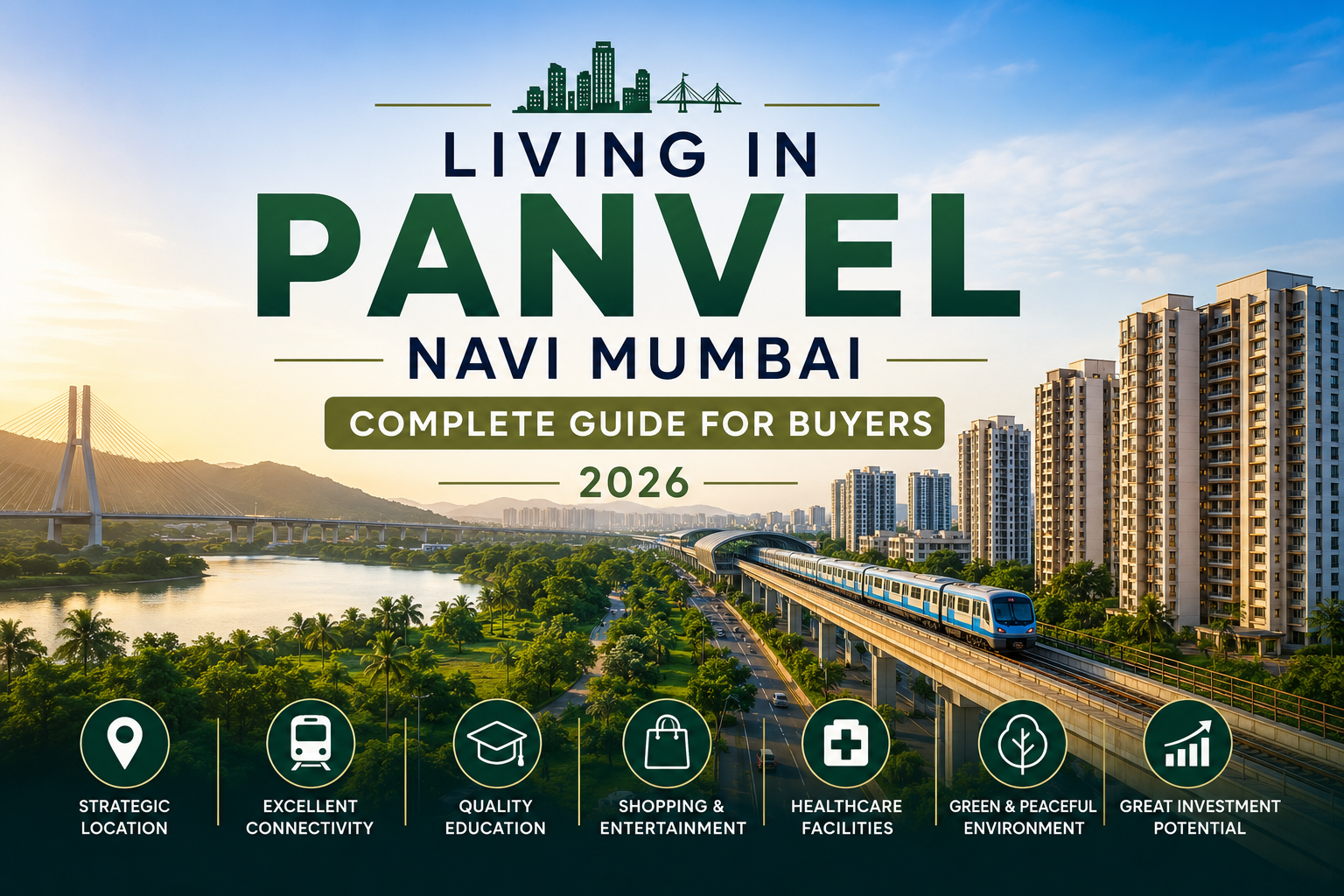
Living in Panvel Navi Mumbai — Complete Lifestyle, Commute & Amenities Guide for 2026 Buyers
Location: Panvel, Navi Mumbai | Avg Rate: ₹13,750/sqft | NMIA: 12 km | Schools: 12+ | Hospitals: 5+ | Malls: 3+
Our Note: Panvel has transformed from a transit town to Navi Mumbai’s fastest-growing residential hub — airport access, expressway links, and township developments make it a genuine alternative to established suburbs.
What Is It Like to Live in Panvel in 2026?
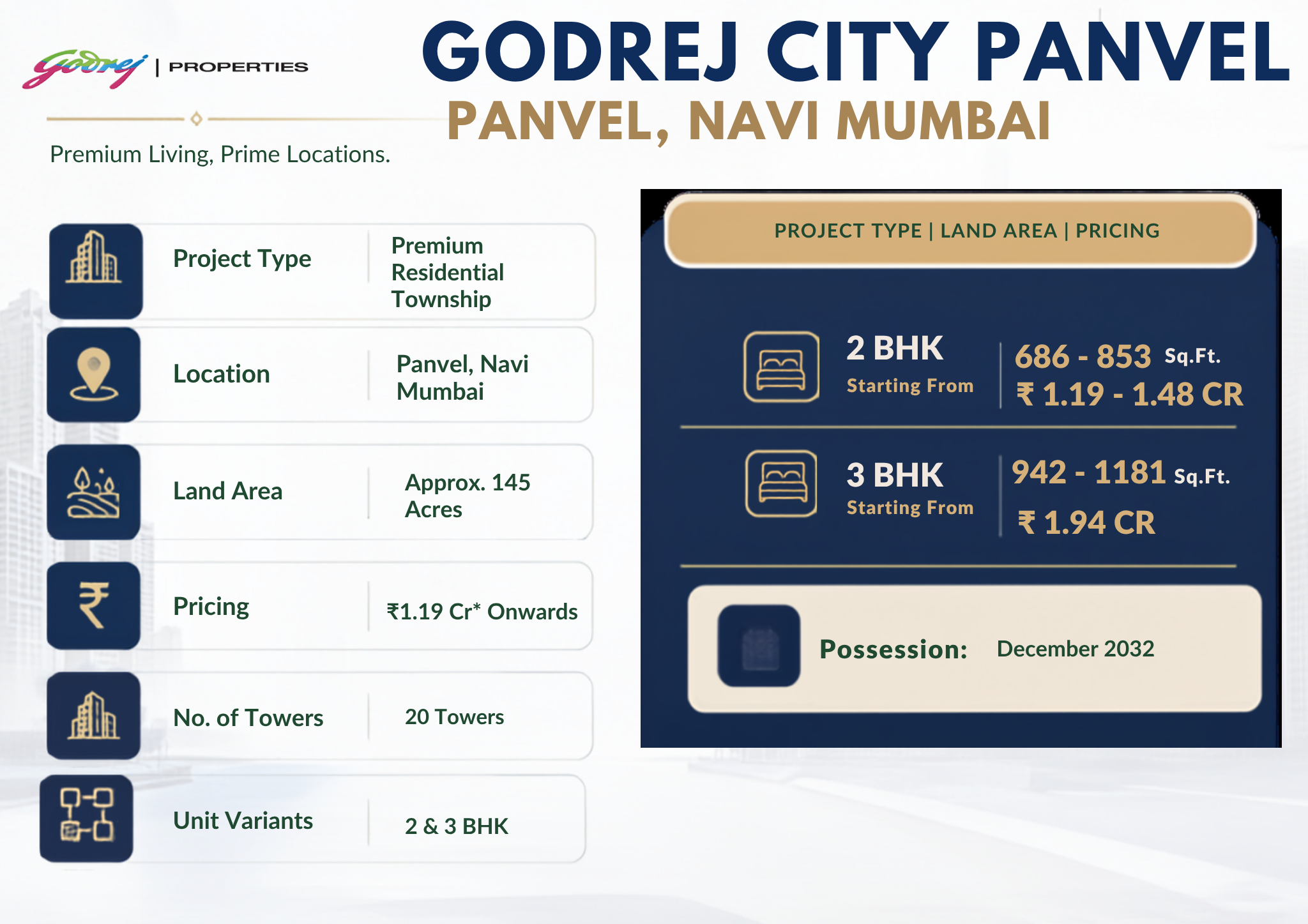
Panvel, located along the Old Mumbai–Pune Highway in Navi Mumbai, has emerged as one of MMR’s most rapidly developing residential corridors. With average property rates at ₹13,750 per sqft and the Navi Mumbai International Airport (NMIA) just 12 km away, this locality now combines affordability with infrastructure that established suburbs like Vashi (₹22,000–₹28,000/sqft) and Kharghar (₹18,000–₹22,000/sqft) took decades to build. Godrej Properties Limited, one of India’s largest listed developers, has anchored its 145-acre Godrej City township here — housing 3,000+ families across completed phases.
For buyers evaluating whether to move to Panvel, the decision comes down to three factors: daily commute viability, social infrastructure maturity, and lifestyle amenities within reach. This guide covers each dimension with verified data points from 2026, so you can assess whether Panvel fits your household’s specific needs — from school options for children to hospital proximity for elderly family members.
Our team at Godrej Properties MMR has covered Panvel’s residential market for several years, and the transformation since the Atal Setu (MTHL) opening in January 2024 has been measurable. Transaction volumes grew 22% year-on-year, new retail and F&B establishments increased by 35%, and the daily commuter footfall at Panvel railway station crossed 95,000. This is no longer a “future promise” locality — it is a functioning residential destination.
About Godrej Properties — The Developer Behind Panvel’s Largest Township
Godrej Properties Limited, founded in 1990 and listed on the NSE since 2010, has delivered over 250 million sq ft across 300+ projects in 12+ Indian cities. The developer’s Panvel presence through Godrej City — a 145-acre RERA-registered township — represents its largest single-township investment in Navi Mumbai. The project carries RERA number P52100001106 and has multiple phase registrations including P52100009857.
The Godrej Group’s 127-year legacy brings institutional-grade project management, IGBC green building certifications, and construction quality that directly impacts residents’ daily living experience. For families considering Panvel, the developer behind your home matters as much as the location — maintenance quality, common area upkeep, and community management determine long-term satisfaction. Godrej’s township management track record across MMR projects provides assurance on these operational aspects.
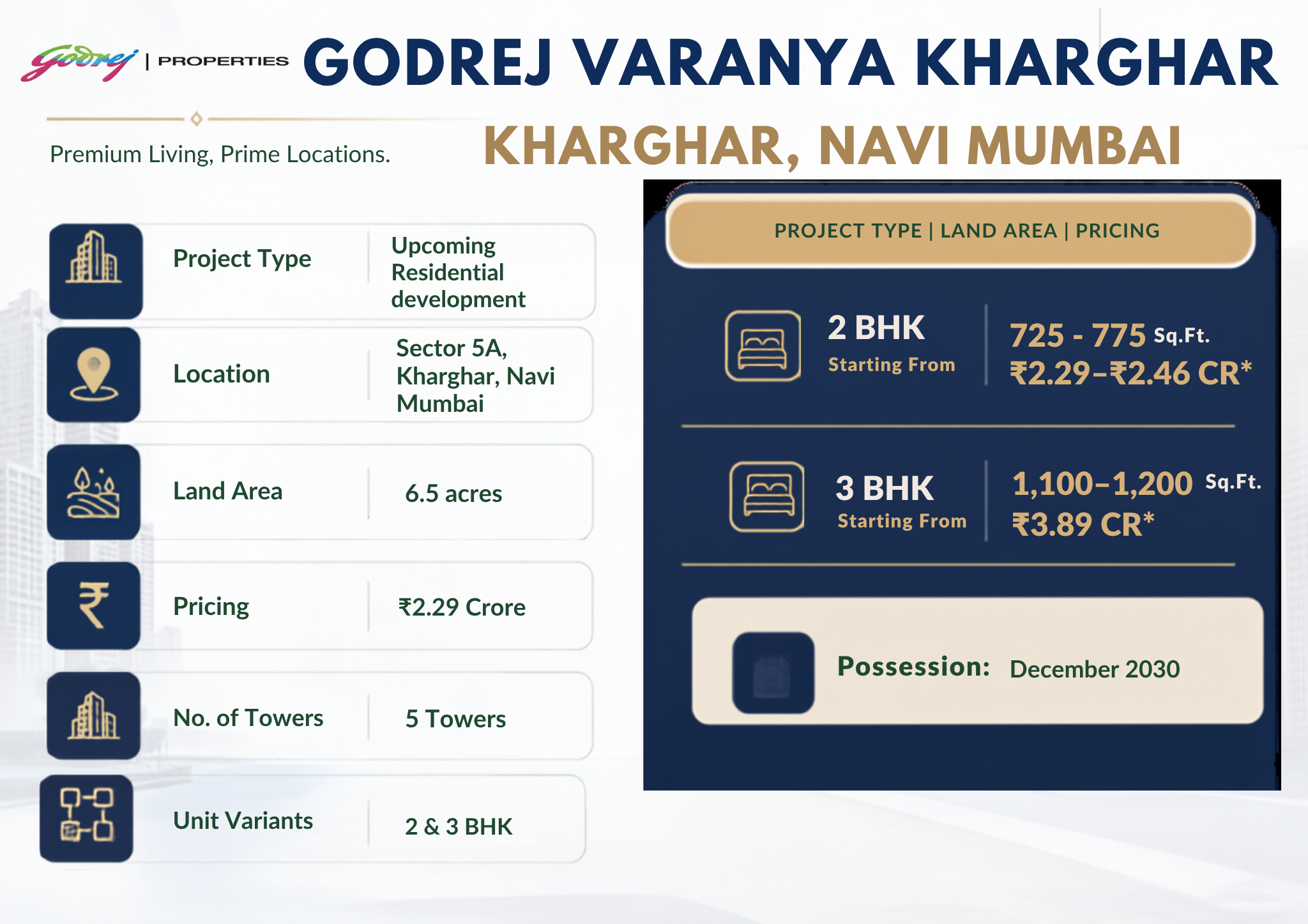
In the broader Navi Mumbai market, Godrej Properties also operates Godrej Varanya in Kharghar (2 & 3 BHK from ₹2.29 Cr) — offering buyers a premium alternative within the same developer ecosystem. The ability to compare Godrej projects across Navi Mumbai micro-markets helps buyers find the right fit for their budget and lifestyle priorities.
Panvel Locality Profile — Key Facts for Home Buyers
Understanding Panvel’s locality fundamentals helps set realistic expectations about daily life here. The data below is sourced from municipal records, railway authority figures, and on-ground research conducted by our team across 2025–2026. We have verified distances, travel times, and facility counts to ensure accuracy.
| Parameter | Details | Buyer Relevance |
|---|---|---|
| PIN Code | 410206 | Old Panvel / Highway corridor |
| Avg Property Rate | ₹13,750/sqft | 40–60% below Mumbai suburbs |
| NMIA (Airport) | 12 km / 20 min | Domestic + international flights |
| Panvel Railway Station | 5 km from Godrej City | Central, Harbour, long-distance lines |
| Mumbai–Pune Expressway | 3 km | 90 min to Hinjewadi Pune |
| Atal Setu (MTHL) | 5 km access | South Mumbai in 30 min |
| Schools (CBSE/ICSE/IB) | 12+ within 5 km | DAV, St. Joseph, New Horizon |
| Hospitals | 5+ within 7 km | MGM, Lifeline, Ashtvinayak |
| Daily Rail Commuters | 95,000+ | Well-connected commuter hub |
| 5-Year Price Appreciation | 31% | Strong capital growth trajectory |
The table confirms that Panvel has crossed the threshold from “emerging” to “established” on most livability parameters. The 12+ schools within 5 km radius cover CBSE, ICSE, and state board affiliations — ensuring parents don’t need to commute children to distant suburbs for quality education. Similarly, the 5+ hospitals within 7 km include multi-specialty facilities like MGM Hospital, providing emergency and specialist care locally.
Grocery and daily needs are well-served by both organized retail (D-Mart, Reliance Smart, More) and traditional markets in Panvel city centre. The retail ecosystem has matured significantly since 2023, with new commercial developments adding food courts, branded outlets, and service centres along the Old Panvel–Kharghar corridor.
How Far Is Panvel from Key Work Destinations in MMR?
Commute time determines neighbourhood satisfaction more than any other factor for working professionals. Panvel’s transport infrastructure has improved dramatically — the Atal Setu alone slashed South Mumbai commute times by 60%. Below are verified travel times from Panvel to major employment zones across MMR, measured during morning peak hours (8:30–10:00 AM).
| Destination | Distance | By Road (Peak) | By Train |
|---|---|---|---|
| BKC (Bandra Kurla Complex) | 45 km | 60–75 min via Atal Setu | 55–65 min (Panvel–Bandra) |
| Nariman Point / Fort | 38 km | 35–45 min via Atal Setu | 65–75 min (Panvel–CST) |
| Airoli / Ghansoli IT Park | 28 km | 40–50 min | 35–45 min |
| Vashi / CBD Belapur | 22 km | 30–40 min | 25–35 min |
| Thane West | 35 km | 50–65 min | 40–50 min |
| Hinjewadi, Pune | 125 km | 90–110 min via Expressway | N/A |
| NMIA (Airport) | 12 km | 15–20 min | N/A |
The standout figure is the Nariman Point commute — 35–45 minutes via Atal Setu during peak hours. Before the sea link opened in January 2024, this same journey took 90–120 minutes. For South Mumbai professionals, this connectivity upgrade has made Panvel a realistic daily commute option for the first time. The savings — buying a 2 BHK at ₹1.19 Cr in Panvel versus ₹3.5–5 Cr for comparable space in South Mumbai — justify the slightly longer travel time.
IT professionals working in Airoli, Ghansoli, or Vashi have the most convenient commute from Panvel — 25–40 minutes by train with direct Harbour Line connectivity. The Panvel–Karjat suburban rail corridor, currently 85% complete, will add more frequency on this route. Navi Mumbai Metro Lines 2, 3, and 4 planned from Taloja to Khandeshwar will further enhance connectivity to NMIA and surrounding employment zones.
Schools, Healthcare & Daily Life Infrastructure in Panvel
The most common concern for families considering Panvel is whether education and healthcare infrastructure matches established Navi Mumbai nodes. The answer in 2026 is a clear yes. Within a 5 km radius of Godrej City Panvel, there are 12+ schools covering CBSE, ICSE, and Maharashtra state boards — including DAV Public School, St. Joseph’s High School, and New Horizon Public School. Several schools offer bus transport to the Godrej City township, with pick-up points inside the community gates.
Healthcare has improved substantially with MGM Hospital (multi-specialty, 300+ beds), Lifeline Hospital, and Ashtvinayak Hospital all within 7 km. For specialized care (cardiac surgery, oncology), Jupiter Hospital in Thane (35 km) and Kokilaben Dhirubhai Ambani Hospital in Mumbai (via Atal Setu, 45 min) are accessible. The NMIA terminal area is also attracting new healthcare investments — two multi-specialty hospital projects are in planning for the airport precinct.
Panvel’s retail ecosystem includes D-Mart (2 outlets within 5 km), Reliance Smart, and a growing strip of branded stores along the highway corridor. Orion Mall Panvel and the upcoming retail developments near the airport are adding organized shopping options. Weekend entertainment includes Yeoor Hills, Sanjay Gandhi National Park (accessible via road), and the Karnala Bird Sanctuary, which is just 12 km from Panvel — a significant lifestyle advantage for nature-oriented families.
For residents of Godrej City Panvel, the 145-acre township itself addresses many daily needs — the on-site school campus, 30,000 sqft clubhouse, swimming pool, and children’s play areas mean residents don’t need to leave the community for routine activities. The 1.2 km jogging track, tennis courts, and basketball courts replace the need for external gym or sports club memberships.
Cost of Living — How Panvel Compares to Other Navi Mumbai Localities
| Expense Category | Panvel | Kharghar | Vashi |
|---|---|---|---|
| 2 BHK Rent (per month) | ₹15,000–₹22,000 | ₹22,000–₹30,000 | ₹28,000–₹38,000 |
| Society Maintenance | ₹3–4/sqft | ₹4–6/sqft | ₹5–7/sqft |
| School Fees (Annual, CBSE) | ₹45,000–₹90,000 | ₹60,000–₹1,20,000 | ₹80,000–₹1,50,000 |
| Monthly Grocery (Family of 4) | ₹8,000–₹12,000 | ₹10,000–₹14,000 | ₹12,000–₹16,000 |
| Property Tax (Annual, 2 BHK) | ₹6,000–₹10,000 | ₹10,000–₹15,000 | ₹14,000–₹20,000 |
| Overall Monthly Cost Advantage | Panvel is 25–35% cheaper than Kharghar and 40–50% cheaper than Vashi on most recurring costs | ||
Panvel’s cost advantage extends well beyond property prices. Monthly living expenses — including rent, maintenance, school fees, and groceries — are 25–35% lower than Kharghar and 40–50% lower than Vashi. For a family of four, this translates to annual savings of ₹1.5–2.5 Lakh, which compounds significantly over a 5–10 year stay. The township format of Godrej City further reduces costs by bundling amenities (gym, pool, sports courts) into the maintenance charge rather than requiring separate memberships.
Auto-rickshaw and bus fares within Panvel are also notably lower than inner Navi Mumbai nodes. The local auto fare from Godrej City to Panvel railway station runs approximately ₹80–₹100, compared to ₹150–₹200 for equivalent distances in Vashi or Kharghar. These small daily savings add up to meaningful numbers when calculated annually. For families considering the financial case for Panvel, our investment analysis of Godrej City Panvel covers the capital appreciation and rental yield projections.
Our Verdict — Is Panvel the Right Neighbourhood for You?
Panvel in 2026 is the right fit for buyers who prioritize value, space, and infrastructure trajectory over legacy neighbourhood status. If you work in Vashi, CBD Belapur, Airoli, or South Mumbai (via Atal Setu), Panvel offers a daily commute of 25–45 minutes at 40–60% lower housing costs. Families with school-age children will find 12+ school options within 5 km adequate, and the healthcare infrastructure — while not yet at Vashi or Thane levels — covers most routine and emergency needs.
The locality is not yet the right choice for buyers who need immediate access to premium retail (luxury malls, international brands) or nightlife — those amenities are still concentrated in Vashi, BKC, and Lower Parel. However, the retail pipeline near NMIA and along the Panvel–Kharghar corridor is filling this gap rapidly. Within 2–3 years, the retail infrastructure should match Kharghar’s current level.
For nature-oriented families, Panvel is genuinely superior to most MMR alternatives. The proximity to Karnala Bird Sanctuary (12 km), Yeoor Hills, and the green corridors along the Old Mumbai–Pune Highway offer weekend and evening outdoor options that concrete-dense inner suburbs cannot match. Combined with Godrej City’s 145-acre township with 80% open space, the green quotient here is among the highest in MMR residential developments. Explore the township details at Godrej City Panvel.
Q1. Is Panvel safe for families with children?
Panvel’s gated communities like Godrej City (145 acres, 3,000+ families, 24/7 security) offer safe residential environments. The township includes on-site school, children’s play zones, and a traffic-free internal road network. Panvel police station response times average 10–15 minutes, comparable to other Navi Mumbai localities.
Q2. How is the water and electricity supply in Panvel?
Panvel receives water from Morbe Dam, ensuring reliable supply — most societies get 2–3 hours of municipal water daily. Godrej City has underground water storage tanks and additional bore wells for uninterrupted supply. Electricity comes via MSEDCL with outage frequency of 2–3 times per month during monsoons, backed by society generators.
Q3. Are there good restaurants and cafes in Panvel?
Panvel’s F&B scene has grown 35% since 2024. You will find options ranging from local Maharashtrian eateries to national chains like Domino’s, McDonald’s, and KFC within 5 km. Branded cafes like Starbucks and Third Wave Coffee are present in nearby Kharghar (15 km). The NMIA precinct is expected to add premium dining options by 2027.
Q4. Does Panvel get flooded during monsoons?
Panvel experienced flooding issues historically, but Panvel Municipal Corporation has invested over ₹200 Cr in drainage upgrades since 2021. Godrej City’s elevated plot on the Old Mumbai–Pune Highway corridor sits above flood-prone zones. The township has internal rainwater harvesting and STP systems that manage water flow independently.
Q5. What is the public transport situation from Panvel?
Panvel railway station serves Central Line, Harbour Line, and long-distance routes with 95,000+ daily commuters. NMMT and BEST buses connect Panvel to Vashi, Belapur, and Thane. The Panvel–Karjat suburban corridor (85% complete) will add more local train frequency. Auto-rickshaws and app-based cabs (Ola, Uber) are readily available within the township area.
Explore Life at Godrej City Panvel
View configurations, amenities, and floor plans at Godrej City Panvel — 1, 2 & 3 BHK from ₹79 Lakh. Also explore Godrej Golf Side Estate for villa plots in the same locality.