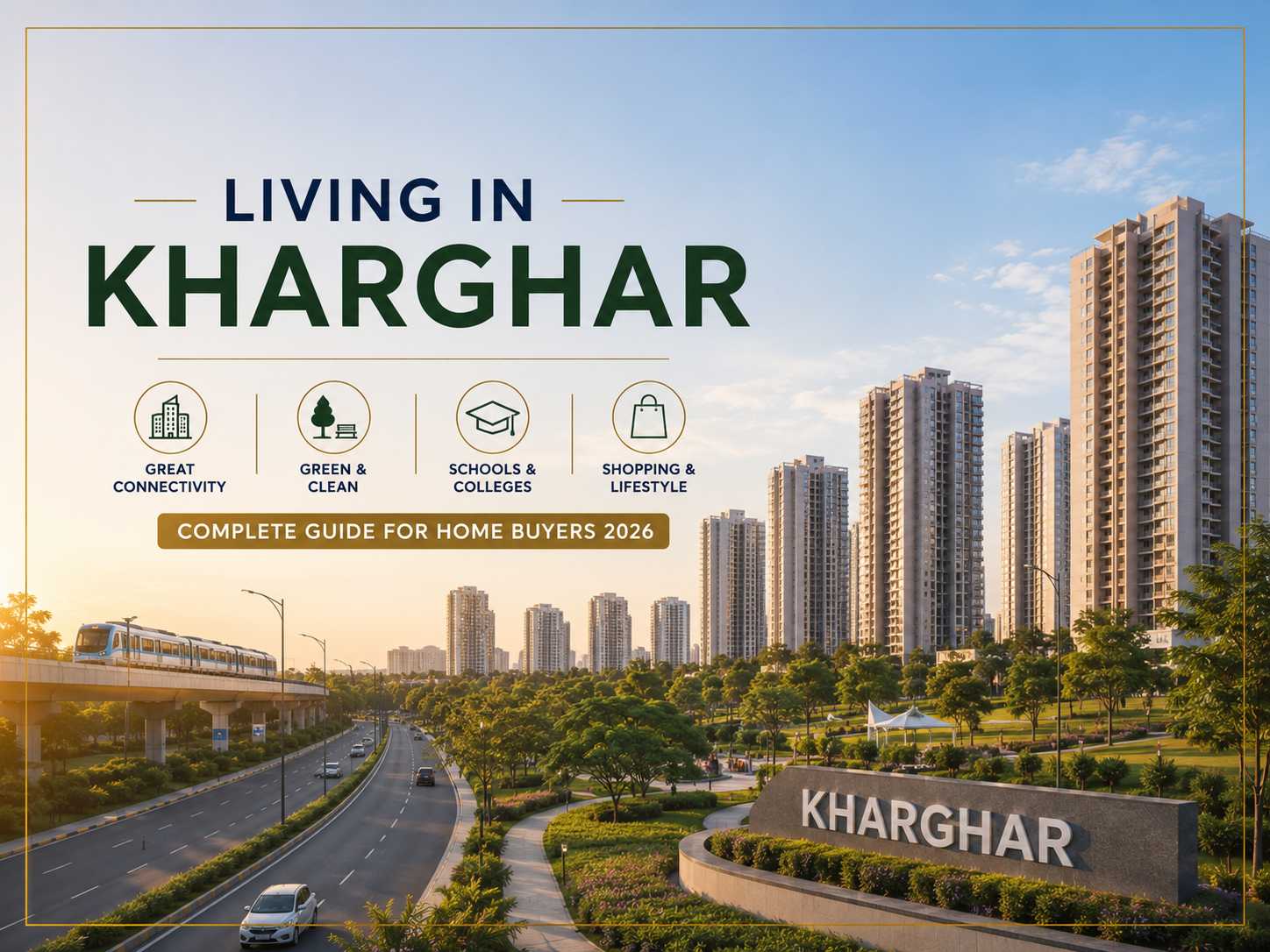
Living in Kharghar — Complete Guide for Home Buyers 2026
Locality: Kharghar, Navi Mumbai | Key Project: Godrej Varanya, Sector 5A | Infrastructure: Harbour Line + Metro + Sion–Panvel Highway
Bottom line: Kharghar is one of Navi Mumbai’s most established and liveable residential nodes — mature schools, hospitals, malls, dual rail connectivity and green-space depth that newer corridors cannot match. The premium pricing reflects this maturity.
1. Introduction — Why Kharghar Stands Out in Navi Mumbai
Kharghar has evolved from a CIDCO-planned sector layout into one of Navi Mumbai’s most desirable residential addresses, combining planned infrastructure, generous green-space allocation and a connectivity depth that few MMR micro-markets can match. Unlike newer corridors like Ulwe or Dronagiri where buyers are betting on future infrastructure, Kharghar’s schools, hospitals, malls, railway station and metro connectivity are already operational — the social infrastructure is in place, not on paper. For a home buyer evaluating where to live in Navi Mumbai, that operational maturity is the single most important distinction between Kharghar and its competitors.
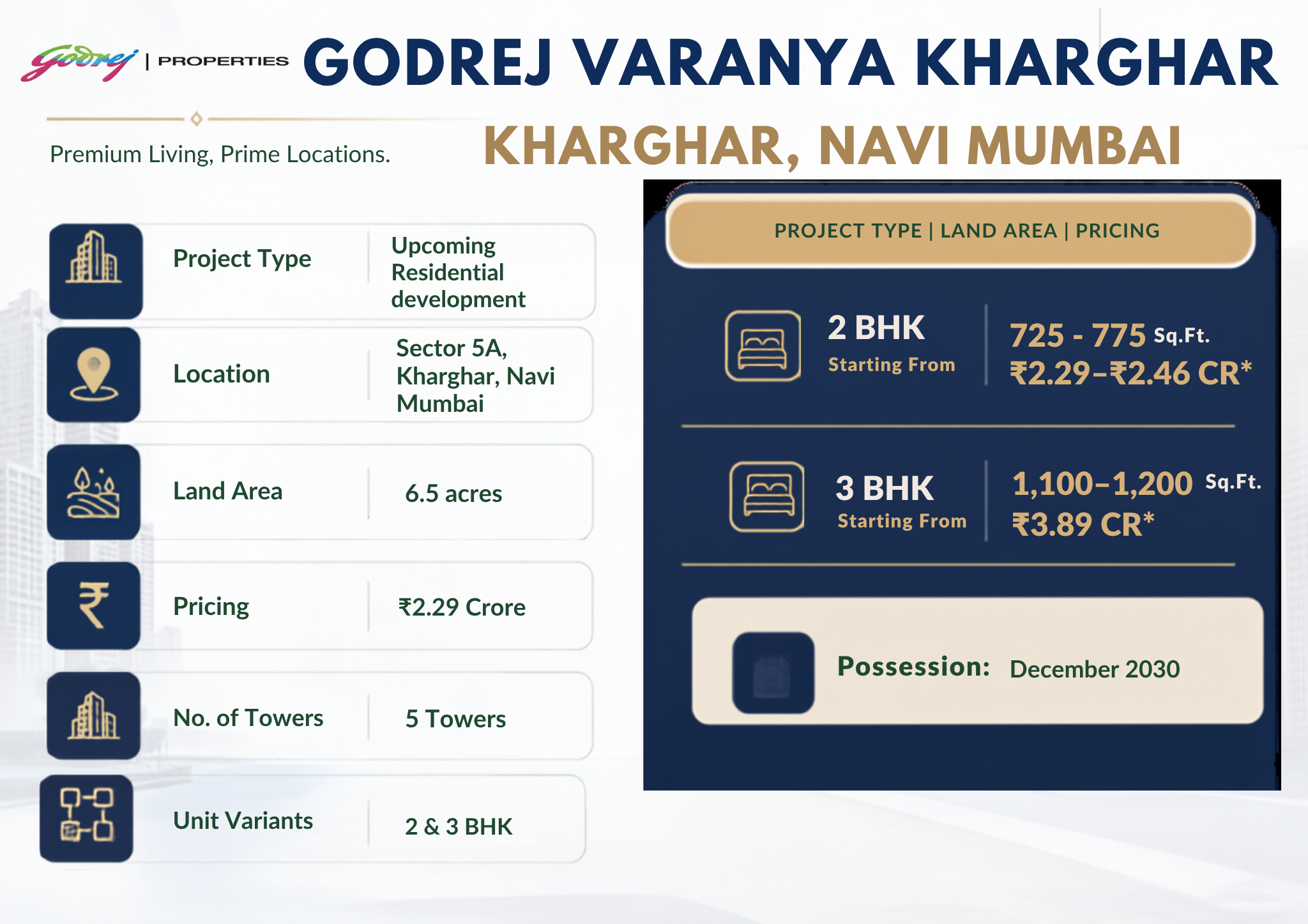
Premium residential rates in Kharghar currently range from ₹28,000 to ₹35,000 per sqft for branded stock, placing it above Panvel (₹14,000–18,000) and competitive with Vashi (₹30,000–40,000). That pricing positions Kharghar as the premium-value node of Navi Mumbai — established enough to command respect, but not yet at the ceiling that a Vashi or Powai address carries. Projects like Godrej Varanya at Sector 5A represent the premium end of the Kharghar market, offering 2 and 3 BHK apartments from ₹2.29 Crore on a 6.5-acre, low-density footprint.
This guide covers everything a prospective buyer needs to know about living in Kharghar — from daily commutes and school options to healthcare access, retail infrastructure and the upcoming catalysts that will shape the locality’s trajectory over the next five years. Every data point is sourced from current operating conditions rather than planned-development timelines, because for a buyer making a home-purchase decision, what exists today matters more than what is promised for tomorrow.
2. Location & Connectivity — How Kharghar Connects to the MMR
Kharghar’s connectivity is anchored by two independent rail networks. Kharghar railway station on the Harbour line connects directly to CST Mumbai, Panvel, Vashi and Belapur — covering the daily commute corridor for most Navi Mumbai professionals. The Belpada metro station adds a second rail option, and the proposed metro expansion will deepen this network further. Godrej Properties Limited, through its Varanya project at Sector 5A, has positioned within a 1-minute walk of both stations — a dual-station proximity that is genuinely rare in the Navi Mumbai residential market.
On road connectivity, the Sion–Panvel Highway forms the arterial spine connecting Kharghar to Mumbai and the wider Navi Mumbai belt. The Mumbai–Pune Expressway interchange is roughly 5 minutes away, providing access to Pune, Lonavala and the national highway network. CBD Belapur — Navi Mumbai’s commercial and administrative hub — is a 10-minute drive, making Kharghar a comfortable daily-commute base for professionals in the Belapur–Vashi office corridor. The Atal Setu (Mumbai Trans Harbour Link) has further compressed travel times between the Navi Mumbai mainland and South Mumbai.
The upcoming Navi Mumbai International Airport is approximately 20 minutes from Kharghar by road. While the airport is not yet operational, its impact on Kharghar’s accessibility and property values is already being priced in. For frequent flyers currently enduring the 90-plus-minute drive to Mumbai’s Chhatrapati Shivaji Maharaj International Airport, the new airport will be transformative. Central Park Kharghar — one of the largest urban parks in the MMR — is roughly 8 minutes from most Kharghar sectors, and Taloja MIDC, a major industrial and employment zone, is about 15 minutes away.
The practical reality of commuting from Kharghar depends on your workplace. If you work in the Belapur–Vashi–Airoli corridor, the commute is 10–20 minutes by road or a few train stops on the Harbour line — genuinely convenient. If you work in South Mumbai (Colaba, Fort, Nariman Point), the Harbour line connects directly to CST, but the 60-plus-minute journey is a commitment that needs to be weighed honestly. If you work in the Andheri–BKC belt, the commute is challenging regardless of mode — 75–90 minutes in most scenarios. Kharghar works best for professionals whose daily orbit stays within the Navi Mumbai–Panvel belt or who commute to South Mumbai on the Harbour line.
3. Infrastructure Snapshot — What’s Operational Today
The table below captures Kharghar’s current social and civic infrastructure — every item listed is operational as of 2026, not planned or under construction. This is the infrastructure that shapes daily life in the locality today.
| Category | Key Facilities |
|---|---|
| Schools | DAV Public School, Ryan International, Apeejay School, DPS Kharghar, Vibgyor High |
| Hospitals | MGM Hospital, Kharghar Medical Centre, Apollo Clinic, Fortis outlets, multiple nursing homes |
| Shopping & Retail | Little World Mall, Raghuleela Mall, Central Park market, Utsav Chowk retail strip |
| Rail Connectivity | Kharghar railway station (Harbour line), Belpada metro station |
| Road Connectivity | Sion–Panvel Highway (1 min), Mumbai–Pune Expressway (5 min) |
| Parks & Recreation | Central Park (~8 min), golf course belt, ISKCON Temple, Pandavkada Falls |
| Commercial Hubs | CBD Belapur (10 min), Airoli IT Park (20 min), Taloja MIDC (15 min) |
| Upcoming Infrastructure | Navi Mumbai International Airport (~20 min), metro expansion, NAINA planning |
The school density is a critical differentiator for family buyers. DAV, Ryan International, DPS and Vibgyor High are all operational within the Kharghar catchment, giving parents multiple options across CBSE, ICSE and IB curricula without a long commute. This school ecosystem is mature — these are not newly opened branches riding on the locality’s growth, but established campuses with years of operating history, exam results and parent feedback available for evaluation. For a family buying a home with a 5-to-10-year view, the school infrastructure in place today is a more reliable indicator of daily life quality than any amenity listed in a project brochure.
Healthcare access follows the same pattern of maturity. MGM Hospital provides multi-speciality tertiary care within the locality, and Apollo, Fortis and multiple private clinics cover outpatient and diagnostic needs. The retail ecosystem around Utsav Chowk, Little World Mall and the Central Park market zone handles daily shopping, dining and entertainment without requiring a trip to Vashi or Belapur. This self-contained infrastructure is what separates Kharghar from growth-stage nodes like Ulwe or Dronagiri, where residents still drive 20–30 minutes to access basic services that Kharghar residents find within a 5-minute radius.
4. Residential Market — Pricing Across Kharghar Sectors
Kharghar’s residential market spans a wide pricing band depending on the sector, the developer and the project vintage. The table below compares current per-sqft rates and positioning across the key sectors and price segments that a buyer would evaluate in 2026.
| Segment | Rs/sqft Range | Typical Ticket | Buyer Profile |
|---|---|---|---|
| Premium branded (Godrej Varanya, etc.) | ₹30,000–35,000 | ₹2.29–4.5 Cr | Professionals, HNIs, upgraders from mid-market |
| Mid-premium (established developers) | ₹22,000–28,000 | ₹1.2–2.5 Cr | Dual-income families, growing households |
| Mid-market (regional developers) | ₹15,000–20,000 | ₹70 Lakh–1.5 Cr | First-time buyers, budget-conscious families |
| Resale (delivered projects) | ₹18,000–30,000 | Varies widely | Buyers wanting immediate possession |
The premium branded segment — where Godrej Varanya sits at ₹30,500–33,000 per sqft — represents the top tier of Kharghar pricing. This segment is defined by national-brand developers, low-density designs and premium amenity packages that differentiate them from the mid-market. The mid-premium band at ₹22,000–28,000 covers established regional developers offering 20-plus-storey towers with standard amenities, while the mid-market at ₹15,000–20,000 serves budget-conscious buyers who prioritise Kharghar’s location over premium specifications.
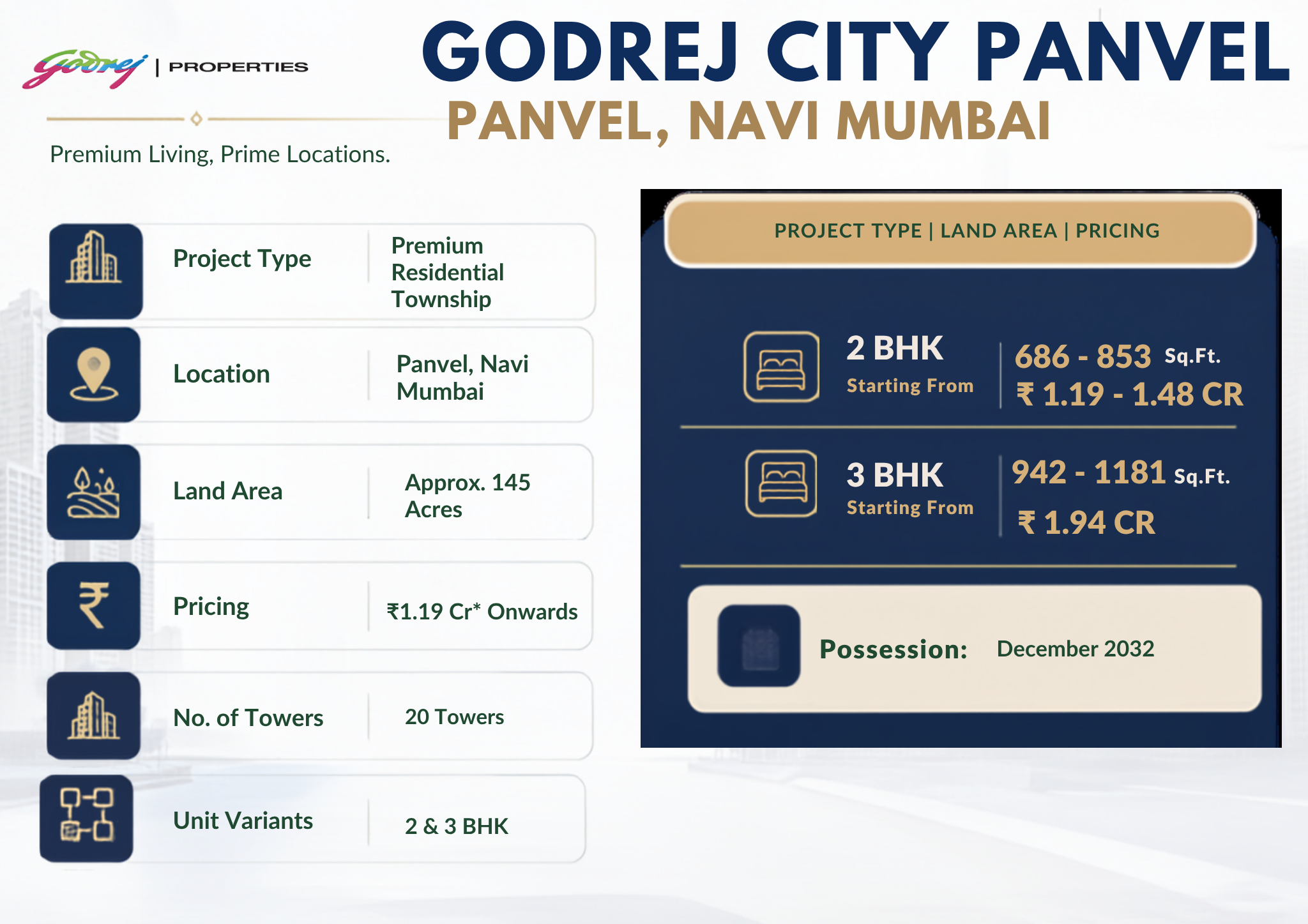
For a buyer choosing between Kharghar segments, the key trade-off is between unit quality and ticket size. A ₹1.5 Crore mid-market 3 BHK in Kharghar gets you the locality’s connectivity and social infrastructure, but in a higher-density project with more neighbours and shared amenities. A ₹3.89 Crore premium 3 BHK at Godrej Varanya gets you the same locality advantages plus 305-unit exclusivity, Godrej’s brand premium at resale and resort-grade amenities designed for a smaller community. The locality benefits are identical — the differentiation is entirely at the project level. Our Godrej City Panvel listing provides a Navi Mumbai alternative at a significantly lower price point for buyers who want the Godrej name without the Kharghar premium.
5. Lifestyle & Community — What Daily Life in Kharghar Looks Like
Daily life in Kharghar revolves around a few anchor points that define the locality’s character. Utsav Chowk is the social centre — a retail and dining strip surrounded by residential towers where families gather in the evenings, children cycle on the pavements and weekend markets set up periodically. Central Park, one of the largest urban parks in the MMR at over 50 acres, provides jogging tracks, open lawns and a biodiversity zone that is rare in a city environment. The park’s proximity — roughly 8 minutes from most Kharghar sectors — means it functions as an extended backyard for the entire locality rather than a weekend destination.
The ISKCON Temple draws both devotees and community visitors, and the Pandavkada waterfall belt on the Kharghar hills provides a hiking and nature option that is literally within the locality’s boundaries. The golf course belt adds a prestige-recreation layer that most Navi Mumbai nodes cannot offer. For families with children, the weekend routine typically involves Central Park in the mornings, mall time at Little World or Raghuleela in the afternoons and Utsav Chowk for dinner — all within a 10-minute radius. That self-contained lifestyle loop is what makes Kharghar feel like a neighbourhood rather than a residential zone.
Dining options span the range from street-food stalls at Utsav Chowk to multi-cuisine restaurants in the mall complexes. The grocery infrastructure includes both modern retail (D-Mart, Reliance Fresh, Big Bazaar outlets) and traditional vegetable markets that serve the daily-shopping needs of a settled residential population. For weekend entertainment, PVR Cinemas in the mall complex and the various community clubs in residential societies provide options without requiring a trip to Vashi or Mumbai. The overall texture of Kharghar life is suburban rather than urban — less dense, more green, more family-oriented than a Mumbai mainland suburb, with the trade-off being the longer commute to the island city.
The community demographic in Kharghar skews toward established families and professionals in the 30–50 age bracket — a mix of Navi Mumbai corporate employees, business owners and professionals who have chosen the locality for its school infrastructure and green-space depth. That demographic stability translates into well-maintained societies, active residents’ associations and a sense of community continuity that newer corridors, where most residents are recent arrivals, take years to develop. For a buyer evaluating Kharghar, spending a Sunday morning at Central Park and an evening at Utsav Chowk provides a better preview of daily life than any brochure or virtual tour.
6. Future Catalysts — What Will Change in Kharghar
The three catalysts that will reshape Kharghar’s trajectory over the next 3–5 years are well-identified: the Navi Mumbai International Airport, the metro expansion and the NAINA (Navi Mumbai Airport Influence Notified Area) development plan. Each one is worth evaluating individually because they affect Kharghar in different ways and on different timelines.
| Catalyst | Impact on Kharghar | Timeline |
|---|---|---|
| Navi Mumbai International Airport | 20-min airport access; employment, commercial and hospitality wave | Phased commissioning expected |
| Metro Line Expansion | Deepens rail connectivity beyond Harbour line | Progressive station additions |
| NAINA Development | Planned infrastructure, road network and commercial zones around airport belt | Multi-year phased development |
| Atal Setu Extension Effects | Continued improvement in Mumbai mainland access | Already operational, usage growing |
The airport is the transformative catalyst. A sub-30-minute drive to a functioning international airport would fundamentally change Kharghar’s positioning — from a well-connected Navi Mumbai suburb to a genuine airport-city residential address. Historical precedents from Hyderabad’s Gachibowli–Shamshabad corridor and Bangalore’s Whitefield–Devanahalli belt show that airport-adjacent residential catchments experience both value appreciation and a shift in the resident demographic toward senior corporate executives and frequent travellers who prioritise airport proximity. Kharghar’s established infrastructure gives it an advantage over greenfield airport-corridor locations because it already has the schools, hospitals and retail that airport-city residents need on day one.
The NAINA development plan adds a medium-term commercial and infrastructure layer across the airport-influence area. For Kharghar specifically, NAINA’s impact will be felt through improved road connectivity, new commercial zones that generate local employment and an overall upgrading of the infrastructure standard in the wider belt. The net effect is that Kharghar’s current advantages — connectivity, social infrastructure, green depth — will be supplemented by a new layer of planned development rather than disrupted by it. For a buyer making a purchase decision today, the NAINA plan means the infrastructure environment around Kharghar is improving, not static.
7. Buyer Guidance — Is Kharghar Right for You?
Kharghar is right for you if your daily commute stays within the Navi Mumbai–Panvel belt or runs on the Harbour line to South Mumbai. It is right if you have school-age children and want multiple CBSE/ICSE/IB options within a 10-minute drive. It is right if you value green space — Central Park, the hills, the golf course belt — as a daily lifestyle feature rather than a weekend destination. And it is right if you want to buy into a settled neighbourhood with operational infrastructure rather than a growth-corridor promise.
Kharghar is less ideal if you commute daily to the western suburbs (Andheri, Goregaon, Malad) — the cross-city journey is 75–90 minutes regardless of mode and will remain so even after the metro expansion. It is also less ideal if your budget is under ₹70 Lakh, as the mid-market options in Kharghar at that price point involve significant compromises on unit size and project quality. For budget buyers, Godrej City Panvel (from ₹55 Lakh) offers a branded alternative at a fraction of the Kharghar ticket.
If your profile fits, the practical next step is to spend a full Saturday in Kharghar — walk Central Park in the morning, drive the school routes, eat lunch at Utsav Chowk, visit project sites in the afternoon and evaluate the evening commute back to wherever you work. That single day will tell you more about whether Kharghar’s daily rhythm suits your family than any number of online reviews or site-visit tours. If it clicks, Godrej Varanya at Sector 5A represents the premium end of the market, while the mid-premium and mid-market segments offer alternatives at lower price points with the same locality benefits.
8. Conclusion & FAQs
Kharghar’s value proposition for home buyers in 2026 is clear: an established, liveable, well-connected Navi Mumbai node with school, hospital and retail infrastructure that is already operational, priced below Vashi and the Mumbai mainland but above Panvel’s growth-corridor rates. The airport catalyst adds a forward-looking dimension to an already strong present-day case. For buyers who fit the commute and budget profile, Kharghar earns its premium — and the locality’s trajectory over the next five years is more likely to strengthen that position than erode it.
The risk is pricing — Kharghar is no longer a value-buy by Navi Mumbai standards, and buyers need to be comfortable with the ₹28,000–35,000 per-sqft range for premium branded stock. But premium pricing for a premium lifestyle is the expected trade-off, and the alternative — buying cheaper in a growth corridor and waiting years for the infrastructure to arrive — carries its own, arguably greater, risk. For the buyer who values what works today over what is promised for tomorrow, Kharghar is the strongest answer in the Navi Mumbai market.
What are the best schools near Kharghar?
DAV Public School, Ryan International, DPS Kharghar, Apeejay School and Vibgyor High are all operational within the locality. These cover CBSE, ICSE and IB curricula, giving families multiple established options within a 10-minute drive.
How is the commute from Kharghar to Mumbai?
Kharghar railway station on the Harbour line connects directly to CST Mumbai. The train journey is 60-plus minutes to South Mumbai. Commutes to western suburbs (Andheri, BKC) take 75–90 minutes and remain challenging regardless of mode.
What is the current property rate in Kharghar?
Premium branded stock in Kharghar ranges from ₹28,000 to ₹35,000 per sqft. Mid-premium projects trade at ₹22,000–28,000, and mid-market options start around ₹15,000–20,000 per sqft. Rates vary by sector, developer and project vintage.
Is Kharghar better than Panvel for home buyers?
Kharghar offers established infrastructure and a settled neighbourhood at a premium price (₹28,000–35,000/sqft). Panvel offers lower entry (₹14,000–18,000/sqft) with higher growth potential but requires waiting for social infrastructure to mature. Your choice depends on whether you prioritise living quality today or value appreciation over time.
How far is Kharghar from the Navi Mumbai airport?
The upcoming Navi Mumbai International Airport is approximately 20 minutes by road from Kharghar. Once operational, it will provide sub-30-minute door-to-terminal access — a transformative improvement over the current 90-plus-minute drive to Mumbai’s Chhatrapati Shivaji Maharaj International Airport.