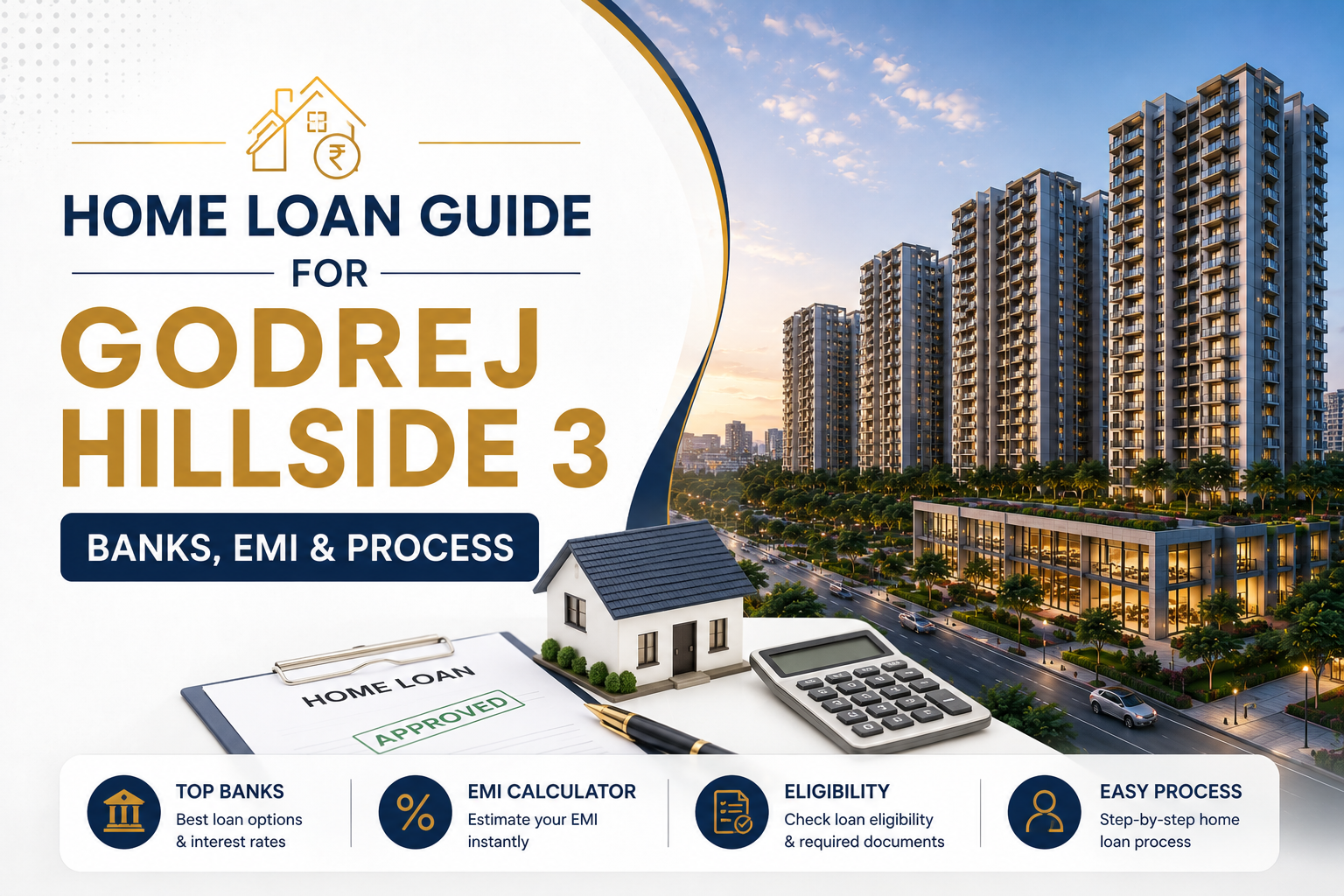
Home Loan for Godrej Hillside 3, Mahalunge: Banks, EMI and the Full Sanction Process
Prices run ₹70 Lakh to ₹1.10 Cr; at 8.5% over 20 years a 2 BHK EMI starts near ₹48,600/month, with floating rates indicated around 8.3-9.0% p.a. for 2026.
Most major lenders fund this RERA-registered project (P52100050939); compare at least three banks because even a 0.25% gap is significant across two decades.
1. Financing Godrej Hillside 3: Where to Begin
Godrej Hillside 3 sits on Nande Road in Mahalunge, West Pune 411045, carrying RERA registration P52100050939 with a price band of ₹70 Lakh to ₹1.10 Cr. Because the tower is still under construction with possession scheduled for February 2028, your financing decision is not just about the headline rate. It is about how the disbursement aligns with a build that runs across 31 floors and 493 units on 2.7 acres. Our team treats the home loan as the second most important contract you will sign here, right after the agreement itself.
The arithmetic matters from day one. With lenders offering up to roughly 75-80% loan-to-value in this ticket band, a buyer of a ₹70 Lakh 2 BHK typically arranges around ₹14 Lakh as down payment before the bank releases a rupee. For a 3 BHK closer to ₹1.02 Cr, the upfront commitment rises proportionally, and that is before you account for stamp duty and GST. We want you to see the full picture, not the brochure version.
This guide walks through bank tie-ups, indicative rates, EMI scenarios for each configuration, eligibility, documentation, the costs beyond the sticker price, and the step-by-step path from application to disbursement. Every figure here is drawn from the project’s published data and current 2026 market indications. You can view the full specification on the main Godrej Hillside 3 listing while you read.
2. About the Project and the Developer
Godrej Hillside 3 is developed by Godrej Properties Limited, one of India’s most widely financed residential brands, which is precisely why so many banks pre-approve its projects. The development is a single tower of 31 floors holding 493 units across a 2.7-acre footprint in Mahalunge. Carpet areas span 657 to 902 sqft for the 2 and 3 BHK formats, translating to roughly ₹10,500 to ₹12,200 per sqft depending on configuration and floor. These are the numbers your bank’s technical valuation team will check against the agreement value.
Developer track record carries real weight in a loan file. Lenders maintain internal approved-project lists, and an established builder shortens the technical and legal due-diligence cycle considerably. Godrej Properties Limited publishes its corporate and project disclosures at godrejproperties.com, which can support the developer-side documentation a bank requests. The RERA number P52100050939 is the single most useful reference you will quote across every lender interaction.
If you are weighing Hillside 3 against the developer’s other Mahalunge inventory, the ready-to-move stock at Godrej Hillside 1 and 2 starts near ₹51 Lakh and changes the loan structure entirely, since a completed unit attracts full disbursement up front rather than stage-wise release. That single difference can shift your pre-EMI burden by lakhs over a construction period.
3. Bank Tie-ups and Interest Rates
Seven lenders dominate financing for Godrej projects in Pune, and all of them routinely process Hillside-series files. Indicative floating rates for 2026 sit in the 8.3 to 9.0% per annum range, with salaried applicants holding clean credit histories landing at the lower end. The table below summarises the typical positioning; treat the rates as starting points for negotiation rather than fixed quotes, because each branch prices to your profile.
| Lender | Indicative Rate (2026, floating) | Typical Max LTV | Best Fit |
|---|---|---|---|
| HDFC | 8.4% – 8.9% | ~80% | Salaried, fast digital processing |
| ICICI Bank | 8.4% – 9.0% | ~80% | Salaried and self-employed mix |
| SBI | 8.3% – 8.8% | ~80% | Lowest-rate seekers, women borrowers |
| Axis Bank | 8.5% – 9.0% | ~78% | Relationship banking customers |
| Kotak Mahindra Bank | 8.5% – 9.0% | ~78% | Premium salaried profiles |
| LIC Housing | 8.5% – 9.0% | ~80% | Self-employed, flexible income proof |
| Bank of Baroda | 8.4% – 8.9% | ~80% | Public-sector preference, low fees |
Notice the spread is only about 0.7 percentage points across the field, yet that band hides real money. The practical takeaway is to collect written sanction terms from at least three of these lenders before committing, since a 0.25% difference compounds heavily over a 20-year tenure. SBI’s edge for women borrowers and HDFC’s processing speed are the kind of profile-specific advantages that change the right answer for each buyer.
4. EMI Scenarios by Configuration
The cleanest way to budget is per-lakh maths. At 8.5% over 20 years, every ₹1 Lakh of loan costs roughly ₹868 per month in EMI. Apply that to a 20% down payment scenario across the three main price points and the monthly commitments emerge clearly. The figures below assume an 8.5% rate and a full 20-year tenure for direct comparison.
| Configuration | Indicative Price | Down Payment (20%) | Loan Amount | EMI (8.5%, 20 yr) |
|---|---|---|---|---|
| 2 BHK (entry) | ₹70 Lakh | ₹14 Lakh | ₹56 Lakh | ~₹48,600/month |
| 3 BHK (mid) | ₹1.02 Cr | ₹20.4 Lakh | ₹81.6 Lakh | ~₹70,800/month |
| 3 BHK (top) | ₹1.10 Cr | ₹22 Lakh | ₹88 Lakh | ~₹76,400/month |
These EMIs are the post-possession steady state. During construction toward February 2028, a construction-linked plan typically charges pre-EMI interest only on the amount disbursed so far, so your early outflow on a ₹56 Lakh sanction is far below the ₹48,600 figure until the build is well advanced. We detail that mechanic in the next section. For a fuller view of value at these price points, our long-term returns analysis pairs naturally with this loan maths.
5. Deep Dive: Eligibility, Documents and Payment Plans
Eligibility hinges on a simple ratio: most lenders cap your total EMI obligations near 40-50% of net monthly income. To service the ₹48,600 EMI on the entry 2 BHK comfortably, a salaried buyer generally needs net monthly income in the region of ₹1 Lakh to ₹1.2 Lakh, after accounting for any existing loans. Your credit score, age, employer category and remaining working years all feed into the final sanctioned amount, so two applicants buying the same flat can receive different offers.
The document set is standard but exacting. You will need KYC (PAN and Aadhaar), income proof (salary slips with Form 16 and ITR for salaried, or business financials for self-employed), bank statements covering 6 to 12 months, and property documents including the allotment letter, agreement, RERA details and the builder NOC. Missing or stale paperwork is the single biggest cause of sanction delay, so assemble the full pack before you apply rather than during processing.
Because Hillside 3 is under construction, the construction-linked payment plan is the default route, releasing funds in stages as each slab and milestone is certified. This keeps your interest cost tied to actual progress across the 31-floor build rather than the full ₹56 Lakh from day one. Where offered, subvention or possession-linked plans shift the timing of your outflow, but they are not universally available and often carry pricing trade-offs. Clarify which plan applies before you sign, because it determines your cash flow until February 2028.
6. Costs Beyond the Price
The agreement value is only part of what you fund. In Maharashtra, stamp duty runs roughly 6-7% inclusive of metro cess and local body charges, registration is about ₹30,000 (the 1% being capped), and GST adds 5% on an under-construction purchase with no input tax credit. On top of these come floor-rise premiums, parking, and society plus maintenance deposits. The table below puts indicative rupee figures against a ₹70 Lakh 2 BHK so the scale is concrete.
| Cost Head | Rate / Basis | Indicative Amount on ₹70 Lakh |
|---|---|---|
| Stamp Duty | ~6-7% incl. metro cess/LBT | ~₹4.2 Lakh – ₹4.9 Lakh |
| Registration | 1% capped at ~₹30,000 | ~₹30,000 |
| GST | 5% on under-construction (no ITC) | ~₹3.5 Lakh |
| Floor-Rise / Parking | Project-specific | Varies by floor and slot |
| Society & Maintenance Deposit | One-time, project-specific | Varies; budget separately |
Add it up and the statutory and incidental costs on a ₹70 Lakh flat can exceed ₹8 Lakh before floor-rise and deposits. Crucially, most lenders fund the loan against the agreement value, not these charges, so this entire sum sits on your shoulders alongside the down payment. Budgeting for it early is the difference between a smooth registration and a last-minute scramble.
7. Step-by-Step Buyer Guidance
Start with an eligibility check across your three shortlisted lenders, ideally before you finalise the unit, so you negotiate from a position of knowing your sanctioned ceiling. Submit the formal application with the complete document pack; a clean file moves through the system in days rather than weeks. The bank then issues an in-principle sanction stating the amount, rate and tenure, which is your green light to proceed with the booking and agreement.
Next comes legal and technical valuation, where the lender verifies the title chain, the RERA registration P52100050939, and the project’s physical progress against the agreement value. For an established Godrej Properties Limited development, this stage is typically faster because the project sits on most banks’ approved lists. Once cleared, you execute the agreement and the bank begins disbursement, which for an under-construction unit is stage-wise rather than a single transfer.
Through to possession in February 2028, each disbursement tranche is released against certified construction milestones, and your pre-EMI interest tracks the cumulative amount paid out. Keep your own copy of every milestone certificate and disbursement advice, because reconciliation errors are easiest to catch in real time. Before signing anything, it is worth reading our independent Hillside 3 review alongside a comparable like The Gale at Godrej Park World in Hinjewadi, which starts near ₹79.9 Lakh.
8. Conclusion
Financing Godrej Hillside 3 is entirely manageable once you separate the three layers: the loan (around 75-80% LTV at 8.3-9.0% rates), the down payment (roughly ₹14 Lakh on the entry 2 BHK), and the statutory costs (which can top ₹8 Lakh). With possession set for February 2028 and a construction-linked plan keeping early outflows light, the structure rewards buyers who plan their cash flow across the full build. Compare at least three of the seven major lenders, lock your rate in writing, and treat the RERA number P52100050939 as your reference point throughout.
Q. How much down payment do I need for a 2 BHK at Godrej Hillside 3?
With lenders offering around 75-80% loan-to-value in this ticket band, a ₹70 Lakh 2 BHK typically needs roughly ₹14 Lakh as down payment at 20%. Remember that stamp duty, GST and registration sit on top of this and are not usually financed by the bank.
Q. Which banks finance Godrej Hillside 3?
Seven major lenders routinely approve this RERA-registered project: HDFC, ICICI Bank, SBI, Axis Bank, Kotak Mahindra Bank, LIC Housing and Bank of Baroda. Indicative 2026 floating rates run 8.3-9.0% per annum, with salaried borrowers holding clean credit profiles generally securing the lower end of that band.
Q. What is the EMI on a 3 BHK here?
At 8.5% over 20 years, a ₹1.02 Cr 3 BHK with 20% down (an ₹81.6 Lakh loan) carries an EMI near ₹70,800 per month, while the top ₹1.10 Cr unit works out to roughly ₹76,400. These are post-possession figures; pre-EMI during construction is lower.
Q. How does a construction-linked plan work for this project?
Since Hillside 3 is under construction until February 2028, the bank disburses the loan in stages tied to certified building milestones across the 31 floors. You pay pre-EMI interest only on the amount released so far, keeping early outflows well below the full EMI until the build nears completion.
Q. What documents do I need to apply?
You need KYC (PAN and Aadhaar), income proof (salary slips, Form 16 and ITR, or business financials), bank statements for 6-12 months, and property documents including the allotment letter, agreement, RERA details and builder NOC. Assembling the full pack before applying is the fastest route to sanction.